


This article was automatically translated from the original Turkish version.
+2 More
Yin-Yang is an ancient Chinese philosophical concept that expresses the balance of opposing yet complementary forces in all entities and phenomena of the universe. This understanding is one of the fundamental elements of the thought system that emerged during the Warring States period (475–221 BCE) and became closely associated with Taoism (Daoism). The Yin-Yang concept symbolizes the dual nature of the universe: opposites such as darkness and light, cold and heat, passive and active, feminine and masculine are seen not as conflicting but as mutually completing elements. According to this philosophical approach, nothing can exist on its own; everything gains meaning only in relation to its opposite.
Yin is typically associated with characteristics such as darkness, night, the moon, winter, feminine energy, coldness, and stillness, while Yang represents light, day, the sun, summer, masculine energy, warmth, and movement. These two forces are not static; they are in constant transformation and change. For example, night turns into day, winter into summer, and stillness into motion. This transformation maintains balance and continuity in the universe. Thus, Yin and Yang do not conflict with each other but find existence within a cycle: when one decreases, the other increases; when one emerges, the other recedes. This dynamic forms the foundation of universal order.
The Yin-Yang concept began to take shape in the 3rd millennium BCE and gradually became central to Chinese thought. It was systematized particularly through the classic text I Ching (Book of Changes), which profoundly influenced ancient China’s understanding of nature, humanity, and the cosmos. This text elaborates on the law of change and the harmony of opposing forces, transforming Yin-Yang thought from a theoretical model into a practical philosophy of life.
Taoist philosophy asserts that the universe is grounded in a principle called Tao (the natural way or order). Yin and Yang represent the two opposing yet complementary aspects of this universal order. Taoists emphasized that everything is in constant motion and change, and that this transformation occurs through the interaction between Yin and Yang. This perspective underscores that life is not static but cyclical and transformative.
The Yin-Yang concept has been applied over time to numerous fields, from Chinese medicine and martial arts to art, architecture, culinary culture, and calendrical systems. In traditional Chinese medicine, illness is viewed as an imbalance between Yin and Yang; treatments aim to restore this equilibrium. Similarly, Chinese martial arts such as Tai Chi and Qigong are based on this philosophy of balance.
Today, the Yin-Yang concept is used in many cultures interested in Eastern philosophy as a symbol of universal balance, harmony, and the unity of opposites. Beyond its philosophical meaning, it is also regarded as a metaphor in psychological, social, and ecological pursuits of equilibrium. In this sense, Yin-Yang represents not merely a symbol but a holistic perspective for understanding universal processes.
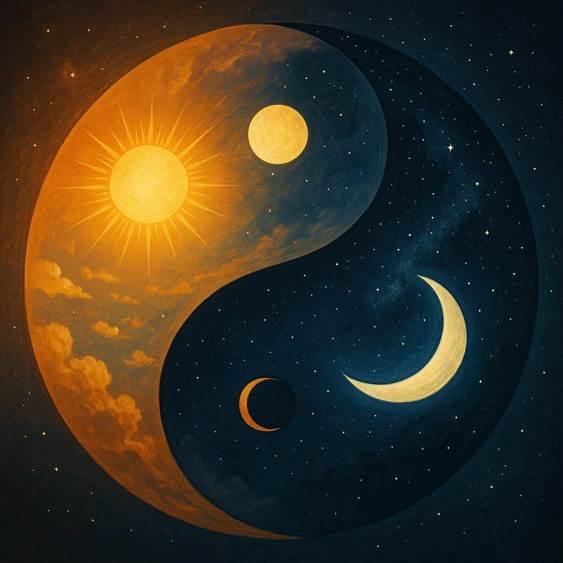
Gece ve Gündüzün Döngüselliğini Temsil Eden Bir Görsel (Yapay Zekâ ile Oluşturulmuştur.)
The terms Yin and Yang first appear on oracle bones from the Shang Dynasty (circa 16th–11th centuries BCE), which were used by spiritual leaders of the time for divination. However, the meaning attributed to Yin and Yang during this period was far removed from their modern philosophical content; the terms were used merely to denote opposite directions or natural phenomena such as shaded and sunlit surfaces.
The Yin-Yang concept evolved over time and was systematized particularly through classical Chinese texts compiled during the Zhou Dynasty, especially the I Ching. The I Ching contains 64 hexagrams—six-line figures representing different combinations of Yin (broken line) and Yang (solid line) symbols. This text is regarded not only as a tool for divination but also as one of the foundational pillars of Chinese metaphysics, natural philosophy, and thought.
The Yin-Yang concept was later interpreted within China’s two major philosophical systems: Confucianism (Rujia) and Taoism (Daoism). However, it was in Taoist philosophy that Yin-Yang thought received its most profound and comprehensive treatment. Although Laozi, traditionally regarded as the founder of Taoism, does not explicitly use the terms Yin and Yang in his foundational text, the Tao Te Ching, he frequently emphasizes the balance between universal opposites. The “Tao” (the Way) expressed in this text refers to an existential order in harmony with the natural flow of Yin and Yang.
During the 3rd and 2nd centuries BCE, the period when Yin-Yang concepts became more systematic, there emerged the Yin-Yang School (also known as the Naturalist School). One of its most important representatives, Zou Yan, integrated Yin-Yang principles with the Chinese Five Elements (Wu Xing) doctrine. According to Zou Yan, all changes in the universe arise from the mutual interaction of Yin and Yang and the cyclical transformations of the five elements—wood, fire, earth, metal, and water. This synthesis formed the basis of a comprehensive thought system applied across many domains, including Chinese astrology, medicine, politics, and agriculture.
Throughout history, Yin-Yang became an indispensable part of Chinese intellectual tradition, particularly adopted as a fundamental principle in the diagnosis and treatment of illness in traditional Chinese medicine. According to this view, health is maintained through the balance of Yin and Yang; disruption of this balance is considered the primary cause of disease.
The Yin-Yang concept also influenced other cultural and philosophical systems in East Asia, sustaining its impact in both theoretical and practical domains. Today, it retains its status as a symbol that contributes to modern thought and various disciplines through themes of universal balance, harmony, and the unity of opposites.
A TED video on Yin-Yang (BrainCraft)
Yin-Yang Sembolünün Kedi Figürleri ile Biçimlendirilmesini Temsil Eden Bir Görsel (Yapay Zekâ ile Oluşturulmuştur.)
The most well-known visual representation of Yin-Yang philosophy is the circular symbol known as the Taijitu. This symbol embodies the interaction and mutual complementarity of Yin and Yang principles. The Taijitu consists of two interlocking, curved shapes within a circle, one black (Yin) and one white (Yang). Each colored area contains a small dot of the opposite color. This detail emphasizes that nothing can be entirely Yin or entirely Yang; each opposing element contains within it a trace of its counterpart.
The circular form of the symbol represents the wholeness and cyclical nature of the universe. The curved line separating Yin and Yang signifies that these two forces are not static but exist in constant motion and transformation. Thus, the symbol reflects not merely opposition but a system in which opposites continuously change into one another within an ongoing cycle.
The meaning carried by the Taijitu is grounded in the universal principle of change and balance observable in phenomena ranging from seasonal shifts to transformations in human emotional states. In this context, the symbol is not merely a visual representation of Yin-Yang philosophy; it is a concrete embodiment of its core principles.
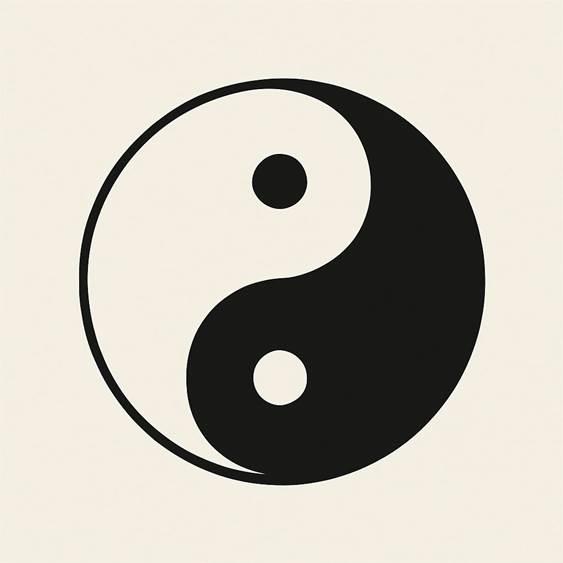
Yin-Yang Sembolünü Temsil Eden Bir Görsel (Yapay Zekâ İle Oluşturulmuştur.)
Yin-Yang philosophy continues to influence lifestyles in many Eastern societies, particularly in Chinese culture. One prominent area of application is traditional Chinese medicine. According to this view, the human body remains healthy through the balance of Yin and Yang forces. Insufficiency of Yin is associated with conditions such as insomnia, restlessness, and excessive heat sensation, while insufficiency of Yang is expressed through symptoms like fatigue, cold sensitivity, and low energy. Treatment methods aim to restore the body’s natural order by balancing these two forces. Practices such as acupuncture, herbal medicine, and qigong are all founded on this principle of equilibrium.
The concepts of Yin and Yang are also effectively applied in dietary practices. Foods are classified as Yin (cooling) or Yang (warming). Yin foods are typically high in water content, cooling, and light in nature—for example, yogurt, cucumber, and watermelon. Yang foods are energizing, induce warmth, and are dense in structure—for example, meat, garlic, and ginger. This classification is used to adjust diets according to seasonal changes and individual physical conditions.
In psychological terms, Yin-Yang balance symbolizes an individual’s quest for spiritual and personality equilibrium. Individuals dominated by Yin tend to exhibit introverted, calm, reflective, and passive traits, while those dominated by Yang display extroverted, energetic, and active characteristics. Similar patterns of opposition and balance are evident in Carl Jung’s concepts of anima (feminine aspect) and animus (masculine aspect) in modern psychology. In this context, Yin-Yang is regarded as a representation of individual wholeness and psychological well-being.
Yin-Yang philosophy has also influenced art, architecture, and aesthetics. In Chinese garden design, the balance between natural and artificial elements is a spatial application of the Yin-Yang principle. In calligraphy, the harmony between black and white spaces reflects the relationship between movement and stillness. In traditional Chinese martial arts such as Tai Chi and Kung Fu, defensive and offensive movements are arranged according to Yin-Yang balance; aggression and passivity, control and flexibility, are evaluated as interdependent forces.
The Yin-Yang symbol is widely used in jewelry design, ornamentation, and everyday objects. This usage is not merely an aesthetic preference but a cultural symbol reflecting the understanding of universal balance and harmony. Yin-Yang philosophy has not remained an abstract system of thought; it has taken concrete form in health, psychology, nutrition, art, architecture, and daily practices, forming a multifaceted concept. In this sense, it is a fundamental principle shaping various dimensions of life at both individual and societal levels in Eastern cultures.
Aslan, Yunus. “Daire Simgesi ve Kutsal Bağlantıları Üzerine: Manevi Temelde Aşkın Bir Üretim.” *Sosyal ve Teknik Araştırmalar Dergisi* 30, no. 2 (2021): 1191–1219.https://dergipark.org.tr/en/pub/std/issue/66322/937809.
Cheng, Chung-Ying. "The Yi-Jing and Yin-Yang Way of Thinking." In The Routledge History of Chinese Philosophy, 83–118. London: Routledge, 2008.
Fang, Tony, and Rune Ellemose Gulev. “Changing the Research Paradigm on Culture and International Business.” *Cross Cultural Management: An International Journal* 18, no. 3 (2011): 257–276.https://www.emerald.com/insight/content/doi/10.1108/13527601111152879/full/html
Fang, Tony. “Yin Yang: A New Perspective on Culture.” *Management and Organization Review* 8, no. 1 (2012): 25–50.https://doi.org/10.1111/j.1740-8784.2011.00221.x.
Jiang, Xiangping. “Chinese Dialectical Thinking—The Yin Yang Model.” *Philosophy Compass* 8, no. 5 (2013): 438–446.https://doi.org/10.1111/phc3.12034
Karyağdı, Gülşah, and Esra Koyuncu. “Çevre, Mimari, İnsan, Zaman Faktörleri Bağlamında Feng Shui’nin İç Mekân Tasarımında Uygulama Kriterlerinin Belirlenmesi.” *Kent Akademisi* (2024): 1030–1059.https://dergipark.org.tr/en/pub/kent/article/1280283
Kırilen, Gülhan. “Eski Çin Metinlerinde Yer-Gök ve Yabancılar.” *Dil ve Tarih-Coğrafya Fakültesi Dergisi* 52, no. 1 (2012): 55–71.https://dergipark.org.tr/en/pub/dtcfdergisi/issue/66785/1044332
Laozi. *Dao De Jing: The Book of the Way.* Translated and explained by Moss Roberts. Berkeley: University of California Press, 2001.https://books.google.com/books?hl=tr&lr=&id=z4qfDwAAQBAJ
Li, Peter Ping. “The Unique Value of Yin-Yang Balancing: A Critical Response.” *Management and Organization Review* 10, no. 2 (2014): 321–332.https://doi.org/10.1111/more.12029
Li, Xin. “Understanding Yin-Yang: A Dialectical Framework for Cross-Cultural Management.” Working Paper 46. Copenhagen Business School, 2014.https://research.cbs.dk/files/58846885/Xin_Li_CDP_2014_46.pdf.
Sever, Mustafa. “Türk Kültüründe İki İlkeli Sistem: Kararıg ve Yaruk.” *Kültür Araştırmaları Dergisi* 17 (2023): 188–196.https://dergipark.org.tr/tr/pub/kulturder/issue/77910/1260998
Shi, Y., J. S. Lee, and K. M. Galvin. “Everything You Have Ever Wanted to Know about Yin Yang 1......” *Biochimica et Biophysica Acta (BBA) - Reviews on Cancer* 1332, no. 2 (1997): F49–F66.https://doi.org/10.1016/S0304-419X(97)00017-5
TED-Ed. "Yin ve yang'ın gizli anlamları - John Bellaimey." TED-Ed Youtube Kanalı. Accessed May 3, 2025.https://youtu.be/ezmR9Attpyc?si=fdCveCL5Ytea27r_.
Wang, Robin R. “Understanding of Yin Yang.” *Religion Compass* 7, no. 6 (2013): 214–224.https://doi.org/10.1111/rec3.12045.
Zhang, Wei. *Taoism and Self Cultivation*. London: Routledge, 2022.https://books.google.com/books?hl=tr&lr=&id=n2VsEAAAQBAJ.

No Discussion Added Yet
Start discussion for "Yin-Yang Philosophy" article
History of Yin-Yang
Yin-Yang and Its Symbolism
Influence of Yin-Yang in Daily Life and Culture