


This article was automatically translated from the original Turkish version.
Xception is an advanced CNN architecture that enables more efficient learning with fewer parameters by using depthwise separable convolutions.
Model | Xception | ||||||||
|---|---|---|---|---|---|---|---|---|---|
Year | 2017-04-04 | ||||||||
Developer | François Chollet | ||||||||
Establishment | Google Inc | ||||||||
Basic Component | Depthwise + Pointwise distinction | ||||||||
Success | ImageNet Top-1 ~79% | ||||||||
Variants | Xception NEXcepTion | ||||||||
Xception is a convolutional neural network (CNN) architecture widely used in deep learning for image classification. Proposed by Google in 2017, the name "Xception" stands for "Extreme Inception" and was developed based on the Inception architecture. The Xception architecture is particularly notable for its reliance on the principle of depthwise separable convolutions, which enables higher performance with fewer parameters.
Xception improves the information processing pipeline by replacing standard convolutional layers with depthwise separable convolutions, making the structure more modular and efficient. This design is based on the principle of filtering each channel separately and then combining them.
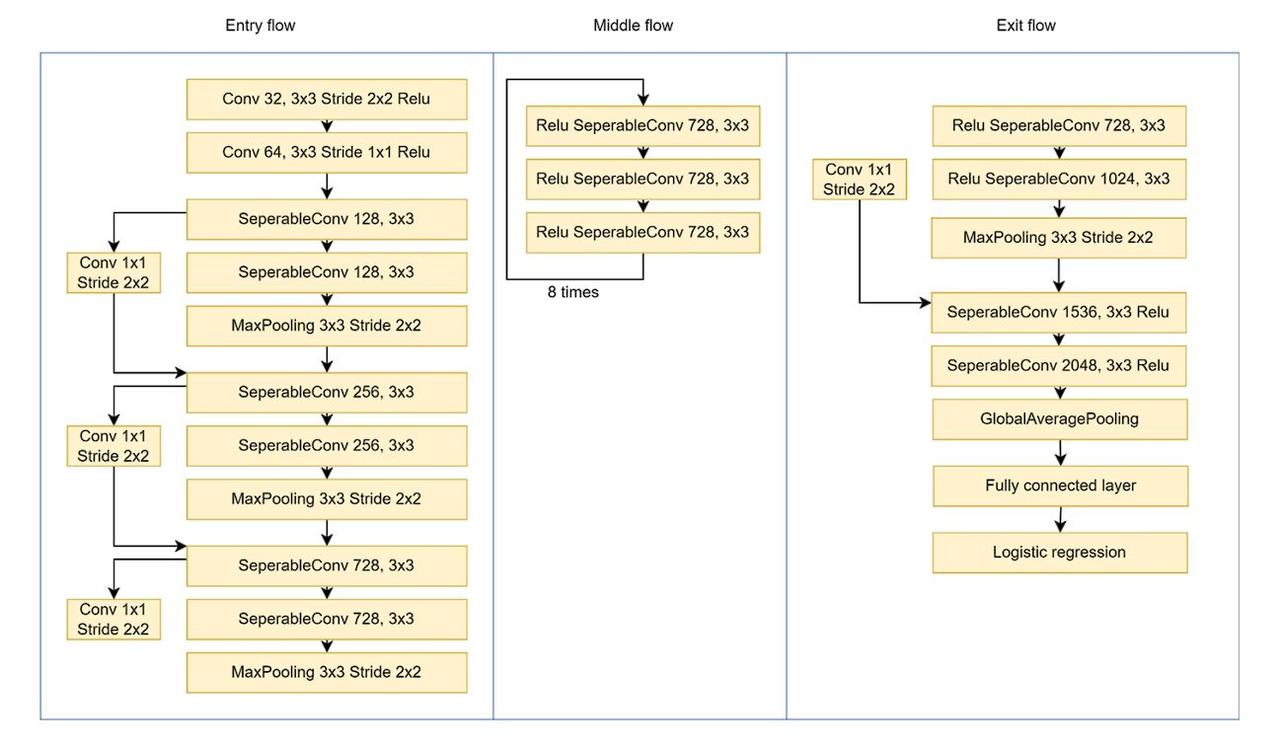
Xception Mimarisi (Kaynak =
Depthwise separable convolutions consist of a two-step process:
These two steps simulate the operations of a classic convolution more efficiently.
Xception consists of 36 convolutional layers, organized into three main blocks:
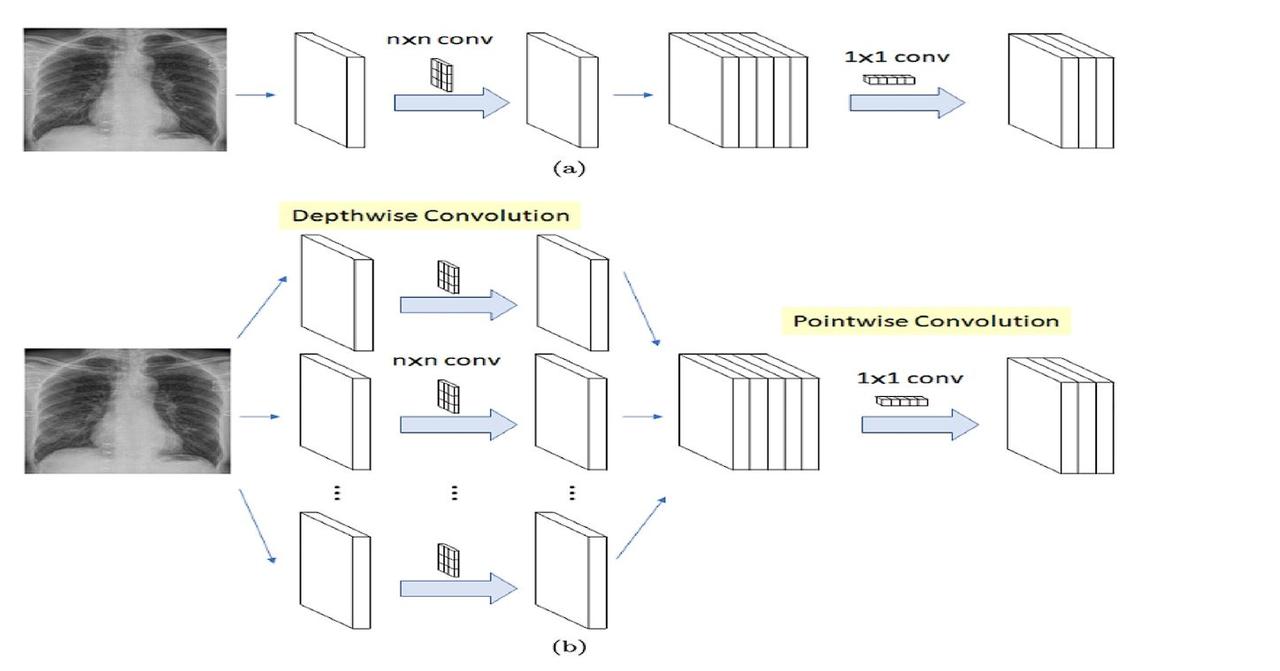
(a) Standart CNN (b) Derinlik Yönün Ayrılabilir CNN (Kaynak =
The Xception architecture achieves more efficient feature extraction compared to classic convolutions by leveraging depthwise separable convolutions.
The Xception architecture has been successfully applied to various image classification and object detection tasks, notably on ImageNet. Similar separable convolution principles have also been adopted in models such as MobileNetV2 and EfficientNet. Its primary application areas include:
Chollet, F. (2017). Xception: Deep learning with depthwise separable convolutions. In *Proceedings of the IEEE conference on computer vision and pattern recognition* (pp. 1251-1258).Accessed Adresi.
Gülmez, B. (2023). A novel deep neural network model based Xception and genetic algorithm for detection of COVID-19 from X-ray images. *Annals of Operations Research*, *328*(1), 617-641.Accessed Adresi.
Panahi, H., Rafiei, A., & Rezaee, A. (2020). FCOD: fast COVID-19 detector based on deep learning techniques. Inform Med Unlocked 22: 100506.Accessed Adresi.
Shavit, H., Jatelnicki, F., Mor-Puigventós, P., & Kowalczyk, W. (2022). From xception to NEXcepTion: New design decisions and neural architecture search. *arXiv preprint arXiv:2212.08448*.Accessed Adresi.

Xception is an advanced CNN architecture that enables more efficient learning with fewer parameters by using depthwise separable convolutions.
Model | Xception | ||||||||
|---|---|---|---|---|---|---|---|---|---|
Year | 2017-04-04 | ||||||||
Developer | François Chollet | ||||||||
Establishment | Google Inc | ||||||||
Basic Component | Depthwise + Pointwise distinction | ||||||||
Success | ImageNet Top-1 ~79% | ||||||||
Variants | Xception NEXcepTion | ||||||||
Xception Architecture
Depthwise Separable Convolutions
Structural Features of Xception
Applications