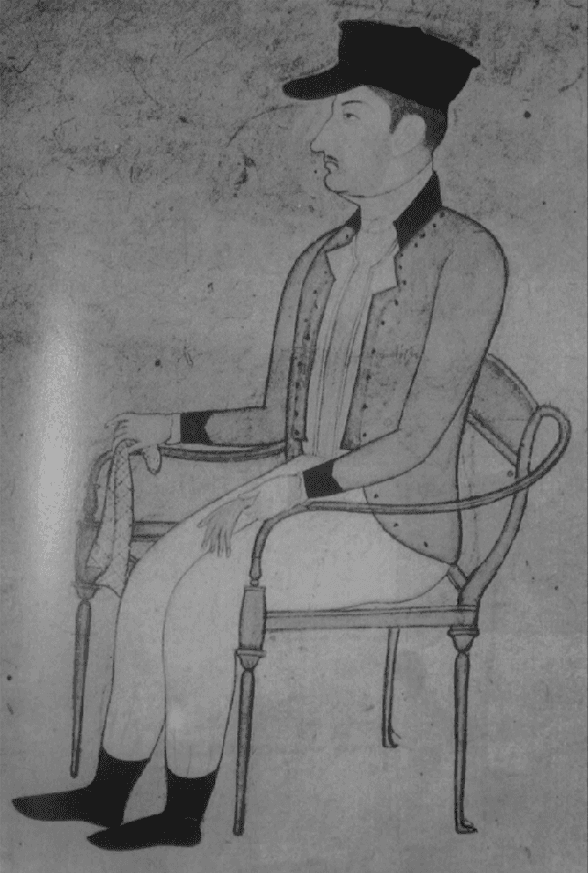
+1 More

Year of Birth | 1767 | ||||||||
|---|---|---|---|---|---|---|---|---|---|
Place of Birth | Ormskirk, Lancashire, England | ||||||||
Occupation | Veterinary Explorer | ||||||||
Date of Death | 1825-08-27 | ||||||||
Place of Death | Andhoy, Afghanistan | ||||||||
William Moorcroft, an English veterinarian and explorer. In the first quarter of the 19th century, he conducted exploration missions on behalf of the British East India Company into Turkistan, undertaking a journey between 1819 and 1825 that encompassed centers such as Kashgar, Balkh and Bukhara. His travel notes and posthumously published works contain some of the earliest Western observations on the cities of Afghanistan and Turkistan.
William Moorcroft was born in 1767 in the town of Ormskirk, in the Lancashire region of England. Born out of wedlock, he was raised by his maternal grandfather, Richard Moorcroft. With the support of influential families connected to his grandfather, he received a good education and learned Latin and Greek during his youth.
After completing his classical education in Ormskirk, he studied surgery at the Liverpool Infirmary but turned to veterinary medicine due to a widespread cattle plague at the time. Moorcroft received veterinary training in Lyon, France, in the 1790s and is recognized as Britain’s first professionally trained veterinarian.【1】
In 1792, Moorcroft established London’s first modern veterinary clinic. During this period, he focused his research on horse diseases and their treatment methods, gaining renown among the British aristocracy and scientific circles.
Moorcroft attracted the attention of the British East India Company through his work on horses and was invited to work for the company in India. He left London in 1808 and was assigned to breed horses at the company’s farm in Bengal. Near the city of Patna, in Pusa, he attempted to breed horses suitable for British cavalry units, but the region’s climatic conditions made this effort difficult, and he failed to achieve the desired animal quality for various reasons.
Starting in 1811, Moorcroft began exploration trips to northern regions of India in search of high-quality horses. In 1812, without official permission, he disguised himself as a "gosain", a type of wandering dervish, and undertook a secret journey to the sacred Lake Manasarovar in Tibet. This journey was not only a geographical exploration but also aimed at gathering economic, commercial and strategic intelligence for the British East India Company.【2】
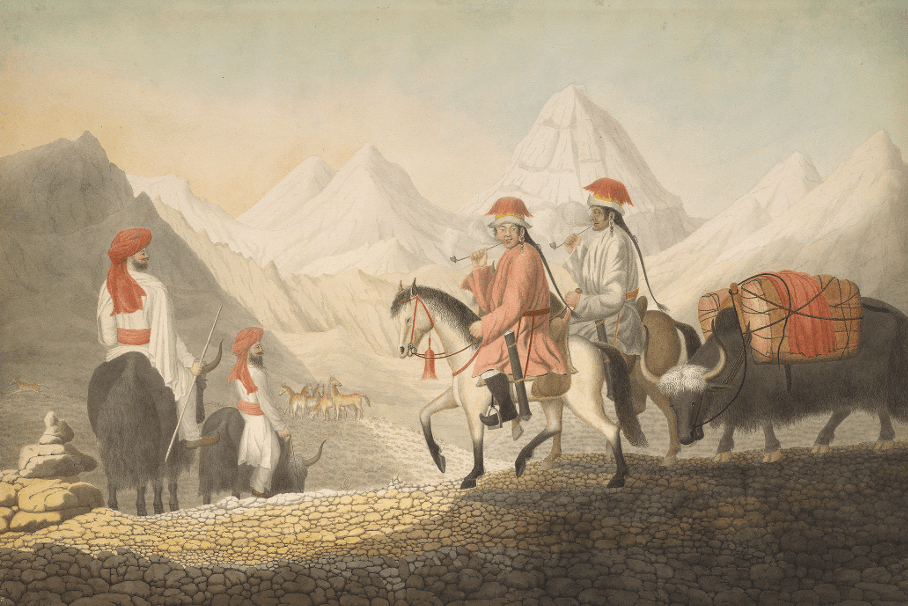
On the Road to Manasarovar Lake, Moorcroft with Captain Hyder and Chinese Horsemen (Wang, Jukar, Tseng, Li)
At the end of his journey, he reached Gartok, the administrative center of Tibet, and acquired important information about its trade routes. Through this expedition, Moorcroft became the first European traveler to cross the Himalayas.【3】
Moorcroft’s efforts to procure horses for British cavalry units and his exploration work continued during his long journey, which began in 1819. Accompanied by his young companion George Trebeck, he traveled through the Kashmir region, visiting its capital Srinagar, Lahore and Ladakh before heading to Afghanistan in 1824.
Among the Afghan cities visited by Moorcroft were important centers such as Balkh, Hulm and Kunduz. The ruler of the Kunduz Emirate, Murad Beg, suspected Moorcroft of being a spy and detained him and his companions for a period. After being released, Moorcroft and Trebeck proceeded to Bukhara. They reached Bukhara in early 1825 and remained there for five months.
Although the primary objective of the journey was to procure suitable horse breeds for the British cavalry, Moorcroft’s records are remarkably comprehensive. He observed and meticulously documented the political, social and economic conditions along his route. His notes from this extended journey, along with drawings made by George Trebeck, were compiled by Horace Hayman Wilson and published in two volumes in 1841.
William Moorcroft contracted a fever while returning from Bukhara and died in August 1825 near Andhoy. The exact cause of death was never determined, but illness and the hardships of the journey were contributing factors. His burial place remains unknown.
Moorcroft’s Central Asian journey made an early contribution to Britain’s strategic planning in the region and is regarded as a pioneering initiative in the so-called “Great Game”, the struggle for influence between Britain and Russia. The data he collected served as a model for subsequent travelers and intelligence agents sent to the region.
His observations on the cities of Afghanistan and Turkistan constitute one of the earliest comprehensive accounts of Turkistan’s internal structure in Western literature. His prolonged journey established him as one of the earliest European explorers of the region.【4】
Alder, G. J. "Standing Alone: William Moorcroft Plays the Great Game, 1808–1825." *The International History Review* 2, no. 2 (1980): 172-215.https://pahar.in/pahar/Books%20and%20Articles/Indian%20Subcontinent/1980%20Standing%20Alone--William%20Moorcroft%20Plays%20the%20Great%20Game%201808-1825%20by%20Alder%20s.pdf
Alder, G. J. "The Asian Years of William Moorcroft, 1808–25," *Asian Affairs* 18(1), (1987): 3-10.https://pahar.in/pahar/Books%20and%20Articles/Indian%20Subcontinent/1987%20The%20Asian%20Years%20of%20William%20Moorcroft%201808-1825%20by%20Alder%20from%20Asian%20Affairs%20v18%20s.pdf
Alder, Garry. *Beyond Bokhara: The Life of William Moorcroft, Asian Explorer and Pioneer Veterinary Surgeon, 1767–1825.* Delhi: Low Price Publications, 2012.https://archive.org/details/dli.pahar.3779/mode/2up
Marczell, P. J. “William Moorcroft’s Commercial Pilgrimage to Manasa Sarowara in 1812”. In *Recent Research on Ladakh 6: Proceedings of the Sixth International Colloquium on Ladakh Leh 1993*, edited by Henry Osmaston and Nawang Tsering, 161–176. Bristol: University of Bristol, 1997.https://pahar.in/pahar/Books%20and%20Articles/Tibet%20and%20China/1993%20William%20Moorcrofts%20Commercial%20Pilgrimage%20to%20Manasa%20Sarowara%20in%201812%20by%20Marczell%20s.pdf
Moorcroft, William and George Trebeck. *Travels in the Himalayan Provinces of Hindustan and the Panjab, in Ladakh and Kashmir, in Peshawar, Kabul, Kunduz and Bokhara, from 1819 to 1825*, ed. Horace Hayman Wilson, Volume I, London: John Murray, 1841.https://archive.org/details/dli.csl.7229/mode/2up
Moorcroft, William and George Trebeck. *Travels in the Himalayan Provinces of Hindustan and the Panjab, in Ladakh and Kashmir, in Peshawar, Kabul, Kunduz and Bokhara, from 1819 to 1825*, ed. Horace Hayman Wilson, Volume I, London: John Murray, 1841.https://archive.org/details/in.ernet.dli.2015.284643
Wang, X., Jukar, A. M., Tseng, Z. J., and Li, Q. “Dragon Bones from the Heavens: European Explorations and Early Palaeontology in Zanda Basin of Tibet, Retracing Type Locality of *Qurliqnoria Hundesiensis* and *Hipparion* (*Plesiohipparion*) *Zandaense*.” *Historical Biology* 33, no. 10 (2020): 2216–27.https://escholarship.org/uc/item/87p8j647
Çiftçi, Ferhat. "Batılı Seyyahlara Göre XIX. Yüzyılın İlk Yarısında Afganistan Şehirleri." Master's thesis, Sakarya Üniversitesi, 2019.
[1]
G. J. Alder, "The Asian Years of William Moorcroft, 1808–25", Asian Affairs 18(1) (1987): 5. https://pahar.in/pahar/Books%20and%20Articles/Indian%20Subcontinent/1987%20The%20Asian%20Years%20of%20William%20Moorcroft%201808-1825%20by%20Alder%20from%20Asian%20Affairs%20v18%20s.pdf
[2]
P. J. Marczell, “William Moorcroft’s Commercial Pilgrimage to Manasa Sarowara in 1812”, Recent Research on Ladakh 6: Proceedings of the Sixth International Colloquium on Ladakh Leh 1993 içinde, ed. Henry Osmaston ve Nawang Tsering (Bristol, University of Bristol, 1997): 166. https://pahar.in/pahar/Books%20and%20Articles/Tibet%20and%20China/1993%20William%20Moorcrofts%20Commercial%20Pilgrimage%20to%20Manasa%20Sarowara%20in%201812%20by%20Marczell%20s.pdf
[3]
Ferhat Çiftçi, “Batılı Seyyahlara Göre XIX. Yüzyılın İlk Yarısında Afganistan Şehirleri.” (Yüksek Lisans Tezi, Sakarya Üniversitesi, 2019): 21. https://tez.yok.gov.tr/UlusalTezMerkezi/TezGoster?key=fS4sqEZr79C_n60Rk6MjFebjsOJwQFVDpqLz9eUSL6EP1gzJX7ZcCgBJ11Y16Smn
[4]
G. J. Alder, "Standing Alone: William Moorcroft Plays the Great Game, 1808–1825", The International History Review, 2(2), (1980): 199. https://pahar.in/pahar/Books%20and%20Articles/Indian%20Subcontinent/1980%20Standing%20Alone--William%20Moorcroft%20Plays%20the%20Great%20Game%201808-1825%20by%20Alder%20s.pdf

Year of Birth | 1767 | ||||||||
|---|---|---|---|---|---|---|---|---|---|
Place of Birth | Ormskirk, Lancashire, England | ||||||||
Occupation | Veterinary Explorer | ||||||||
Date of Death | 1825-08-27 | ||||||||
Place of Death | Andhoy, Afghanistan | ||||||||
Early Life and Education
Veterinary Career
British East India Company
Tibet Journey
Turkistan Journey
Death and Legacy