


This article was automatically translated from the original Turkish version.
Harmony refers to the balanced and coordinated functioning of different elements. This concept is applied in many fields including music, art, nature, human relationships and even psychology. Harmony describes situations in which everything operates in mutual compatibility.
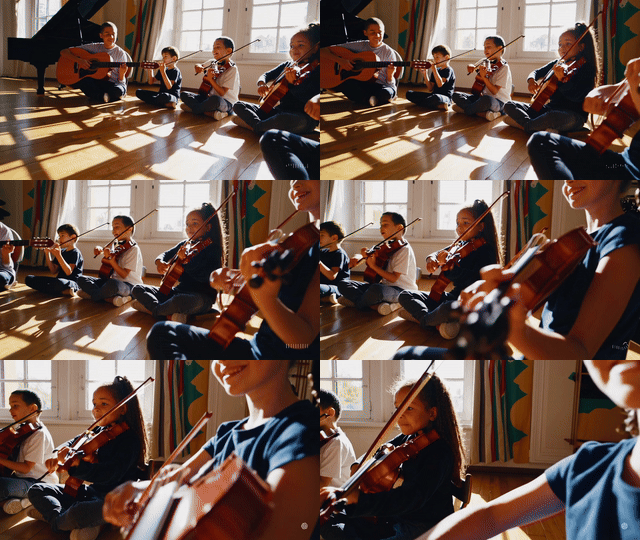
In music, harmony is the pleasing effect produced when different sounds are played together. For example, when a guitar and a piano play together, their sounds blending in harmony create a pleasing result. Musicians combine different tones in their songs to form beautiful melodies. Long ago, in ancient Greece, people noticed that certain musical notes were mathematically compatible. This discovery laid the foundation for the musical principles we use today.
Over time, music became more complex. During the Renaissance, musicians combined more voices and melodies to create richer and more intricate compositions. In the Baroque period, musical harmony further developed, producing melodies that reflected human emotions. Today, musical harmony continues to be used across various musical genres.
class=\
In philosophy, harmony means that life and our world exist in balance and order. Ancient Greek philosophers such as Plato and Aristotle believed that when the world functions at its best, everything is in equilibrium. Plato argued that in an ideal society, each person should live in peace, fulfilling a role suited to their abilities. Aristotle similarly maintained that people must live in harmony with one another.
Today, harmony remains a topic in philosophy, but now people seek ways to solve global problems through greater cooperation in society. Individuals living in a peaceful society are more likely to be happy and successful.
Artists also think deeply about harmony. In art, harmony is the aesthetically pleasing use of colors, shapes and patterns. A painter combines colors and objects to create a sense of balance, making the artwork visually appealing. For instance, a painter uses appropriate colors and forms to make a composition more engaging and cohesive.
During the Renaissance, artists employed harmony while striving to depict humans and nature realistically. Today, artists continue to create paintings, sculptures and other art works by applying harmony in diverse ways.
Harmony is not limited to music, art or philosophy; it is also vital in our daily lives. In society, harmony means people living together in mutual accord. When everyone contributes to society according to their abilities, the society becomes more peaceful. For example, people can create a better world by showing mutual respect and working together. Harmony is not only about individuals coexisting peacefully; it also requires different groups and cultures to live in harmony. When harmony exists in a society, people are happier and social problems are more easily resolved.
In psychological terms, harmony means a person’s inner state of balance and peace. A person who is mentally and emotionally balanced is likely to be happier and healthier. For example, someone who can manage stress, understand themselves and show empathy toward others is psychologically harmonious. Inner peace enhances the quality of life.
Harmony plays an important role not only in music, art and philosophy, but in every aspect of our lives. This concept is essential for fostering peace in our social lives, artistic expressions and inner worlds. By exploring harmony across different domains, we can better understand both ourselves and our society.
Aristotle. "Nicomachean Ethics." Translated by W. D. Ross, The University of Chicago Press, 1925.
Cattell, Raymond B. "The Scientific Analysis of Personality." The University of Chicago Press, 1946.
Cooke, Mervyn. "A History of Western Music. 9th ed." W.W. Norton & Company, 2014.
Davies, Stephen. "Musical Meaning and Expression." Cornell University Press, 1994.
Gombrich, E.H. "The Story of Art." Phaidon Press, 2006.
Langer, Susanne K. "Feeling and Form: A Theory of Art." Charles Scribner’s Sons, 1953.
Plato. "The Republic." Translated by Benjamin Jowett, Dover Publications, 2000.
Stravinsky, Igor. "Poetics of Music in the Form of Six Lessons." Harvard University Press, 1947.

No Discussion Added Yet
Start discussion for "What Is Harmony? (Children)" article
Harmony in Music
Harmony in Philosophy
Harmony in Art
Harmony in Society
Psychological Harmony