This article was automatically translated from the original Turkish version.
+1 More
Region | Sunda Indonesia (Java) Bali | ||||||||
|---|---|---|---|---|---|---|---|---|---|
Definition | Traditional Shadow Theatre and Ritual | ||||||||
History | 800s AD / Pre-10th Century TECHNIQUE AND MATERIAL | ||||||||
Director | Dalang (Puppeteer, Narrator, Orchestra Conductor) | ||||||||
Stage | Kelir (Screen), Blencong (Light), Banana Trunk | ||||||||
Story Source | Ramayana, Mahabharata, Islamic Adaptations | ||||||||
Sections (Pathet) | Youth, Adulthood, Wisdom | ||||||||
Key Symbols | Gunungan (Tree of Life / Golden Ratio) Punakawan (Comic Philosophers) | ||||||||
Material | Processed Buffalo Leather (Tatah Carving) | ||||||||
Music | Gamelan Orchestra | ||||||||
Status | UNESCO Intangible Cultural Heritage (2003) | ||||||||
Duration | 9 Hours (Until Dawn) | ||||||||
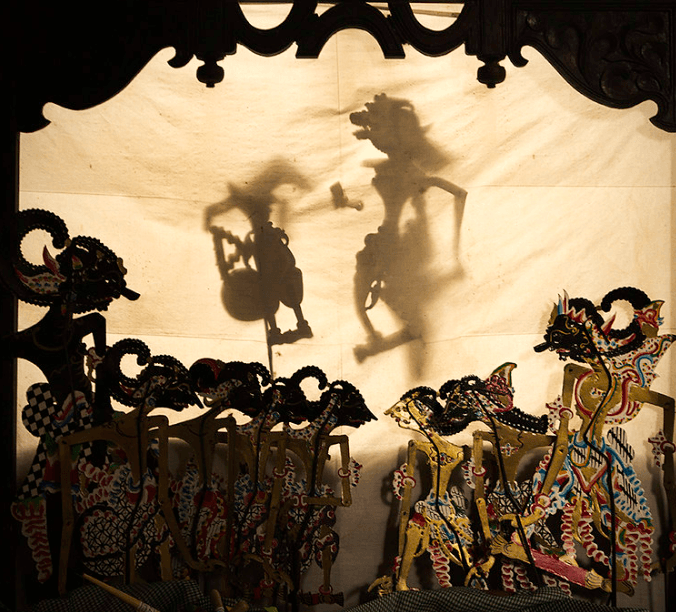
Wayang Kulit is a traditional shadow puppet theater performed in the Indonesian archipelago, particularly in the cultural zones of Java, Bali, Sunda, Lombok, and Malaysia. It involves the animation of stylized flat puppets made from buffalo hide, using a light source and a semi-translucent screen. This art form is said to derive etymologically from the word "bayang," meaning "shadow," and is not merely a visual spectacle but a complex ritual encompassing philosophical, mystical, and social dimensions.【1】 In 2003, it was inscribed by UNESCO as a Masterpiece of the Oral and Intangible Heritage of Humanity.【2】
Wayang Kulit (National Geographic Asia)
Wayang Kulit is one of the oldest and most deeply rooted art forms of Indonesian and Javanese culture, with historical traces extending back to the 800s CE and even earlier.【3】 Academic debates regarding its origins have centered on theories proposing either local (Javanese/Indonesian) or foreign (Indian or Chinese) sources.
One of the most significant early records of the art’s emotional impact dates to the reign of East Javanese King Airlangga (1035–1049). A court poet described how audiences, fully aware that the puppets were merely carved and manipulated pieces of leather, wept deeply during performances. During the Hindu-Buddhist period between 800 and 1500 CE, the repertoire became largely based on Indian epics Ramayana and Mahabharata, linked to the legendary Prince Aji Saka, who was said to have brought Indian culture to the island. However, these epics were reinterpreted according to local political and cultural values.【4】
The spread of Islam in Java during the 1500s brought a decisive transformation to both the aesthetics and narrative of Wayang Kulit. After the fall of the last Hindu-Buddhist kingdom, Majapahit, around 1520, some communities fled to Bali, preserving the older style there, while the art remaining in Java adapted to Islamic beliefs. To comply with Islamic prohibitions on figurative representation, the anatomy of the puppets was altered by the nine Islamic saints of Java. According to legend, Sunan Kalijaga elongated the arms and noses of the puppets, distancing them from realistic human forms and stylizing them. Narrative adjustments were also made to align with Islamic morality; for instance, Princess Drupadi from the Mahabharata, originally polygamous, was made monogamous, and the character Durna, representing Hindu priests, was discredited.【5】
A Wayang Kulit performance presents an integrated structure combining technical equipment, music, and narration. At the center of the show is the Dalang, the puppet master. The Dalang is not merely an operator of the puppets but also the storyteller, orchestra conductor, philosopher, and spiritual guide. Sitting behind the screen, he voices all characters in distinct tones, uses his feet to strike wooden clappers that give rhythmic cues to musicians, and shapes the narrative through improvisation.
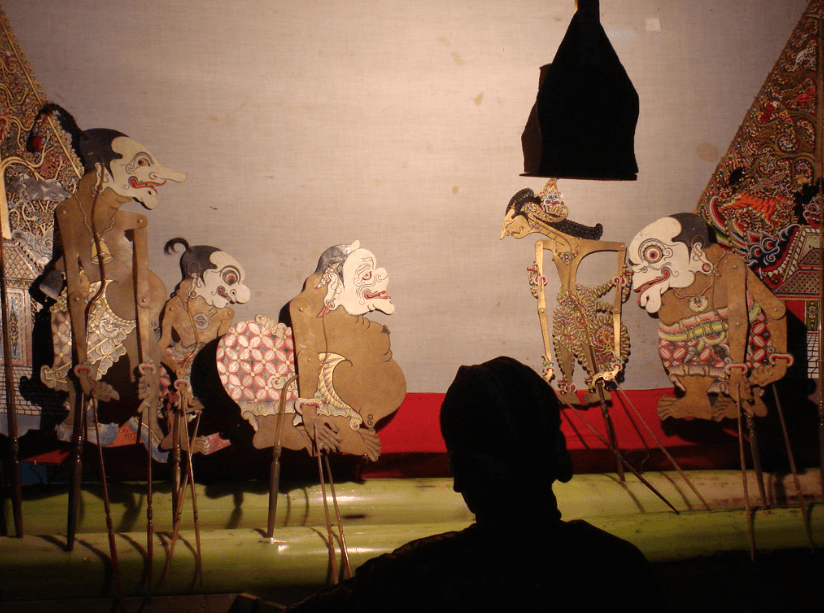
Wayang Kulit Puppeteer (Dalang) (Flickr)
The stage setup is rich in symbolic meaning. The white cloth screen, called the Kelir, represents the universe; the wooden log placed beneath it symbolizes the earth; and the traditional light source, known as the blencong (traditionally fueled by coconut oil), represents the sun or the eternal light of life. The puppets are manipulated between the light and the screen to cast their shadows. The performance is accompanied primarily by the Gamelan orchestra, composed largely of bronze percussion instruments. In Java, large orchestras using two distinct tuning systems—Slendro and Pelog—are employed, while in Bali, smaller quartets known as gender wayang are preferred. The music establishes the atmosphere of the scene, reflects the emotional state of the characters, and supports the action.
A traditional Javanese Wayang performance begins in the evening and continues uninterrupted until dawn. This nine-hour span is divided into three main musical and dramatic phases known as Pathet, corresponding to stages of human life or spiritual development. The first phase, "Pathet Nem" (9:00 PM–12:00 AM), symbolizes youth and formation; during this section, characters are introduced, kingdoms are established, and seeds of conflict are sown.
Beginning after midnight, "Pathet Sanga" (12:00 AM–3:00 AM) represents adulthood and spiritual quest. The hero leaves the palace, enters the forest, meditates, and confronts internal or external demons. Scenes known as the "War of Flowers" (Perang Kembang), in which the hero defeats giants representing his own ego rather than brute force, typically occur in this section. The final phase, "Pathet Manyura" (3:00 AM–6:00 AM), signifies maturity and wisdom. It is the concluding section where conflicts are resolved, major battles (such as the Bratayudha) take place, and good triumphs over evil. The cycle is completed at sunrise with the placement of the Gunungan figure at the center of the screen.
Wayang puppets are crafted through a complex process involving buffalo hide. The hide is dried, scraped, and then meticulously perforated with intricate, lace-like patterns using special tools called "tatah." These perforations allow light to pass through the puppet, adding depth and texture to its shadow. The puppets are then painted according to traditional color codes and often adorned with gold leaf. Mobile arms are controlled by rods made from buffalo horn.
Puppet designs are coded to reflect the moral and physical traits of the characters. Noble characters, classified as "Alus" (such as Arjuna or Rama), have slender physiques, almond-shaped eyes, graceful postures, and heads tilted downward; their voices are typically soft and melodic. Powerful warriors of the "Gagah" group (such as Bima) are depicted with upright stances, large eyes, muscular builds, and deep voices. The "Denawa"—giants and evil spirits—are portrayed with coarse facial features, protruding teeth, bulging eyes, and large noses. Skin colors also convey character temperament: black and blue signify spiritual maturity and calmness, red denotes anger and ambition, white represents purity, and gold symbolizes nobility.
One of the most loaded visual elements of the performance is the Gunungan (or Kayon), a figure shaped like a mountain or tree. Placed at the center of the screen at the beginning and end of the performance and used to indicate scene or time transitions, it symbolizes the "Tree of Life" and the three layers of the universe (Tribuwana: Upper, Middle, and Lower Worlds).
Its design typically includes a gate (the gate of heaven), a tree, various animals (tiger, ox), birds, and snakes. The motifs on the Gunungan represent the four elements of nature and are viewed in Javanese mysticism as a map of the human spiritual journey. Analyses of Gunungan designs in the Cirebon style have shown that mathematical values close to the Golden Ratio (1.618) are used to achieve aesthetic balance.【6】
Another carrier of philosophical depth is the group of clown servants known as Punakawan. In Javanese tradition, these include Semar, Gareng, Petruk, and Bagong; in Balinese tradition, characters such as Twalen. They interrupt the narrative to comment on current events and translate the elevated language of the heroes into terms understandable to the audience. The figure of Semar, in particular, embodies the "unity of opposites," both through his divine origins and his physically grotesque and genderless (androgynous) form.
Alpha. "Wayang Kulit." Flickr, January 21, 2026.https://www.flickr.com/photos/27494734@N07/3190572612.
Asia Society. "Wayang Kulit: Indonesia's Extraordinary Shadow Puppetry Tradition". NEW WORK. Accessed January 21, 2026.https://asiasociety.org/new-york/wayang-kulit-indonesias-extraordinary-shadow-puppetry-tradition
Asian Art Museum. "The History of Indonesian Puppet Theater (Wayang)." *Asian Art Museum Education Resources*. Accessed January 21, 2026.https://education.asianart.org/resources/the-history-of-indonesian-puppet-theater-wayang/.
Creative_QR. "Wayang Kulit." Flickr, January 21, 2026.https://www.flickr.com/photos/creativeqr/19547955788.
Flaig, Vera H. "Indonesia: Javanese Gamelan and Shadow Puppet Theatre (Wayang Kulit)." Gamelan Outreach Project, University of Michigan Center for South East Asian Studies. Accessed January 21, 2026.https://lsa.umich.edu/content/dam/cseas-assets/cseas-documents/gamelan/ShadowPuppetTheatre.pdf
Krishna, Ida Bagus Wika, and Ida Bagus Putu Eka Suadnyana. "Wayang Kulit Bali Sebagai Media Komunikasi." *Prosiding Seminar Nasional IKH.* (2019): 164–171. Accessed January 21, 2026.https://jayapanguspress.penerbit.org/index.php/ganaya/article/view/399.
Loita, Aini. "Simbol-Simbol Dalam Gunungan Wayang Kulit Jawa." *Magelaran: Jurnal Pendidikan Seni* 1, no. 2 (2018). Accessed January 21, 2026.https://journal.umtas.ac.id/index.php/magelaran/article/view/463.
Masroer, Ch. Jb. "Spiritualitas Islam dalam Budaya Wayang Kulit Masyarakat Jawa dan Sunda." *Jurnal Sosiologi Agama* 9, no. 1 (2015): 38–61. Accessed January 21, 2026.https://ejournal.uin-suka.ac.id/ushuluddin/SosiologiAgama/article/view/091-03/1045.
National Geographic Asia. "Documenting the Art of Wayang Kulit." YouTube, 2:04. Accessed January 27, 2026.https://www.youtube.com/watch?v=kbjKJHSa3nU
Perasutiyo, Ian, Arif Muchyidin, and Indah Nursuprianah. "Golden Ratio and the Meaning of the Wayang Kulit Gunungan Philosophy". *Journal of Mathematics Instruction, Social Research and Opinion* 1, no. 1 (2022): 41–53. Accessed January 21, 2026.https://journal-gehu.com/index.php/misro/article/view/10/73
Royal College of Music. "Wayang - Shadow Puppets." RCM Sparks. Accessed January 21, 2026.https://www.rcm.ac.uk/media/Wayang%20Shadow%20Puppet%20Resouce.pdf.
Schechner, Richard. "Wayang Kulit in the Colonial Margin". *TDR* 34, no. 2 (1990): 25–61. Accessed January 21, 2026.https://doi.org/10.2307/1146026
UNIMA (Union Internationale de la Marionnette). "Wayang." *World Encyclopedia of Puppetry Arts.* Accessed January 21, 2026.https://wepa.unima.org/en/wayang/.
[1]
UNIMA (Union Internationale de la Marionnette), "Wayang," World Encyclopedia of Puppetry Arts, erişim 21 Ocak 2026, https://wepa.unima.org/en/wayang/.
[2]
Asia Society, "Wayang Kulit: Indonesia's Extraordinary Shadow Puppetry Tradition," erişim 21 Ocak 2026, https://asiasociety.org/new-york/wayang-kulit-indonesias-extraordinary-shadow-puppetry-tradition
[3]
Asian Art Museum, “The History of Indonesian Puppet Theater (Wayang),” Asian Art Museum Education Resources (2026), Erişim 21 Ocak 2026, https://education.asianart.org/resources/the-history-of-indonesian-puppet-theater-wayang/
Royal College of Music, “Wayang - Shadow Puppets.” RCM Sparks, syf 2, https://www.rcm.ac.uk/media/Wayang%20Shadow%20Puppet%20Resouce.pdf
[4]
Asian Art Museum, “The History of Indonesian Puppet Theater (Wayang),” Asian Art Museum Education Resources (2026), Erişim 21 Ocak 2026, https://education.asianart.org/resources/the-history-of-indonesian-puppet-theater-wayang/
[5]
A.e.,
[6]
Ian Perasutiyo, Arif Muchyidin ve Indah Nursuprianah, “Golden Ratio and the Meaning of the Wayang Kulit Gunungan Philosophy,” Journal of Mathematics Instruction, Social Research and Opinion 1, 1 (2022): syf 43, https://journal-gehu.com/index.php/misro/article/view/10/73

Region | Sunda Indonesia (Java) Bali | ||||||||
|---|---|---|---|---|---|---|---|---|---|
Definition | Traditional Shadow Theatre and Ritual | ||||||||
History | 800s AD / Pre-10th Century TECHNIQUE AND MATERIAL | ||||||||
Director | Dalang (Puppeteer, Narrator, Orchestra Conductor) | ||||||||
Stage | Kelir (Screen), Blencong (Light), Banana Trunk | ||||||||
Story Source | Ramayana, Mahabharata, Islamic Adaptations | ||||||||
Sections (Pathet) | Youth, Adulthood, Wisdom | ||||||||
Key Symbols | Gunungan (Tree of Life / Golden Ratio) Punakawan (Comic Philosophers) | ||||||||
Material | Processed Buffalo Leather (Tatah Carving) | ||||||||
Music | Gamelan Orchestra | ||||||||
Status | UNESCO Intangible Cultural Heritage (2003) | ||||||||
Duration | 9 Hours (Until Dawn) | ||||||||
Historical Origins and Development
Structure and Elements of the Performance
Dramatic Timing: The Pathet System
Puppet Construction and Aesthetic Features
Symbolism and Philosophy: Gunungan and Punakawan