This article was automatically translated from the original Turkish version.
+1 More
Author(s) | Mustafa Kutlu | ||||||||
|---|---|---|---|---|---|---|---|---|---|
Number of Pages | 87 | ||||||||
Publisher(s) | Dergâh Yayınları | ||||||||
Type(s) | Hikâye | ||||||||
First Publication Date(s) | November 1979 | ||||||||
Waters Flowing Uphill is a compelling narrative that portrays Turkey’s social and political environment before 1980 through the tragedy of a young worker who migrates from village to city during the industrialization process. The story centers on the transformation, alienation, and struggle experienced by individuals transitioning from an agrarian society to an industrial one. Through the tragic tale of the young character Cevher Bican, the work offers both a personal and societal critique.
Cevher Bican is a 17-year-old youth who travels from Sarıkamış district of Kars to Istanbul in search of work, aided by his uncle. He comes to the city with the intention of settling permanently, but the reality he encounters is far removed from his expectations. Neither nature nor people remain as they were. Within the gray atmosphere of the city, spiritual values, worship, and sincerity are forgotten; people are depicted as lost in the relentless pursuit of livelihood and mechanized existence.
As Bican struggles to find his place in the urban chaos, he encounters political concepts for the first time—particularly "referendum", "union" and "strike" . He begins to learn about and defend workers’ rights. Yet this struggle is not easy: the voices of workers are drowned out by the noise of machines, their lungs fill with factory dust, and their sweat is dismissed as insignificant. Bican and his friends’ quest for justice is, as the saying goes, as difficult as “waters flowing uphill.” In the story’s tragic conclusion, Cevher loses his life during a strike, struck by a stray bullet.
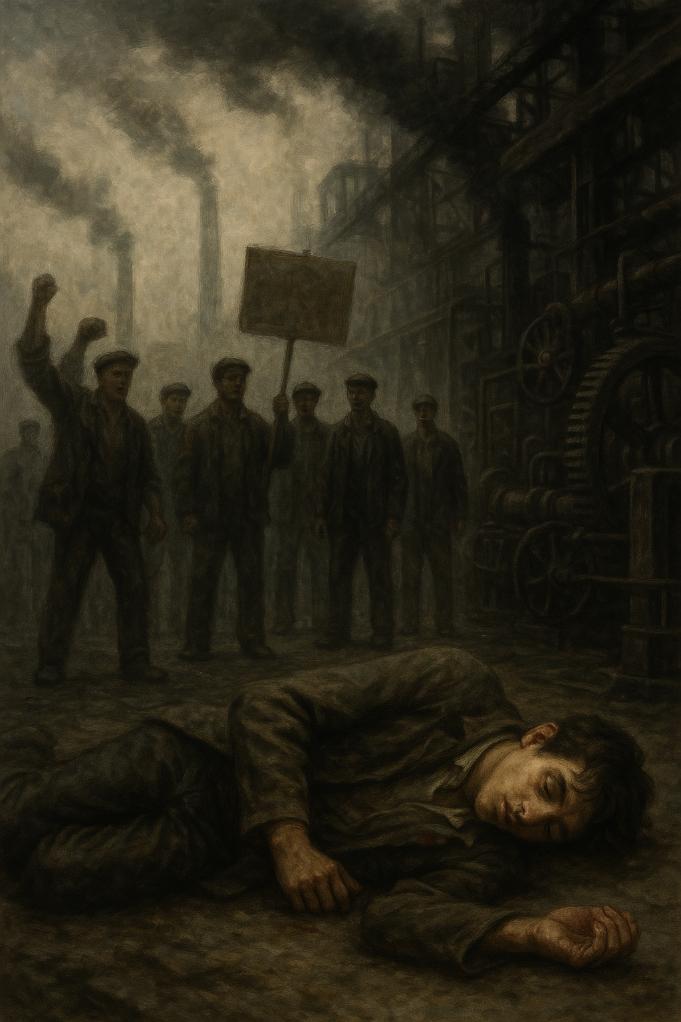
Cevher Bican’s Death by a Blind Bullet (Generated by Artificial Intelligence)
Industrialization and Alienation: The story explores how industrialization mechanizes human beings and disrupts both nature and interpersonal relationships.
Loss of Spiritual Values: The narrative emphasizes how people consumed by the struggle for survival drift away from spiritual practices such as worship.
Workers’ Rights and Strikes: The central focus is on labor struggle, unionization, and the concept of strikes, portraying workers’ pursuit of justice.
Class Struggle: The exploitation of workers in factories, who lose their health and youth, is laid bare as they fight for their rights.
Youthful Hope and Disillusionment: Through Cevher Bican, the story illustrates how young people, embarking on their journey with hope, are swallowed by the gears of the system.
Cevher Bican: The protagonist. A young worker who arrives in the city from the village with great hopes, confronts repeated disillusionment, and is ultimately killed during a strike.
Fellow Workers: Other young laborers who join Bican in demanding their rights, participate in strikes, endure the same harsh conditions, and stand in solidarity with him.
The story depicts a period in pre-1980 Türkiye when labor movements, strikes, and political organization were rapidly gaining momentum. During this era of growing societal polarization and the working class’s efforts to organize, the hardships, tragic events, and social injustices faced by individuals form the backdrop of the narrative.
Kutlu, Mustafa. *Yokuşa Akan Sular.* Dergâh Yayınları, 2023. https://www.dergah.com.tr/kitaplar/yokusa-akan-sular

Author(s) | Mustafa Kutlu | ||||||||
|---|---|---|---|---|---|---|---|---|---|
Number of Pages | 87 | ||||||||
Publisher(s) | Dergâh Yayınları | ||||||||
Type(s) | Hikâye | ||||||||
First Publication Date(s) | November 1979 | ||||||||
No Discussion Added Yet
Start discussion for "Waters Flowing Uphill (Book)" article
Plot
Themes
Characters
Social Context