This article was automatically translated from the original Turkish version.
+1 More
System Name | Upsilon Andromedae | ||||||||
|---|---|---|---|---|---|---|---|---|---|
Location | Andromeda constellation | ||||||||
Distance | Approximately 44 light years | ||||||||
Upsilon Andromedae (υ Andromedae, abbreviated υ And) is a Sun-like star located approximately 44 light-years from Earth in the direction of the Andromeda constellation, accompanied by a multiplanet system orbiting it. In 1999, with the discovery of its second and third planets, it became a landmark in astronomical history as the first multiplanet system ever detected around a main-sequence star outside the Solar System.

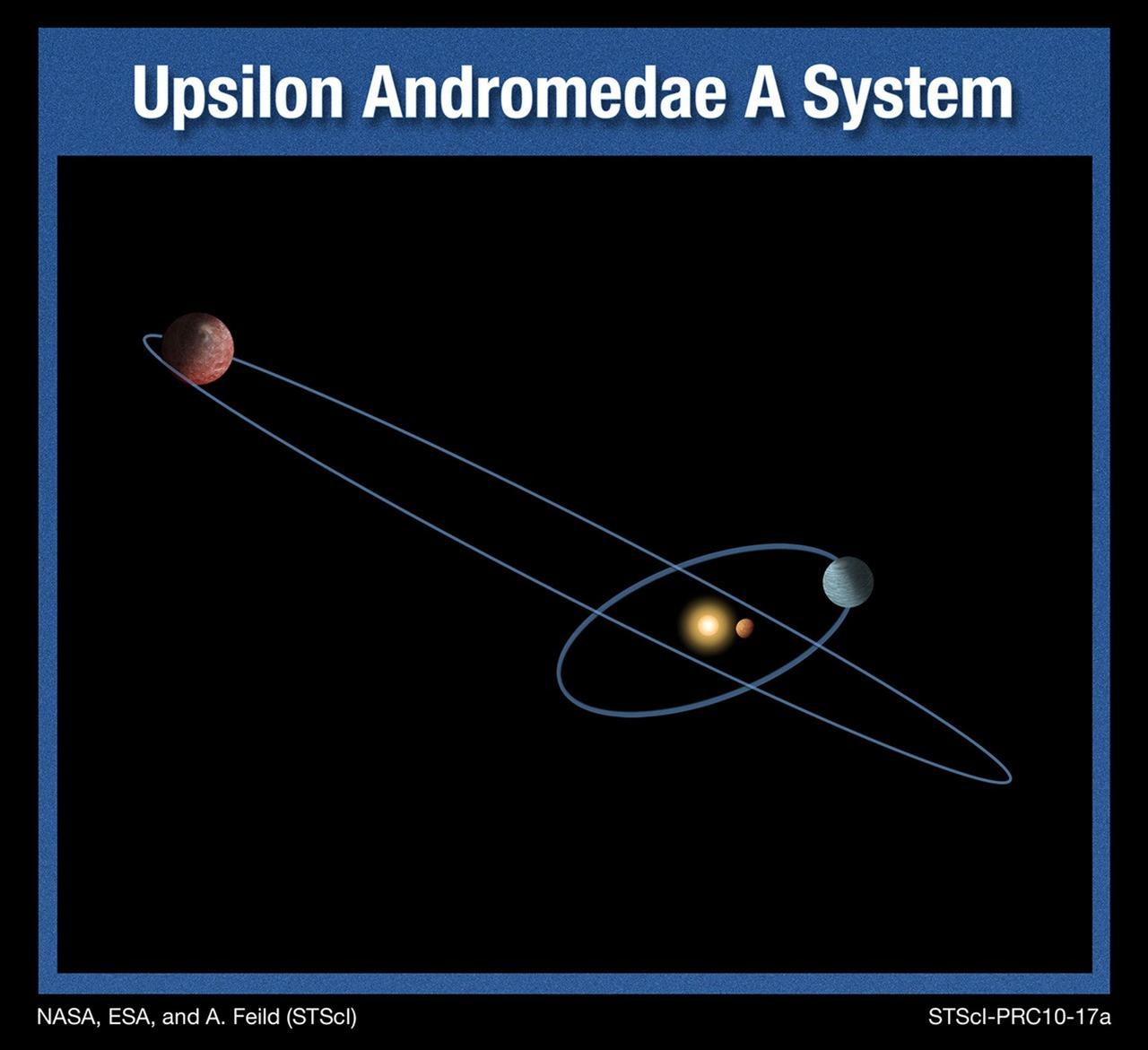
Upsilon Andromedae System (NASA)
The system’s architecture consists of a “hot Jupiter” and two outer gas giants with highly eccentric orbits. This configuration provides an important observational testbed for theories of planet formation and the evolution of multiplanet systems.
The first planet in the Upsilon Andromedae system, Upsilon Andromedae b, was discovered in 1996 by astronomers Geoffrey Marcy and R. Paul Butler using the radial velocity method. This planet is one of the first “hot Jupiters” identified following the discovery of 51 Pegasi b.
A major breakthrough came in 1999 when the same team announced the detection of two additional planets. Detailed analysis of long-term radial velocity data from the Lick and Keck Observatories revealed two distinct signals after subtracting the signal from the inner planet. These signals indicated the presence of two large gas giants, now named Upsilon Andromedae c and Upsilon Andromedae d. Thus, for the first time, a multiplanet system orbiting a main-sequence star outside the Solar System was observationally confirmed, marking a pivotal moment in exoplanet research.
In December 2015, the International Astronomical Union (IAU) officially named the system as part of the NameExoWorlds project. Following a proposal by the “Venera” Astronomy Club in the United States, the host star was named Titawin after a UNESCO World Heritage site in Morocco, while the planets were named in honor of Arab astronomers from the 10th and 11th centuries: Saffar (b), Samh (c), and Majriti (d). This naming has imbued the system with both scientific and cultural significance.
Upsilon Andromedae is in fact a wide binary star system:
This binary structure offers an important context for studying the formation and stability of multiplanet systems.
Three giant planets have been confirmed around Upsilon Andromedae A via the radial velocity method:
This triple configuration provides a key observational example for understanding the evolution of multiplanet systems, particularly through the dynamics of hot Jupiters and the eccentric orbits of outer planets.
One of the most striking and extensively studied features of the Upsilon Andromedae system is the dynamical structure of its planets. Initially, it was assumed that all planets orbited in the same plane, as in the Solar System. However, advanced analyses based on astrometric and radial velocity data from the Hubble Space Telescope and various ground-based observatories have shown this assumption to be incorrect.
A comprehensive study published in 2010 revealed a mutual inclination of approximately 30 degrees between the orbital planes of Upsilon Andromedae c and Upsilon Andromedae d. This indicates that the orbits of these two planets are significantly tilted relative to each other, creating a striking contrast with the nearly coplanar architecture of the Solar System.
This orbital inclination points to a relatively rare dynamical behavior in multiplanet systems and suggests possible traces of complex processes during planet formation, such as planetary collisions, external perturbations, or interactions with other stars.
The unusual architecture of the Upsilon Andromedae system — featuring a hot Jupiter alongside two massive planets on eccentric and inclined orbits — cannot be easily explained by classical planet formation models. Consequently, researchers have proposed various dynamical evolution scenarios to account for its current state:
Upsilon Andromedae remains one of the earliest and strongest observational examples demonstrating that planetary systems do not necessarily evolve in a calm and orderly manner; they can instead be shaped by violent interactions and chaotic processes.
"Final Results of NameExoWorlds Public Vote." International Astronomical Union. December 15, 2015. Accessed July 20, 2025. https://www.nao.ac.jp/en/news/topics/2015/20151218-nameexoworlds.html.
Butler, R. Paul., et al. "Evidence for Multiple Companions to υ Andromedae." *The Astrophysical Journal*. Accessed July 20, 2025. https://iopscience.iop.org/article/10.1086/308035.
Butler, R. Paul., et al. "Three New ‘51 Pegasi-Type’ Planets." *The Astrophysical Journal*. Accessed July 20, 2025. https://iopscience.iop.org/article/10.1086/310444.
McArthur, E. Barbara. "New Observational Constraints on the υ Andromedae System with Data from the Hubble Space Telescope and Hobby-Eberly Telescope." *The Astrophysical Journal*. Accessed July 20, 2025. https://iopscience.iop.org/article/10.1088/0004-637X/715/2/1203.
NASA Exoplanet Archive. "Upsilon Andromedae A System." Accessed July 20, 2025. https://science.nasa.gov/asset/hubble/upsilon-andromedae-a-system/.

System Name | Upsilon Andromedae | ||||||||
|---|---|---|---|---|---|---|---|---|---|
Location | Andromeda constellation | ||||||||
Distance | Approximately 44 light years | ||||||||
No Discussion Added Yet
Start discussion for "Upsilon Andromedae System" article
Discovery History and Nomenclature
Stellar System
Planetary System and Architecture
Dynamics and Orbital Inclinations
Formation and Evolution Scenarios