


This article was automatically translated from the original Turkish version.
Umay is a sacred being in Turk mythology regarded as the protector of fertility, abundance, and children. Mentioned in the Old Turkic inscriptions, Umay was venerated under names such as "Umay", "Umay Ene", "Ubay Ene" or "Kuş Ene" among many Turkic communities of Central Asia. Believed to have descended from the sky, this goddess was seen as a powerful force in ensuring women’s fertility and safeguarding the spiritual and physical well-being of children.
Umay is especially revered as the protector of infants and children. Among the Khakas, Yakut and Altai myths, it was believed that until the age of three, a child’s soul was carried by Umay. During this period, when the child laughed, it was thought to be speaking with Umay; when the child cried, Umay was believed to have temporarily withdrawn. Depicted in bird form, Umay was thus referred to by some communities as "Kuş Ene". Bird motifs found in archaeological artifacts are associated with this belief.
Among Umay’s symbols, the color white, light, earth, and the bird motif stand out. White symbolizes purity and fertility, light represents life energy, earth signifies abundance and productivity, and the bird embodies spiritual protection. In Turkish folk narratives, Umay is sometimes identified with the archetype of the elderly and wise woman, showing similarities to figures such as Ulu Ana, Ak Ana, and Yer Ana.【1】
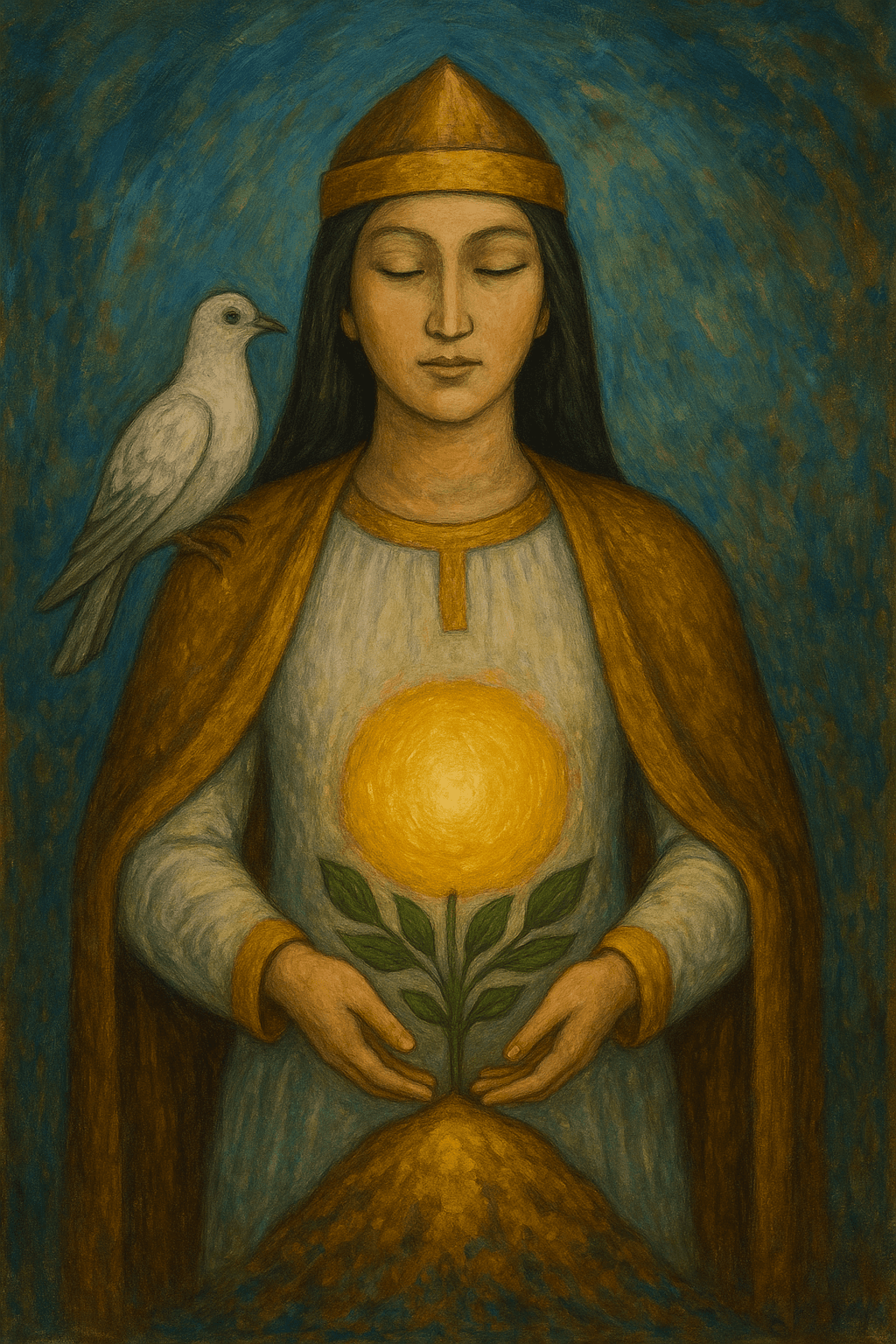
Umay Ana, the Sacred Female Entity Symbolizing Life and Abundance(Generated by Artificial Intelligence)
In the context of Jung’s archetypal theory, Umay is associated with the “Great Mother” archetype. Within this framework, she is perceived as a creative, protective, and transformative force. Her role in aiding female fertility, supporting women during childbirth, and shielding newborns from malevolent entities establishes her as a reflection of the maternal archetype.
In mythological narratives, Umay’s evolution is notable for shifting from a creative figure to sometimes taking on malevolent forms such as Al Karısı. This reflects the dual nature of Umay as both protector and chaotic force. From an archetypal perspective, figures like Umay can simultaneously embody life-giving and destructive powers.
The figure of Umay is frequently encountered in Azerbaijani literature between the 11th and 17th centuries. During this period, the goddess, also known as Humay, was depicted in poetry as a “bird of fortune”, “white bird” and “protective shadow”. Her continued use as a female given name is regarded as evidence of cultural continuity.
Beliefs surrounding Umay fulfilled a protective function during pre-natal, childbirth, and post-natal periods. A woman’s conception, safe delivery, and the child’s growth were all seen as occurring under Umay’s guardianship. Among the Yakut Turks, small bird figurines symbolizing Umay were worn as jewelry by women. Similar symbols have also been found in ancient graves in Azerbaijan.
In Turk mythological thought, Umay is a figure that balances nature, humanity, and society, offering spiritual guidance especially in matters of motherhood and childhood. Throughout her mythological evolution, Umay has retained the dual characteristics of benevolence and destructiveness, preserving the archetypal traits of the “Great Mother.” Cultural, literary, and archaeological traces reveal her enduring place and influence within ancient Turkic belief systems.
Değirmenci, Reyhan. *TürkMitolojisinde Yu Ana Arketipi: Umay Üzerine Arketipsel Bir İnceleme*. Master's thesis,Ege Üniversitesi Institute of Social Sciences, 2024. Accessed June 19, 2025.https://ekam.ege.edu.tr/files/ekam/icerik/2024-REYHAN_DEGIRMENCI.pdf
Geybullayev, Giyasettin, and Vefa Rızayeva. “Eski Türklerde Umay Tanrıçası.” *Türk Dünyası İncelemeleri Dergisi*, no. 15 (1999): 215–218. Accessed June 19, 2025. https://d
Hüseynova, Şebnem. “Türk Halk Edebiyatında Yaşlı Karı Karakterinin Tarihsel Gelişimi: Mitlerden Masallara.” Accessed June 19, 2025. https
Keskin, Kadriye. “Umay Ana’nın Çalıkuşları Mitolojiyi Yorumlarken.” *International Journal of Turkish Academic Studies (TURAS)* 4, no. 2 (2023): 101–110. Accessed June 19, 2025. https://dergipark.org.tr/en/download/article-file/3216750
[1]
Hüseynova, Şebnem. “Türk Halk Edebiyatında Yaşlı Karı Karakterinin Tarihsel Gelişimi – Mitlerden Masallara.” Türk Tarih Kurumu Yayınları, s. 1. Erişim 19 Haziran 2025. https://www.ttk.gov.tr/wp-content/uploads/2022/04/25-SebnemHuseynova.pdf.

Mythological Characteristics and Symbols
Mythological Evolution
Cultural Spread and Literary Traces
Belief Practices and Rituals