This article was automatically translated from the original Turkish version.
Turaç (Francolinus francolinus)
Family | Phasianidae (Sülüngiller) | ||||||||
|---|---|---|---|---|---|---|---|---|---|
Order | Animalia | ||||||||
Class | Aves | ||||||||
Subclass | Chordata | ||||||||
Egg Count | 7–12 individuals | ||||||||
Incubation Period | 18–21 days | ||||||||
Weight | Male: 283–566 g Female: 227–482 g | ||||||||
Length | 31–36 cm (Males are approximately 10% larger than females) | ||||||||
Conservation Status | (IUCN): LC - Least Concern | ||||||||
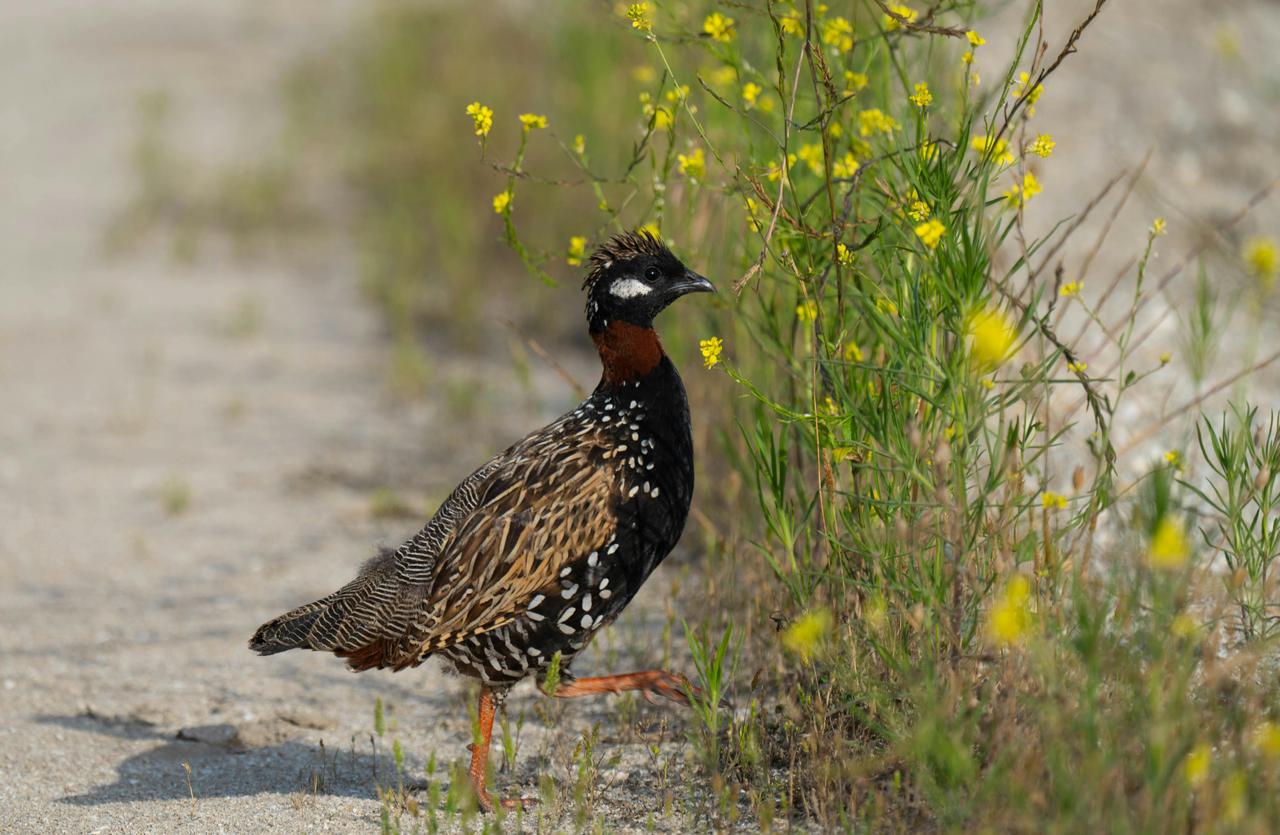
Francolin (Francolinus francolinus) is a medium-sized ground bird belonging to the Phasianidae family, characterized by a robust body, rounded wings, and a short tail. The species exhibits marked sexual dimorphism. Males are distinguished by a predominantly black underpart plumage with white spotting, a prominent white facial patch, and a chestnut-colored collar around the neck; females have a more subdued pale brown coloration with cryptic markings that blend with their surroundings.
The francolin (Francolinus francolinus) is a bird species within the Phasianidae family. Its taxonomic structure varies according to geographic distribution and plumage coloration. Generally, western populations are larger in size, while individuals become smaller toward the east. Regional differences in coloration are also observed, with some populations exhibiting lighter and others darker plumage. Six subspecies have been recognized: Francolinus francolinus francolinus, F. f. arabistanicus, F. f. bogdanovi, F. f. henrici, F. f. asiae, and F. f. melanonotus. These subspecies are primarily distinguished by differences in size, overall plumage color, and geographic distribution.
The francolin (Francolinus francolinus) is a medium-sized terrestrial bird measuring 33–36 cm in length with a wingspan of 50–55 cm. Pronounced sexual dimorphism is evident, with males being larger than females. Adult males weigh approximately 283–566 grams, while females range from 227–482 grams. The underparts of adult males are largely black, with the throat and chest distinctly darker. A prominent white cheek patch is visible above a black area surrounding the eye, and a striking chestnut-colored collar encircles the neck. The back and wings are brown with pale-edged feathers that create a scaled appearance. The belly is chestnut-colored, and the flanks display white spotting.
Females have a more muted and cryptic coloration: upperparts are brown, while underparts are pale with fine blackish streaks. The bill varies from dark horn-brown to black in males and is duller brown in females. Legs and feet are reddish-brown in both sexes but appear brighter in males and often bear a short spur. Juveniles resemble females in appearance but are paler and smaller in body size.
The francolin naturally ranges from southeastern Türkiye through Cyprus, Syria, Iraq, and Iran to southwestern Turkmenistan, Pakistan, and northern India. It is also found as far east as Kashmir and Myanmar. Fragmented populations occur in the western parts of its range. Additionally, it has been introduced by humans to regions such as Italy, certain areas of the former Soviet Union, Guam, islands in the Indian Ocean, and the United States.
It prefers well-watered open habitats, including grasslands, scrub-covered hills, open thorny woodlands, forest edges, and agricultural fields. It is also commonly found in irrigated plantations, along canals, and waterways. The species can adapt to golf courses, road verges, and other human-modified landscapes. It occasionally occurs in bamboo and tea plantations. Although it can occur up to 2,500 meters above sea level, it typically inhabits lower elevations.
Francolins are usually seen alone, in pairs, or in small groups of three to five individuals. They are predominantly asocial and spend most of the year living solitarily. When threatened, they prefer to escape by running rather than flying and move with remarkable speed. The species is non-migratory but may exhibit local movements.
They forage in open areas, scrublands, and along the edges of agricultural fields. They are most active during early morning and late afternoon. During the breeding season, males emit loud, far-carrying calls from elevated perches such as rocks, low trees, or fence posts to advertise their territory. During courtship displays, males sweep their wings along the ground, fan their tails, circle the female, and make periodic leaps.
Francolins are fast-walking, ground-feeding birds. When alarmed, they take short, rapid flights before landing again and resuming running. Social interactions are limited, and aggressive behaviors, particularly among males, may occur during the breeding season.
Francolins are omnivorous, feeding on both plant and animal matter. Their primary food items include grass seeds, cereal crops, herbs, shoots, leaves, tubers, fruits, and figs. Insects and their larvae also constitute an important part of their diet, particularly termites and ants.
They forage on the ground, directly picking up seeds and plant material. Occasionally, they consume earthworms, spiders, amphibians, and small reptiles in addition to insects. During feeding, they actively move through agricultural fields, scrub areas, and open terrain.
The francolin has a monogamous breeding system, with the breeding season extending broadly from March to October, depending on regional rainfall patterns and vegetation development. With the arrival of spring, males emit long-distance calls from elevated perches such as rocks or low trees to claim territory and attract females. During courtship displays, males sweep their wings along the ground, fan their tails, circle the female, and make periodic leaps.
The female constructs a shallow nest cavity hidden among tall grasses, shrubs, or cultivated crops such as cotton or sugarcane. The nest is lined with grass, twigs, and leaves, and the female lays a clutch of typically seven to twelve pale brown eggs. Incubation, lasting approximately 18–21 days, is carried out solely by the female, while the male remains nearby to defend the nest and accompanies her during feeding periods. The species may produce two clutches per season. Both parents jointly care for the chicks, which remain with the family group for several months and reach sexual maturity within their first year.
The francolin (Francolinus francolinus) is classified as “Least Concern” (LC) on the IUCN Red List of Threatened Species at the global level. However, this stable global status masks significant regional variations. In Türkiye, it is a rare and threatened bird. The primary causes of the severe decline in regional populations include trapping, excessive and unregulated hunting, habitat loss, the use of fertilizers and agrochemicals in agriculture, and nestling mortality caused by stubble fires. Due to these historical losses, hunting of the francolin has been completely banned in Türkiye for many years. Thanks to protected areas and conservation initiatives, local populations are slowly showing signs of recovery.
Bakhshiyev, Saleh. "Black Francolin Bird Walking on Ground." Pexels. Accessed May 24, 2026. https://www.pexels.com/photo/black-francolin-bird-walking-on-ground-26167609/
BirdLife International. “*Francolinus francolinus*.” *The IUCN Red List of Threatened Species*. Accessed May 24, 2026. https://www.iucnredlist.org/species/22678719/131903818
BirdLife International. “Black Francolin (Francolinus francolinus),” Birds of the World. Edited by S. M. Billerman, B. K. Keeney, P. G. Rodewald, and T. S. Schulenberg. Ithaca, NY: Cornell Lab of Ornithology, 2020. Accessed May 24, 2026. https://birdsoftheworld.org/bow/species/blkfra/cur/introduction
Ornito. "Turaç (*Francolinus francolinus*)." *Ornito (Bird Watching Community).* Accessed May 24, 2026. https://ornito.org/Bird/Detail/462
TRAKUS. “Turaç (Francolinus francolinus).” TRAKUS (Türkiye'nin Anonim Kuşları). Accessed May 24, 2026. https://www.trakus.org/kods_bird/uye/?fsx=2fsdl17@d&tur=Tura%E7

Turaç (Francolinus francolinus)
Family | Phasianidae (Sülüngiller) | ||||||||
|---|---|---|---|---|---|---|---|---|---|
Order | Animalia | ||||||||
Class | Aves | ||||||||
Subclass | Chordata | ||||||||
Egg Count | 7–12 individuals | ||||||||
Incubation Period | 18–21 days | ||||||||
Weight | Male: 283–566 g Female: 227–482 g | ||||||||
Length | 31–36 cm (Males are approximately 10% larger than females) | ||||||||
Conservation Status | (IUCN): LC - Least Concern | ||||||||
No Discussion Added Yet
Start discussion for "Turaç (Francolinus francolinus)" article
Taxonomy
Morphological Characteristics
Distribution and Habitat
Behavior and Ecology
Diet
Reproduction
Conservation Status