


This article was automatically translated from the original Turkish version.
Dendrochronology is the scientific discipline that determines the timing of past tree rings, climate conditions, environmental changes, and historical events through the analysis of tree rings.
Tree rings can be defined as annual growth bands of variable width, depending on the availability of water. Therefore, the development of each tree ring is unique. The “fingerprints” collected by scientists from trees in different parts of the world, when compared, shed light on past climates and ecosystems and even on the lives of ancient civilizations.
The science of dendrochronology was systematized in the early 20th century by American astronomer Andrew Ellicott Douglass. While investigating the effects of solar cycles on Earth’s climate, Douglass turned to tree rings. During his time at the Lowell Observatory in 1894, he noticed that tree rings exhibited characteristics parallel to annual climate variations. This discovery marked a turning point not only in climatology but also in the chronological ordering of historical events.
After discovering the correlation between these two natural phenomena, Douglass began systematically collecting tree ring samples to enable analyses of past climates. Using samples primarily from pine trees in the southwestern United States, he constructed a chronological record extending back to the mid-15th century. These efforts laid the foundation for dendrochronology as a scientific discipline and paved the way for its application in numerous research fields in subsequent years.
Valerie Trouet, who continues Douglass’s scientific legacy, states in her latest book Tree Story that tree rings have documented key moments in human history. For instance, unusually “wet” years between 1211 and 1225 in Central Asia may have provided an advantage in sustaining Genghis Khan’s armies, serving as a key factor in the rapid expansion of the Mongol Empire. At the same time, traces of more recent events have also been recorded in tree rings. For example, radiation effects from the 1986 Chernobyl disaster were detected in tree rings.
The field of dendrochronology is akin to a detective investigation. For example, wood patterns in a violin allegedly crafted by Antonio Stradivari, one of 18th-century Europe’s most renowned instrument makers and valued at $20 million, have been precisely dated through dendrochronological analysis.
To analyze tree rings, scientists typically extract cylindrical core samples from the trunk using specialized drills without cutting down the tree. Detailed data are collected through microscopic analysis, scanning, and computerized measurement techniques on these samples.
Tree rings are highly valuable to archaeologists and historians, particularly for determining the age of ancient structures, wooden artifacts, or wooden fragments uncovered during archaeological excavations. This method provides far more precise results than carbon-14 dating. For example:
In the modern era, tree rings are also used to monitor environmental changes. Industrial pollution, acid rain, forest fires, and even radiation negatively affect tree growth, which manifests as changes in the shape, color, or structure of the rings.
One of the most effective ways to understand past climate changes is by analyzing tree rings. Each ring not only records the existence of a given year but also reflects how much the tree was able to grow during that year. This growth is directly influenced by factors such as temperature, precipitation, and environmental stressors.
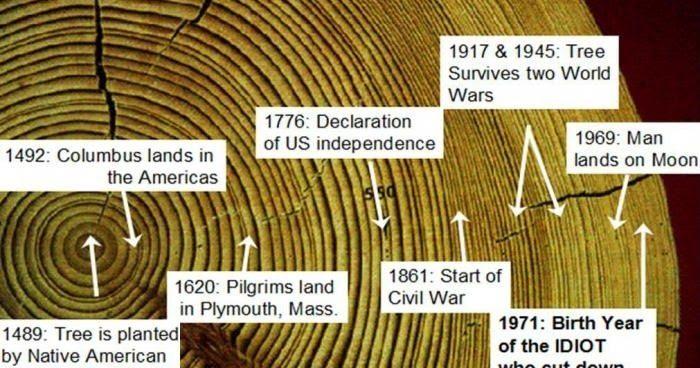
An Example of Tree Examination in América (Bizsiziz)
Tree rings can be regarded as an exceptionally detailed record quietly maintained by nature over time. Each ring reflects not only the biological development of the tree but also changes in environmental conditions, climatic fluctuations, and stress factors affecting the ecosystem. In this sense, tree rings serve as a valuable data source across many disciplines, from climatology and archaeology to environmental science and historical research. For scientists, they are a quantitative indicator of the past; for historians, a tool for chronological verification; and for nature observers, a fascinating biological phenomenon. Thus, dendrochronology is an interdisciplinary approach used to study human-nature interactions.
Voosen, Paul. “Tree Story Book Explores What Tree Rings Can Tell Us About the Past.” Science News. Accessed April 22, 2025.https://www.sciencenews.org/article/tree-story-book-explores-what-tree-rings-can-tell-us-about-past.
Witze, Alexandra. “Climate Change Made This Southwestern U.S. Drought the Worst in 1,200 Years.” Science News, February 14, 2022.https://www.sciencenews.org/article/climate-change-made-southwestern-u-s-drought-worst-1200-years.
Wohlleben, Peter. "A History of the World Written in Rings." Journal of Wild Culture. Accessed April 22, 2025.https://www.wildculture.com/article/history-world-written-rings/1865.

No Discussion Added Yet
Start discussion for "Tree Rings and Dendrochronology" article
The Origins of Dendrochronology
What Can We Learn from Tree Rings?
Techniques Used in Dendrochronology
Core Methods
The Role of Tree Rings in Historical Research
Ecosystem Monitoring and Environmental Surveillance
Scientific Applications
Reading Climate History Through Tree Rings
Examples