


This article was automatically translated from the original Turkish version.

Çamsakızı is a semi-transparent, resinous, and aromatic substance naturally obtained from the trunks of pine trees. It has been traditionally used in medicine, carpentry, cosmetics, and the arts. Particularly in regions of Türkiye such as Giresun, which are rich in pine forests, çamsakızı has been regarded as an important natural resource and has found application in various health practices. Thanks to its antibacterial and preservative properties, it has been used as a natural supportive agent in wound healing.
Giresun is a significant region for çamsakızı due to its abundant pine forests. Locals in Giresun have collected resin seeping from pine tree bark for various purposes. Specifically, çamsakızı was applied directly to minor cuts and wounds to reduce the risk of infection and support healing. This practice was passed down from generation to generation as part of nature-based traditional medical methods.
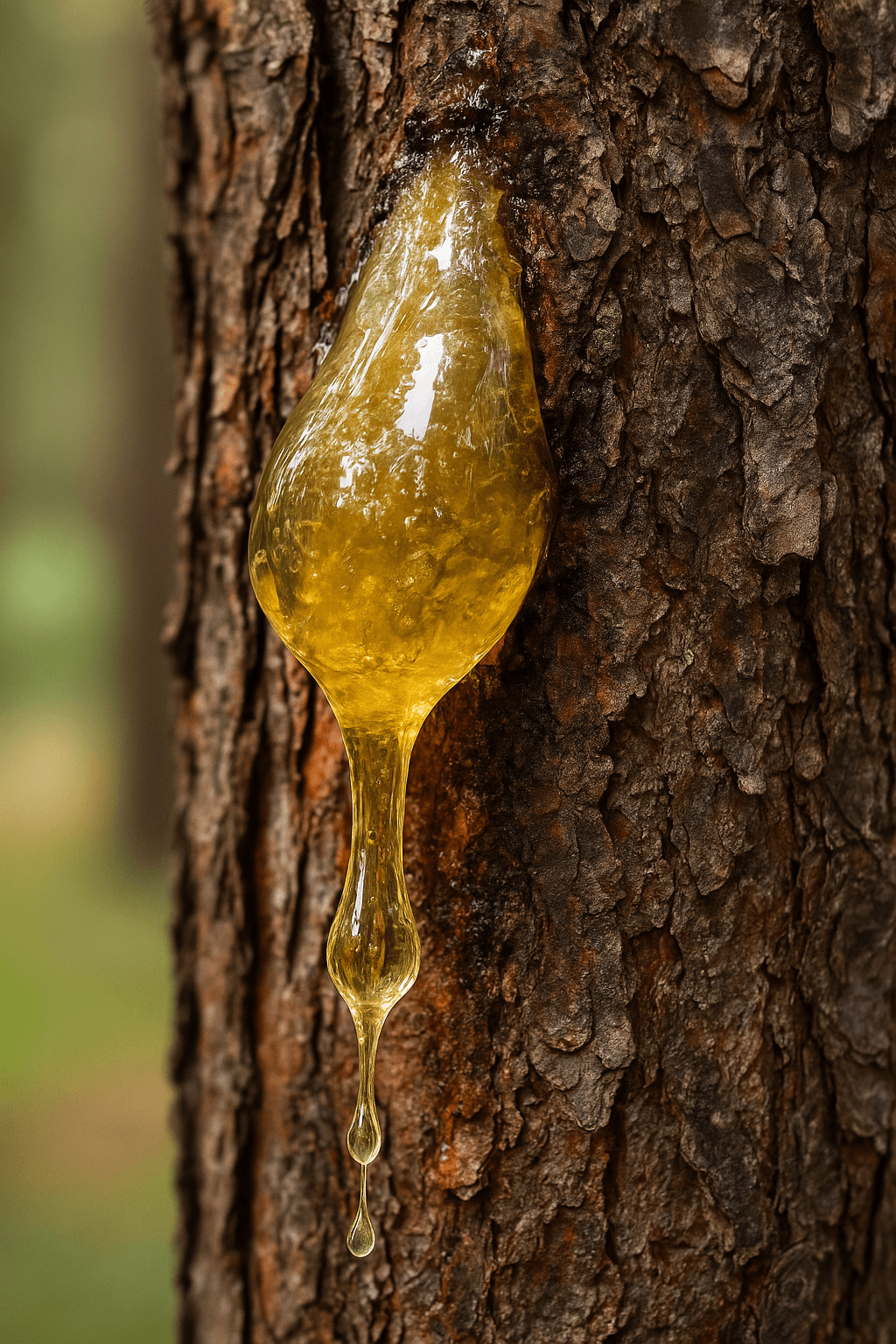
Pine resin (generated with the aid of artificial intelligence)
Çamsakızı contains natural compounds such as terpenes and resin acids. These substances give çamsakızı its distinctive aroma and stickiness. Its structure hardens over time, providing both physical and chemical protection. It is insoluble in water but soluble in organic solvents such as alcohol. Thanks to the volatile oils it contains, it is resistant to environmental conditions.
The most prominent biological property of çamsakızı is its antibacterial effect. The resin acids and volatile compounds it contains inhibit the growth of microorganisms, thereby reducing the risk of infection. In traditional applications, it was applied to open wounds to control infection and support the healing process. It is also known to have mild anti-inflammatory effects, playing a role in soothing skin irritations and minor inflammations. In the past, çamsakızı was chewed as a natural gum to help maintain dental health.
Throughout history, çamsakızı has been used in numerous different fields. In carpentry, it was employed as a natural adhesive for wooden work. It was applied to the bows of stringed musical instruments to increase friction. When burned as incense, it released a pleasant aroma that masked unpleasant odors and purified the air. In the cosmetics industry, it was used as a natural fragrance and preservative in products such as soap and perfume. In the past, it was also used in shipbuilding to coat wooden vessels, making them waterproof.
Warning: The content contained herein is provided solely for general encyclopedic informational purposes. The information presented here must not be used for diagnosis, treatment, or medical advice. Before making any decisions regarding health, you must consult a physician or qualified healthcare professional. The author and KÜRE Encyclopedia accept no responsibility for any consequences arising from the use of this information for diagnostic or therapeutic purposes.
Akbulut, S., and Z. C. Özkan. “Traditional Usage of Some Wild Plants in Trabzon Region (Turkey).” *Kastamonu University Journal of Forestry Faculty*, 2014, 135–145. Accessed May 21, 2025. https://www.researchgate.net/publication/284028180_Traditional_Usage_of_Some_Wild_Plants_in_Trabzon_Region_Turkey.
Di Lodovico, S., E. Napoli, E. D. Campli, and P. D. Fermo. “Pistacia vera L. Oleoresin and Levofloxacin Is a Synergistic Combination against Resistant Helicobacter pylori Strains.” *Scientific Reports* 9, no. 1 (2019): 4646. Accessed May 21, 2025. https://pubmed.ncbi.nlm.nih.gov/30874618/.
Ercanlı, İ. “Relationship between Site Index of Oriental Spruce [Picea orientalis (L.)].” *Scandinavian Journal of Forest Research* 23, no. 4 (2008): 319–329. Accessed May 21, 2025. https://www.researchgate.net/publication/233349425_Relationship_between_site_index_of_oriental_spruce_Picea_orientalis_L_Link_and_ecological_variables_in_Macka_Turkey.
Kültür, Ş., O. Altınbaşak, S. Anıl, and G. Melikoğlu. “Türkiye’de Mide Ülserinde Kullanılan Tıbbi Bitkiler.” *Marmara Pharmaceutical Journal* 22, no. 1 (2017): 1–14. Accessed May 21, 2025. https://jrespharm.com/uploads/pdf/pdf_MPJ_563.pdf.
T.C. Ministry of Agriculture and Forestry. *2020 Türkiye Orman Varlığı*. Ankara: T.C. Ministry of Agriculture and Forestry, 2020. Accessed May 21, 2025. .
Öz, M. “Chemical Composition and Antimicrobial Properties of Essential Oils Obtained from the Resin of Picea orientalis L.” *Journal of Essential Oil Bearing Plants*, 2022, 326–334. Accessed May 21, 2025. https://www.researchgate.net/publication/360813651_Chemical_Composition_and_Antimicrobial_Properties_of_Essential_Oils_Obtained_from_the_Resin_of_Picea_orientalis_L.
Use in Giresun
Properties
Biological Properties
Applications