


This article was automatically translated from the original Turkish version.
Transparent solar panels are innovative energy systems that generate electricity while allowing a specific portion of incoming light to pass through, thereby contributing to ambient lighting. Unlike traditional opaque photovoltaic panels, these panels offer versatile application potential in terms of both aesthetics and energy efficiency due to their ability to be integrated into architectural elements such as window glazing, building facades, greenhouses, and automotive glass. Developed as an alternative to conventional photovoltaic systems, this technology supports sustainable building applications that are compatible with urban architecture and aim to broaden energy production.
Transparent solar panels can generally be classified into two main structural types: semi-transparent and fully transparent. Their operating principle relies on transmitting a portion of visible light while absorbing infrared (IR) and ultraviolet (UV) wavelengths to generate electricity. Thanks to these properties, the panels maximize benefit from sunlight while maintaining electrical efficiency.
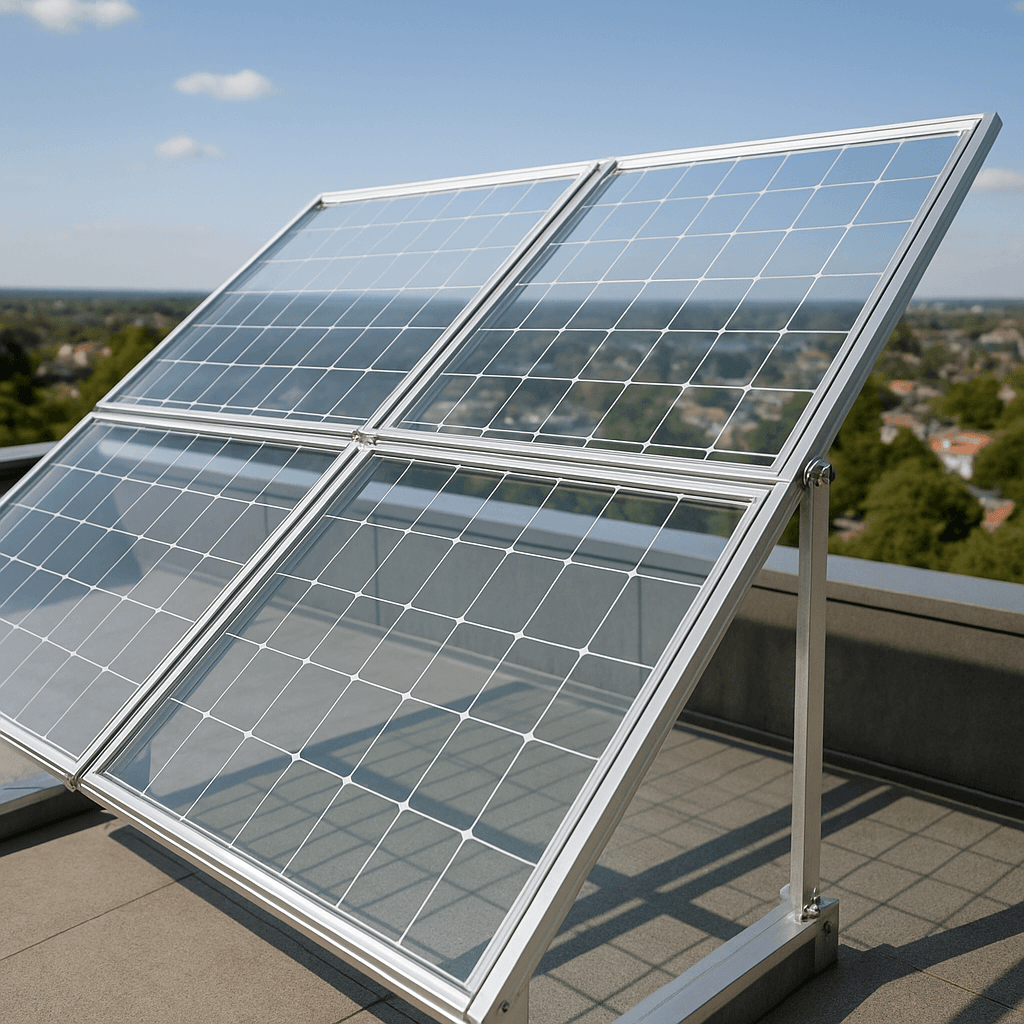
Şeffaf güneş panelleri. (Yapay zeka ile oluşturulmuştur.)
The efficiency of transparent panels is generally lower than that of conventional silicon-based systems. The primary reason is that these systems must allow part of the visible spectrum to pass through, resulting in a narrower active absorption area. However, this efficiency gap is being reduced through next-generation materials such as perovskites, hybrid nanostructures, and carbon nanotube additives, making commercialization of transparent panels increasingly feasible.
Transparent solar panels directly contribute to the concept of energy efficiency by generating power without occupying additional building envelope space. In particular, they reduce cooling loads and enhance energy independence in large-window commercial buildings. They also earn favorable points in green building certification systems such as LEED and BREEAM.
High-energy-consumption structures such as buildings in city centers, shopping malls, and transportation terminals are key target applications for these panels. Transparent solar panels enable the integration of renewable energy infrastructure without compromising urban aesthetics and can be combined with smart city applications.
Transparent solar panels align with modern design principles by enabling seamless aesthetic integration into architectural structures. They offer dual functionality by combining electricity generation with lighting. They are a suitable solution for overcoming space constraints in urban areas and enhancing energy efficiency in built environments. Additionally, by filtering infrared (IR) rays, they reduce heat buildup and thereby improve indoor comfort. This technology, compatible with smart city applications, can play a significant role in sustainable urban planning.
However, transparent solar panels face several challenges. Current systems typically have efficiencies ranging from 5% to 10%, which is lower than conventional panels. Additionally, some designs still lack full protection against environmental factors. High production costs remain another limiting factor for widespread adoption. Furthermore, sufficient long-term durability data on the materials used is not yet available, creating uncertainty regarding system lifespan and reliability.
Fthenakis, V., & Kim, H. C. (2010). Photovoltaics: Life-cycle analyses. *Solar Energy, 85*(8), 1609–1628.https://doi.org/10.1016/j.solener.2009.10.002Accessed May 19, 2025. Lunt, R. R., & Bulović, V. (2011). Transparent, near-infrared organic photovoltaic solar cells for window and energy-scavenging applications. *Applied Physics Letters, 98*(11), 113305.https://doi.org/10.1063/1.3567516Accessed May 19, 2025. TÜBİTAK Bilim Genç. Güneş Enerjisi.https://bilimgenc.tubitak.gov.tr/konular/gunes-enerjisiAccessed May 19, 2025. Yoon, S., Kang, M., & Kim, D. (2022). Recent advances in transparent solar cells: Materials and devices. *Nano Energy, 95*, 107052.https://doi.org/10.1016/j.nanoen.2022.107052Accessed May 19, 2025.

No Discussion Added Yet
Start discussion for "Transparent Solar Panels" article
Technological Structure and Operating Principle
Main Technologies Used:
Material Science and Efficiency Relationship
Energy Efficiency and Sustainability Impact
Application Potential in Urban Planning and City Transformation
Application Areas
Advantages and Challenges