


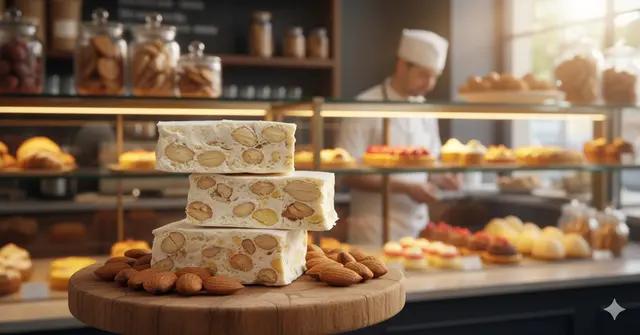
Torrone di Bagnara (Generated by Artificial Intelligence.)
Name(s) | Torrone di Bagnara | ||||||||
|---|---|---|---|---|---|---|---|---|---|
Category | Dessert/Nougat | ||||||||
Production Area | Bagnara Calabra, Reggio Calabria, Calabria Region Italy | ||||||||
Control Organization | AGROQUALITA' SPA | ||||||||
Torrone di Bagnara (Bagnara Nougat in English) is a traditional variety of nougat (halva) specific to the Bagnara Calabra commune, with IGP (Indicazione Geografica Protetta) status, meaning "Protected Geographical Indication" in Italian. It is produced mainly with honey, sugar, roasted shelled almonds, cinnamon and clove powder.
The production of Bagnara Nougat involves steps based on traditional methods and local craftsmanship. Key ingredients include sugar and citrus or kir/sulla honey (in varying proportions depending on the version), used for the nougat dough, as well as unshelled sweet almonds, cinnamon, and clove powder. The product contains no dyes or preservatives.
A crucial step in the production process is the direct cooking of the sugar mixture and almonds (in the Martiniana version) over high heat. The mixture is stirred to achieve the brown color known as "manto di monaco." Cooking continues slowly, allowing the mass to develop a brittle, glassy consistency ("rottura vitrea") when pressed at room temperature. Spices are then added and almonds are mixed in (in the Torrefatto glassato version). The homogenized mixture is poured into molds, cooled, and portioned. Finally, the nougat pieces are dipped in the prepared sugar syrup, and the excess sugar is drained off. The Martiniana version is immediately coated in sugar crystals while still hot, while the Torrefatto glassato version is finished by coating the bottom surface with cocoa syrup (nastratura) after it has dried, completing the glaze.
About Bagnara Nougat ( Oh Yum with Anna Olson )
The name Bagnara Nougat is reserved for the product obtained by cooking and processing only honey, sugar, roasted shelled almonds, cinnamon and clove powder, and topped with a coating of sugar crystals or bitter cocoa.
There are two main versions:
The distinctive qualities of Torrone di Bagnara stem from the historical, economic, and cultural ties it shares with its region of origin. The product's history began in the 1700s, when Bagnara's maritime trade contributed to the local production of almonds and honey, supplemented by imported sugar and spices. In the 19th century, its reputation was further enhanced by local "confectioners" like the Cardone family, who even became suppliers to the Royal Family of Savoia. Historical sources even recorded that Torrone di Bagnara "traveled the world and deserved this honor" in 1885. 【1】 From an economic perspective, production of the product has historically and continues to be a major source of economic activity and employment for the commune of Bagnara Calabra, creating what is known as the "Torrone di Bagnara District" and preserving the special artisanal techniques passed down through generations.
To maintain product quality, packaging must be completed within a maximum of four hours after cooling. This prevents bacterial contamination and prevents the product from absorbing moisture from the external environment, preserving its crispness and appearance. The product is marketed in packaging bearing the product logo "Torrone di Bagnara", "Indicazione Geografica Protetta" (or the abbreviation IGP) and/or the EU symbol, or in individually wrapped multipacks. The additional designations "Martiniana" or "Torrefatto glassato" are permitted, indicating the type of coating.
Verification of compliance with the Torrone di Bagnara IGP production specifications is carried out by an independent control body. The designated control body for this task is AGROQUALITA' SPA , based in Rome. Monitoring of every stage of production, documentation of inputs and outputs, registration of producers and packers on special lists, and timely reporting of produced quantities to the control structure are mandatory. This system guarantees end-to-end traceability of the product throughout the production chain.
MASAF – Ministry of Agriculture, Food and Forestry Policies. “Torrone di Bagnara (IGP)” MASAF . Retrieved October 21, 2025. https://www.masaf.gov.it/flex/cm/pages/ServeAttachment.php/L/IT/D/f%252Fd%252F3%252FD.9c2a341dc6b1dd6dacfe/P/BLOB%3AID%3D3347/E/pdf?mode=download
Oh Yum with Anna Olson. " Anna's INCREDIBLE Torrone Recipe!." Youtube . Accessed October 21, 2025. https://www.youtube.com/watch?v=-UlWbKq7GpA
Qualigeo. ''Torrone di Bagnara PGI''. Qualigeo. Accessed October 22, 2025. https://www.qualigeo.eu/en/product/torrone-di-bagnara-pgi/
[1]
MASAF – Ministry of Agriculture, Food and Forestry Policies, “Torrone di Bagnara (IGP)” page 5 MASAF, Retrieved October 21, 2025, https://www.masaf.gov.it/flex/cm/pages/ServeAttachment.php/L/IT/D/f%252Fd%252F3%252FD.9c2a341dc6b1dd6dacfe/P/BLOB%3AID%3D3347/E/pdf?mode=download

Torrone di Bagnara (Generated by Artificial Intelligence.)
Name(s) | Torrone di Bagnara | ||||||||
|---|---|---|---|---|---|---|---|---|---|
Category | Dessert/Nougat | ||||||||
Production Area | Bagnara Calabra, Reggio Calabria, Calabria Region Italy | ||||||||
Control Organization | AGROQUALITA' SPA | ||||||||
Production Method
Product Features and Types
Regional Ties
Packaging and Labeling
Control and Traceability
This article was created with the support of artificial intelligence.