This article was automatically translated from the original Turkish version.
+1 More
Title(s) | The Wedding of Dionysus (Dionysus and Ariadne) | ||||||||
|---|---|---|---|---|---|---|---|---|---|
Dimension(s) | 7.60 × 3.80 m | ||||||||
Material(s) | Natural stone and glass tesserae | ||||||||
Location | Dionysus Villa Zeugma Ancient City | ||||||||
Current Location | Gaziantep Zeugma Mosaic Museum | ||||||||
Technique | Opus tessellatum | ||||||||
Main Characters | Dionysus, Ariadne, Eros, Maenad, Satyr/Silenus | ||||||||
Historical Period | Roman Period (2nd–3rd century AD) | ||||||||
The Wedding of Dionysus Mosaic is an important floor mosaic dating to the Roman Imperial period, discovered in the Dionysus Villa within the boundaries of the ancient city of Zeugma in Gaziantep Province. The artwork is dated to between the 2nd and 3rd centuries AD and depicts the mythological marriage of the wine god Dionysus and Ariadne, the daughter of King Minos of Crete.
The mosaic was found in 2000 during rescue excavations at the ancient city of Zeugma, embedded in the floor of a reception room within the Euphrates Villa. The figurative panel, measuring approximately 7.60 x 3.80 meters, is not positioned at the geometric center of the space but rather at a location determined by the functional layout of the room. This placement demonstrates that the mosaic design was carefully adapted to the architectural function and spatial usage.
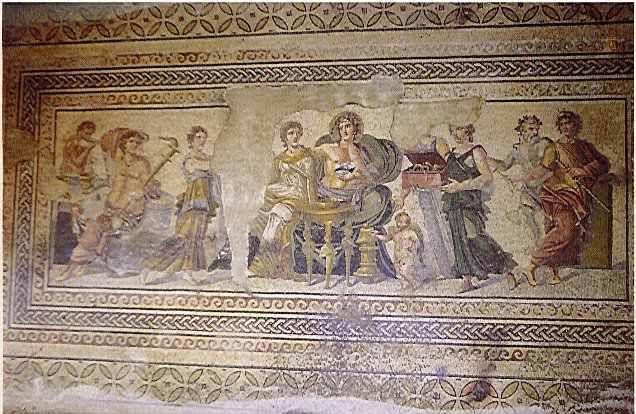
The mosaic features a total of ten figures arranged from left to right. Rather than a static portrayal, the scene presents a ceremonial narrative, creating a dynamic composition that evokes a mythological wedding procession.
At the center of the panel, within a architectural niche (aedicula), Dionysus and Ariadne are depicted seated side by side. Dionysus is shown wearing a headdress of flowers and leaves and draped in a himation. He is seated on a cushioned seat, resting his left elbow on it, and holds a silver bowl in his hand. The figure of Ariadne beside him is partially damaged; however, it is clear that she is dressed and that her veil has been lifted, representing the anakalypsis ritual, a key moment in ancient wedding ceremonies. Near the couple, the god of love Eros is depicted in child form, symbolizing the themes of love and union in their marriage.
On the left side of the composition, a standing male figure is shown drinking wine, while a seated Maenad holds a torch. The Maenad embodies the ecstatic, unrestrained and ritualistic atmosphere associated with the cult of Dionysus. On the right side of the scene, two female figures are shown moving leftward; one of them carries a gift box, directly referencing the wedding ceremony. At the far right, a woman plays double flutes, and behind her stands a bearded male figure with an uncovered upper body. These figures complete the festive atmosphere of the scene through music and entertainment.
The scene depicted in the mosaic represents the happy conclusion of Ariadne’s story in Greek mythology. Ariadne, daughter of King Minos of Crete, helped Theseus slay the Minotaur by giving him a thread to find his way out of the Labyrinth. However, Theseus abandoned her on the island of Naxos. According to myth, Dionysus found the deserted Ariadne, married her, and granted her immortality. The mosaic visually portrays this union as a divine wedding, emphasizing Ariadne’s transformation in fate.
The Wedding of Dionysus Mosaic is significant for illustrating how mythological themes were represented in domestic spaces during the Roman period. The arrangement of figures, the use of colored glass and stone tesserae, the architectural framing, and the iconographic details exemplify the techniques and design characteristics of Zeugma mosaic art. Through this mosaic, it becomes evident that themes of marriage, fertility, and happiness carried symbolic meaning within private living environments.
The mosaic has suffered partial damage due to fires and illegal excavations at the ancient city of Zeugma. Certain sections of the figurative panel have not survived intact. Today, the artwork is displayed at the Zeugma Mosaic Museum in Gaziantep and stands among the museum’s most notable examples, renowned for its Dionysian iconography and powerful mythological narrative.
Aslan, Hannan. *Zeugma Mozaik Müzesi’ndeki Dionysos Betimlemeleri.* Gaziantep Üniversitesi Arkeoloji, 2017. Accessed January 15, 2026. https://www.academia.edu/30966145/Zeugma_Mozaik_M%C3%BCzesindeki_Dionysos_Betimlemeleri
Barsanti, Claudia. “The Fate of the Antioch Mosaic Pavements: Some Reflections.” JMR 5, (2012): 25-42. Accessed January 15, 2026. http://arkeoloji.uludag.edu.tr/JMRe/documents/JMR%205.pdf.
Gaziantep İl Kültür ve Turizm Müdürlüğü. "Dionysos’un Düğünü." Zeugma.org.tr. Accessed January 15, 2026. https://zeugma.org.tr/portfolio/dionysos-un-dugunu/.
Güneydoğu Anadolu Projesi Bölge Kalkınma İdaresi Başkanlığı. "Zeugma Antik Kenti Acil Kazı ve Kurtarma Çalışmaları." GAP.gov.tr. Accessed January 15, 2026. https://www.gap.gov.tr/sayfa/plan-ve-program/programlar/kultur-ve-turizm-projeleri/tamamlanan-projeler/zeugma-antik-kenti-acil-kazi-ve-kurtarma-calismalari/
Önsoy, Demet. "ANADOLU’NUN KÜLTÜREL MİRASI MOZAİKLER VE TURİZM." Master's thesis, İstanbul Üniversitesi, 2021. Accessed January 15, 2026. https://nek.istanbul.edu.tr/ekos/TEZ/ET002693.pdf.

Title(s) | The Wedding of Dionysus (Dionysus and Ariadne) | ||||||||
|---|---|---|---|---|---|---|---|---|---|
Dimension(s) | 7.60 × 3.80 m | ||||||||
Material(s) | Natural stone and glass tesserae | ||||||||
Location | Dionysus Villa Zeugma Ancient City | ||||||||
Current Location | Gaziantep Zeugma Mosaic Museum | ||||||||
Technique | Opus tessellatum | ||||||||
Main Characters | Dionysus, Ariadne, Eros, Maenad, Satyr/Silenus | ||||||||
Historical Period | Roman Period (2nd–3rd century AD) | ||||||||
No Discussion Added Yet
Start discussion for "The Wedding of Dionysus Mosaic" article
Location and Discovery
Depiction and Figure Analysis
Mythological Background
Cultural and Artistic Significance
Current Status