


This article was automatically translated from the original Turkish version.
+1 More
Aşık atışması is a spontaneous poetry and music competition typically performed by two or more aşıks accompanied by the saz, and forms part of Turkish folk literature and musical tradition. This practice has played a central role for centuries in the transmission of oral culture, the reinforcement of social values, and the demonstration of individual talent.
Known in different regions by various names such as deyişme, "karşılama", "karşıberi", "söyleşi", "bağlama", "müşaare", and "tekellüm", it fundamentally revolves around the challenge between aşıks testing each other’s poetic and instrumental skill.
The origins of the aşıklık tradition are believed to stem from ancient Turkish belief and artistic practices such as shamanism, bahşılık, and ozanlık. In these early periods, shamans and ozans were recognized as spiritual and cultural leaders of their communities, preserving collective memory through the recitation of epics and poetry.【1】 Aşık atışması is thought to have gradually developed as a continuation of this oral tradition, acquiring a distinct structure within the Anatolian region.
Throughout history, it has been intertwined with religious and ritualistic elements while also persisting as a form of entertainment. By adapting to social changes, it has survived through the efforts of saz poets and enriched itself through elements of diverse cultural environments.
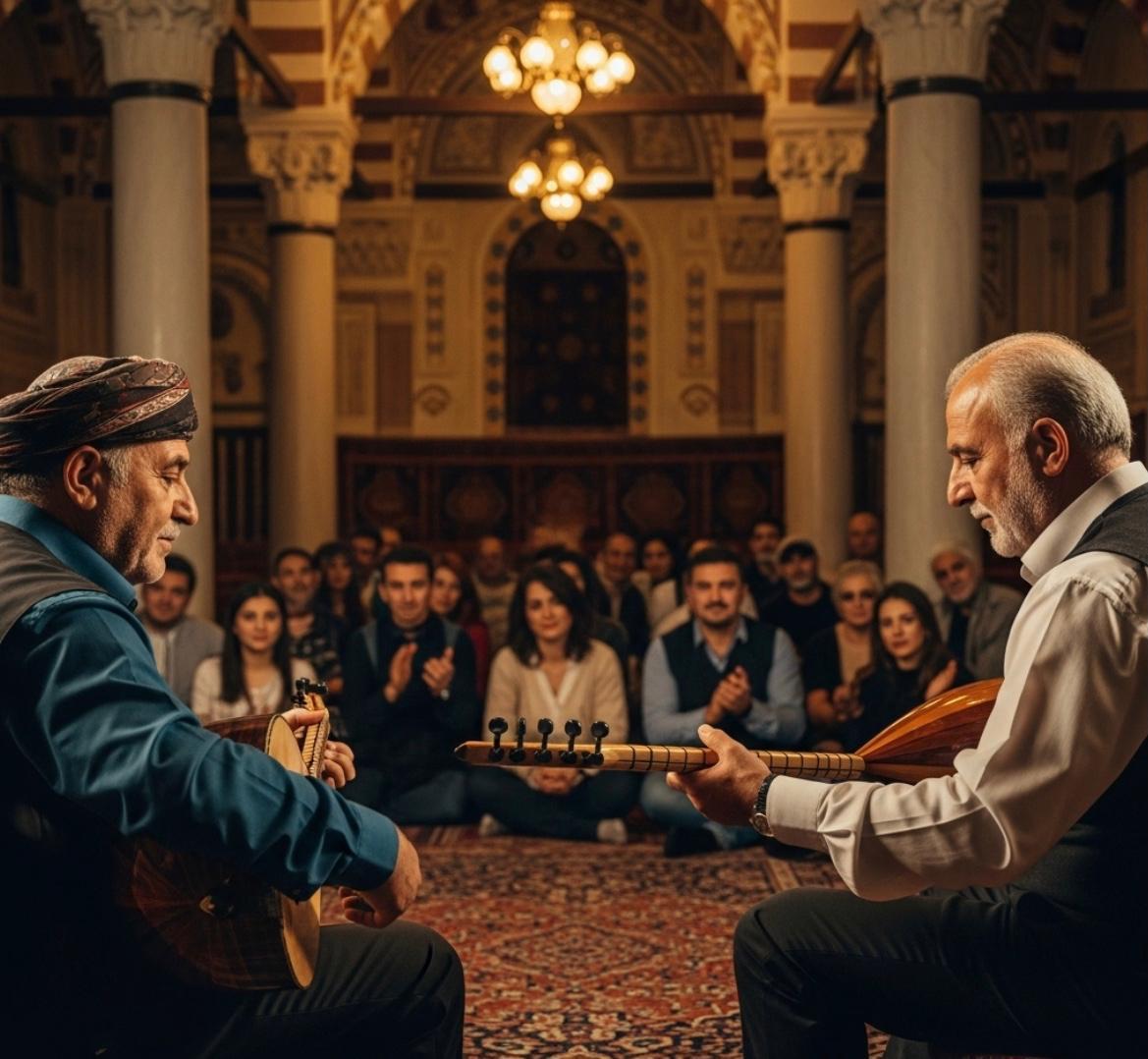
Aşık Atışması Görseli (Yapay zekâ ile oluşturulmuştur)
Aşık atışmaları are typically performed in front of an audience and follow established principles. The primary aim of these competitions is for aşıks to demonstrate their poetic intelligence, improvisational ability, knowledge base, and mastery of the saz.
While these competitions generally follow a systematic flow, spontaneous moments may also arise. Some of the common poetic forms and techniques used in atışmalar include:
Success in aşık atışması is not merely a matter of correct rhyme and meter; it also requires the ability to think quickly, respond cleverly, captivate the audience, and outwit one’s opponent.
Lebdeğmez Atışması (TRT Archive)
Aşık atışması is a complex oral performance that demands high-level cognitive skills. During these competitions, aşıks actively employ the following abilities:
These cognitive skills demonstrate that aşık atışması is more than mere entertainment—it is a mental exercise and an intellectual challenge.
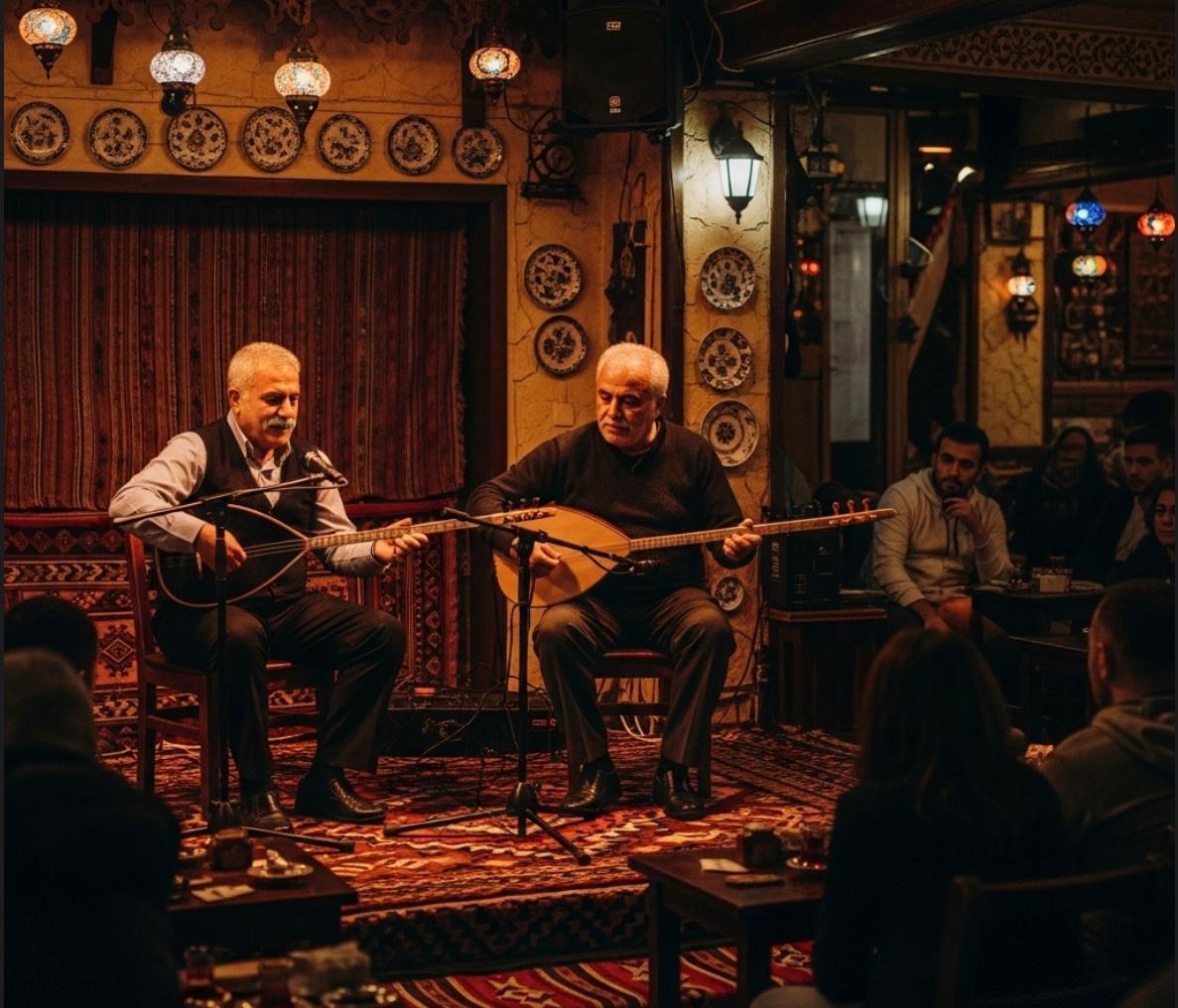
Aşık Atışması Görseli (Yapay zekâ ile oluşturulmuştur)
The aşıklık tradition and aşık atışması continue to be vital elements of Türkiye’s cultural ecology. However, the sustainability of this tradition today depends on socio-cultural context, audience engagement, economic support, and patronage.
While the survival of traditional arts faces challenges in the face of modernization and media culture, aşık atışması is still kept alive in certain regions and cultural events. Festivals, celebrations, and gatherings of folk poets play a crucial role in transmitting this tradition to new generations.
The aşık atışması tradition continues its efforts to adapt to changing times and ensure its transmission into the future.
Artun, Erman. “Çukurova Âşıklık Geleneğinde Atışma.” *Folklor/Edebiyat* 19, no. 75 (2013): 73–116. Accessed June 15, 2025.https://turkoloji.cu.edu.tr/HALK%20EDEBIYATI/erman_artun_cukurova_atisma.pdf
Kölbaeva, Meerim, and Hüseyin Satıcıoğlu. Tradition of Minstrelsy in Turkic Peoples / Türk Halklarında Âşık Atışması Geleneği. Selçuk Türkiyat, August 2024, (62): 285–298. Accessed June 15, 2025.https://dergipark.org.tr/tr/download/article-file/4168112
Sevindik, Azem. Âşıklık Geleneğinin Güncel Durumu ve Âşıklar Üzerine Bazı Tespitler / Current State of Minstrel Tradition and Some Evaluations on the Minstrels. SUTAD, December 2019, (47): 127–144. Accessed June 15, 2025.https://dergipark.org.tr/en/download/article-file/1494285
TRT Arşiv. “Dudak Değmez Geleneği.” YouTube. Accessed June 15, 2025.https://www.youtube.com/watch?v=FzJtr8Km0VM
Ulusoy, Asuman. Âşık Atışmalarındaki Üst Düzey Düşünme Becerilerine Bir Bakış: Şeref Taşlıova Örneği. IJHE, Volume 10, no. 23 (2024): 534–573. Accessed June 15, 2025.https://dergipark.org.tr/tr/download/article-file/3957990
Çelik, Aşkın. “Ulusal Tez Merkezi Özelinde Anadolu Âşıklık Geleneğiyle İlgili Yapılmış Lisansüstü Çalışmaların Yöntem Bilimsel Açıdan İncelenmesi.” Journal of Social, Humanities and Administrative Sciences, e-ISSN: 2630-6417. Accessed June 15, 2025.https://journalofsocial.com/files/josasjournal/81638652-dcee-451b-a339-cf509cdef9c8.pdf
[1]
Kölbaeva, Meerim, ve Hüseyin Satıcıoğlu.Tradition of Minstrelsy in Turkic Peoples / Türk Halklarında Âşık Atışması Geleneği.Selçuk Türkiyat, Ağustos 2024, (62): 285–298. Sayfa 285.Erişim 15 Haziran 2025. https://dergipark.org.tr/tr/download/article-file/4168112.

No Discussion Added Yet
Start discussion for "The Tradition of Aşık Atışması" article
Origins and Evolution of Aşık Atışması
Structure and Rules of Aşık Atışması
Cognitive Skills in Aşık Atışması
Current Status and Future of Aşık Atışması