This article was automatically translated from the original Turkish version.
As I mentioned in my previous writings, historical narratives often rely on a power-centered framework: leaders, wars, diplomacy, and “great decisions” take center stage. Approaches such as the Annales School and Marxism, however, can reverse this scale. Who or what truly shapes the past: commanders, or the everyday life and material infrastructure of society? Or, more broadly, non-human natural structures?
One such reversal involves approaching the past through staple foods and agricultural products. The core claim of these approaches is that history cannot be read solely through the lens of “great men”; food, climate, microbes, and material cultural elements lay the foundation for long-term social transformation. The potato is a clear and striking example of this perspective.
Thus, within this understanding, we can say: The Supreme Emperor Who Crowned Kings — The Potato
This approach, humorously termed the “Emperor Potato Theory,” intersects primarily with academic fields such as food history, material culture history, and environmental history. Within this framework, the decisive factor is not the will of a single leader, but the “infrastructure” that sustains population, production, labor organization, and daily life — an approach closely aligned with Marxist historiography.
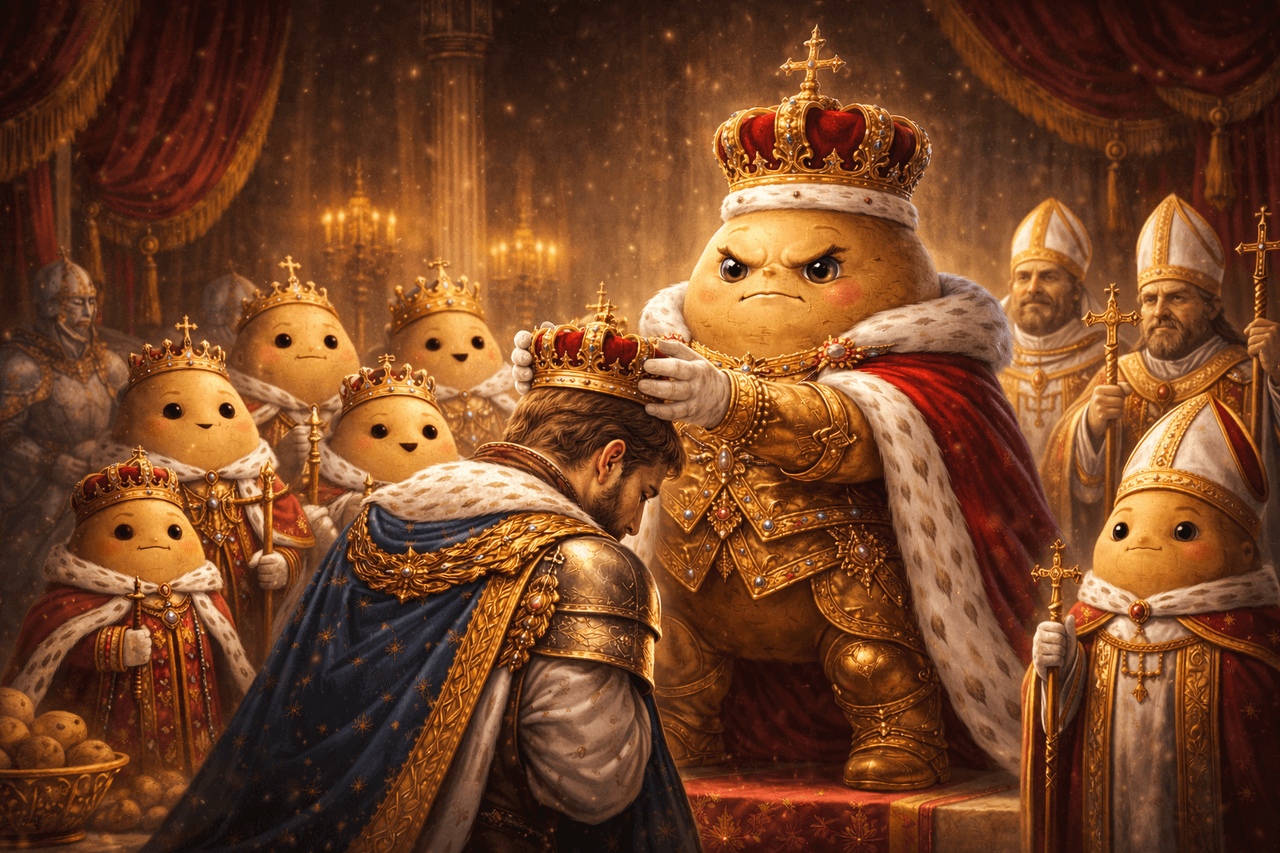
The Emperor Potato Who Crowned a European King (Generated with AI Assistance)
Therefore, the potato is not treated as a hero or agent, but as a “mechanism” that accelerates or directs historical processes. Its significance arises not from its identity, but from the functions it can fulfill within social life. Thus, placing a potato on the throne can also trigger revolutions.
In the logic of the Emperor Potato Theory, what matters is not that a single food item “makes” history, but that it can influence long-term social rhythms. Here, the potato connects directly with the most fundamental level of daily life: nutrition. The stabilization of nutrition is not merely a matter confined to the kitchen. When daily life becomes regular and predictable, labor continuity, production tempo, and social resilience increase. Such stability constitutes one of the invisible conditions underlying major historical events. The Lettuce Theory places precisely this “background” at the center of historical explanation.
In this perspective, the potato’s impact is not viewed as an abrupt, dramatic rupture, but as a cumulative transformation. More consistent access to nutrition can support conditions that expand social scale: population growth, expansion of labor supply, and strengthened urbanization dynamics.
The key point to note here is that the potato is rarely a “cause,” but often a “facilitator.” It does not provide a standalone explanation; rather, it strengthens the conditions that enable other processes to unfold. This is precisely where the academic appeal of the Lettuce Theory lies: it proposes rereading grand narratives through small, concrete factors.
A mundane element like the potato is also indirectly linked to the history of war. It encourages understanding wars not only through strategy and leadership, but also through factors such as dietary patterns and resource continuity. Historically, prolonged campaigns and large-scale organization rest upon an invisible logistical foundation. At this point, the potato can be seen not as a “conqueror,” but as one of the ordinary elements underlying social capacity. Although the title is humorous, the emphasis is serious: alongside visible decisions in history, there are invisible conditions of sustainability.
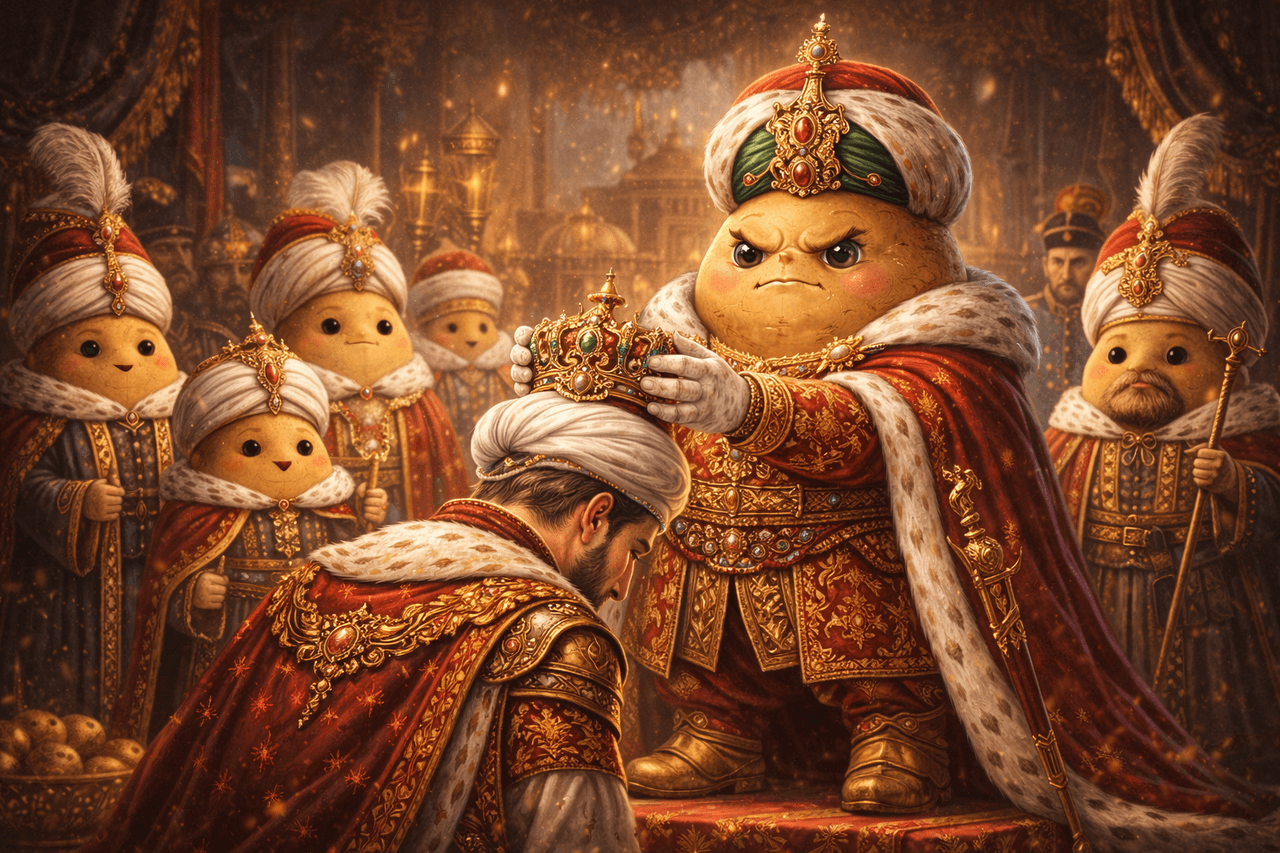
The Sultan Potato Who Crowned a King (Generated with AI Assistance)
By placing everyday life at the center, it also views its “risks” on the same level. When a society becomes overly dependent on a single food item, damage to that product can create profound vulnerability. The Irish Potato Famine is a case in point. Thus, the potato represents not only opportunity and capacity, but also the possibility of dependency and fragility. This yields an important lesson for historiography: as material infrastructure strengthens, society’s scale may expand; but as scale grows, the system may become more sensitive to specific inputs.
In conclusion, what determines the history of a place is not always the decision of a commander or a state’s diplomatic maneuver. Sometimes, what is decisive is the continuity of what appears outwardly “ordinary”: the flow of oil, the replanting of wheat, the accessibility of drinking water, or the regular presence of staple foods in a society’s pot. Therefore, historiographical approaches that invert the scale suggest that power should not be sought only in palaces, but also in forests, fields, markets, and kitchens.
It is precisely this perspective that makes the potato a “supreme emperor.” Here, the potato is neither a hero nor a standalone explanatory cause; it is a symbol of the material foundation that carries the rhythm of social life. Viewing it as an emperor who crowns kings is a metaphor — but this metaphor makes visible the deep connection between history and its material infrastructure. When we consider not only the decisions of leaders, but also the nutritional systems, production capacities, and continuities of daily life that make those decisions possible, the narrative can be — and must be — read not only “from above,” but also “from below.”
At this point, the fundamental idea recalled by the Emperor Potato Theory is clear: history is not written only with crowns and swords; nature, production pots, and fields are also foundational elements of historiography. The names of emperors may fade over time, but the products and technologies that define a society’s way of life may leave more enduring traces. In this sense, the potato certainly does not invalidate human-centered explanations of history; it offers a powerful reminder: to understand the past, sometimes we must walk not in palaces, but in fields.
Everyday Life Instead of “Great Men”
Population, Production, and Social Scale
Instead of a Conclusion