This article was automatically translated from the original Turkish version.
When we lift our heads to the night sky, we encounter a dark void. Aside from a few twinkling stars, and if we are lucky, a planet or perhaps a satellite, there is vast darkness. At first glance, the reason for this seems simple: sunlight does not reach the side of Earth facing away from the Sun, so the sky appears dark. But the truth is far deeper and more thought-provoking.
This question—“Why is the night sky dark?”—has occupied curious minds and scientists for centuries. This mystery is known in the history of science as the Olbers Paradox.
According to the Olbers Paradox, if the universe is sufficiently large, timeless (without a beginning), and homogeneous—that is, filled with stars uniformly in every direction—the night sky should not be dark but brightly illuminated.
Consider this: no matter which direction we look in space, there must surely be a star far enough away. Nearby stars appear brighter, but distant stars are far more numerous. In fact, as distance increases, the number of stars increases because the surface area expands. Due to this balance, the amount of light reaching Earth from stars at any given distance appears constant. Therefore, every point in the sky should glow as if covered by a star. Yet we see darkness. This contradiction lies at the heart of the Olbers Paradox.
One of those who pondered this paradox was the American writer Edgar Allan Poe. According to Poe, the sky is dark because we cannot see the entire universe. If light travels at a finite speed through space and the universe has a beginning, then there may be stars whose light has not yet reached us. Even if space is infinite, the observable universe is limited. Poe’s interpretation was remarkably accurate: yes, the distance light can travel is finite, and the age of the universe sets this limit. Yet this alone does not fully resolve the paradox.
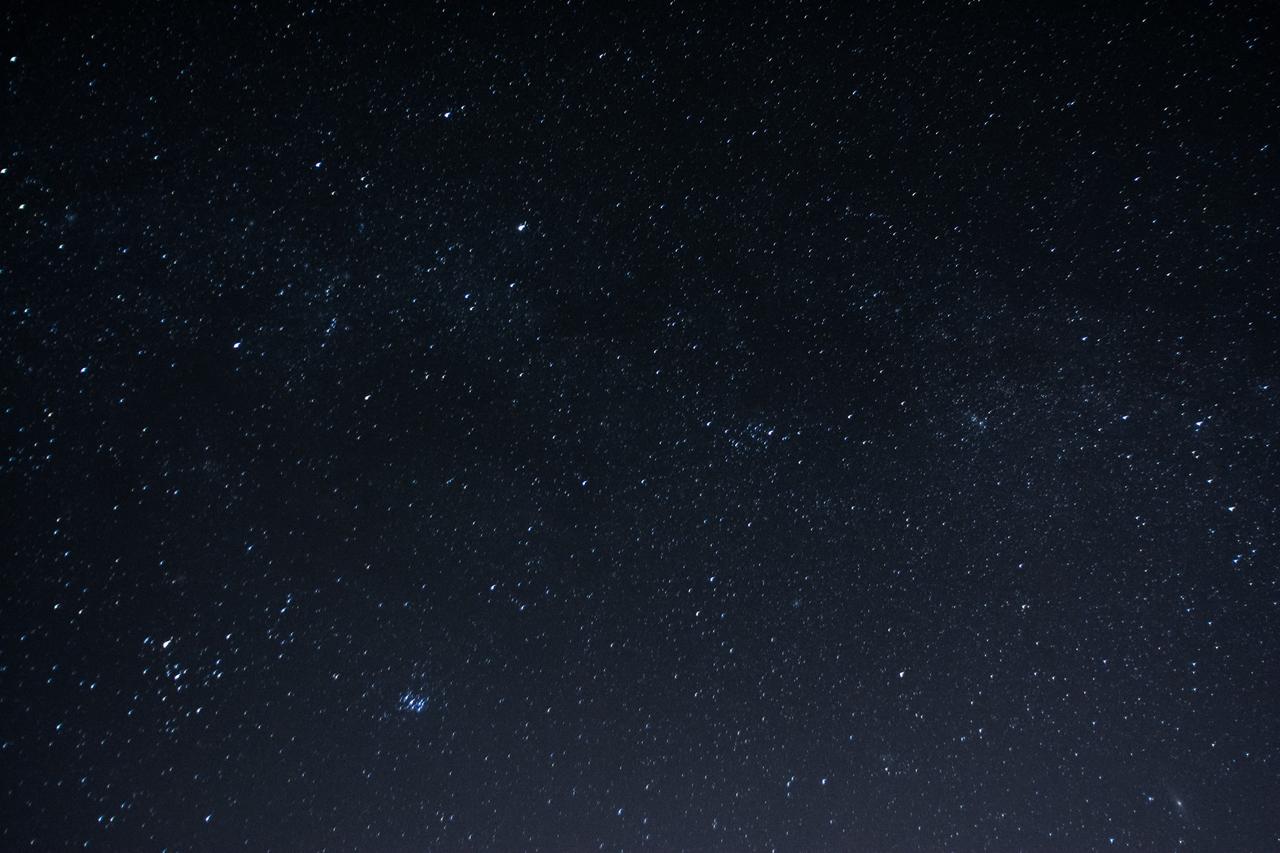
Stars, the Milky Way, Space (pixabay)
When we look back into the history of the universe, another crucial fact emerges: the Big Bang. In the earliest moments of the universe, temperatures were so high that intense light existed everywhere. If traces of that era still existed, should we not see that light when we look at the sky today?
In fact, we do see it—but not with the naked eye. The universe is expanding, and this expansion has stretched the wavelength of that ancient light. It has shifted into wavelengths too long for our eyes to detect: the microwave region. This radiation is now known as the cosmic microwave background radiation. It can be measured with specialized telescopes, but our eyes perceive it as darkness.
In short, the reasons the night sky is dark are not simple, but they are profound: the universe has a finite age, so light from every star has not yet reached us. The universe is expanding, shifting the light from the early era into the microwave range, beyond our visual perception. For this reason, the night sky appears calm, dark, and mysterious. In truth, darkness is merely a product of our perception. The sky is filled with the light of the past—but that light is now too distant and too faint for our eyes to see.
Gürel, Hasan. “Güneş Parlak Olmasına Rağmen Uzay Neden Karanlıktır?” BilimUP, August 7, 2025. https://www.bilimup.com/gunes-parlak-olmasina-ragmen-uzay-neden-karanliktir
Ocak, Mahir E. “Uzay Neden Karanlıktır?” TÜBİTAK Bilim Genç. Accessed August 7, 2025. https://bilimgenc.tubitak.gov.tr/makale/uzay-neden-karanliktir.
Pixabay. "Yıldızlar Gökada Uzay Astronomi." Pixabay, Accessed August 7, 2025. https://pixabay.com/tr/photos/y%C4%B1ld%C4%B1zlar-g%C3%B6kada-uzay-astronomi-2617438/.
Olbers Paradox: A Vast Universe, Vast Light?
Poe’s Interpretation: Not Every Star Emits Light We Can See
The Big Bang and the Expanding Universe
Darkness Is What Our Eyes Can See