


The Stag Hunt Model is a metaphor used in international relations to understand the security dilemma and cooperation problems. The story describes a primitive group of hunters living on an isolated island. These hunters believe that if they successfully hunt a stag, they will have enough food to feed everyone, and they decide to cooperate to achieve this. Hunting the stag requires everyone to give their full effort and act collectively.
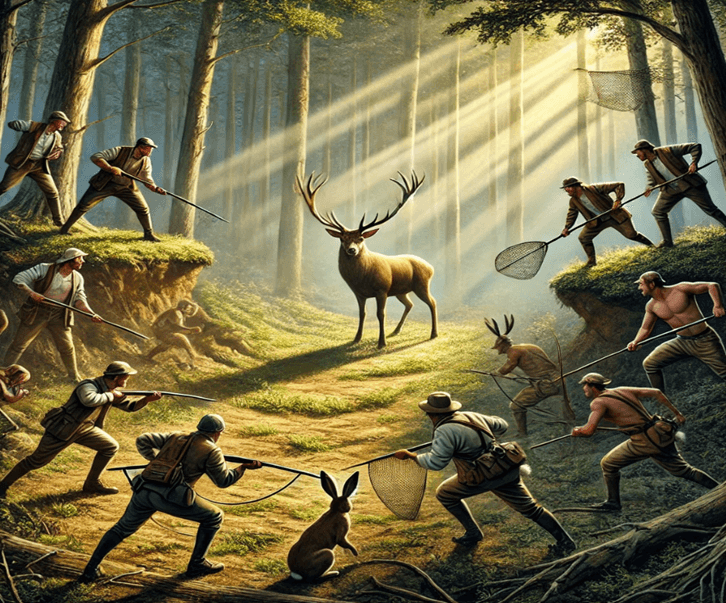
Illustration of Stage/Hare Analogy (Source: Artificial Intelligent)
However, during the hunt, one of the hunters spots a rabbit. The rabbit would only be enough to satisfy their own hunger and catching it would guarantee an immediate reward. This hunter abandons the stag hunt to pursue the rabbit. By doing so, they cause the stag to escape, leaving the rest of the group hungry. If cooperation had been maintained, all the hunters would have been fed, achieving the best outcome. However, the hunter is uncertain whether the group will successfully catch the stag or whether another hunter might abandon the effort to chase a rabbit. In this uncertainty, acting in self-interest appears to be rational behavior.
The stag/rabbit analogy highlights that under conditions of uncertainty (i.e., anarchy), acting individually and pursuing self-interest is rational. In this context, the tragedy of international relations lies in the inability to guarantee cooperation, even when mutual interests are at stake, preventing the achievement of shared benefits.
The story illustrates situations in the international system where states prioritize their individual interests over cooperation due to a lack of trust and uncertainty about the actions of others. Particularly in the context of the security dilemma, this helps explain the competitive behaviors of states driven by mutual distrust.
In game theory, the Stag Hunt is a model that defines the conflict between security and social cooperation. This game is also referred to by other names: "assurance game," "coordination game," and "trust dilemma."
The basic dynamics of the game are as follows:

Table of Stag Hunt Payoffs
As shown in the table, if the first player chooses the stag and the second player also chooses the stag, both receive a payoff of 5. However, if the first player hunts the rabbit while the second player decides to hunt the stag, the first player earns 4, and the second player earns 0, leading to similar outcomes in other cases.
In international relations, this model explains situations where states must cooperate for mutual benefits. However, such cooperation is only possible under conditions of high trust and coordination. If one party believes others will not cooperate, it may prioritize short-term individual interests instead.
"The Stag Hunt Game Theory." iMotions (blog). Accessed January 17, 2025. https://imotions.com/blog/learning/research-fundamentals/the-stag-hunt-game-theory/.
"Uses of Game Theory in International Relations." The Theory of Networks (blog). February 11, 2013. Accessed January 17, 2025. https://tuecontheoryofnetworks.wordpress.com/2013/02/11/uses-of-game-theory-in-international-relations/.
Arı, Tayyar. Uluslararası İlişkiler Teorileri: Çatışma, Hegemonya, İşbirliği. İstanbul: MKM Yayıncılık, 2013.
Steans, Jill, Lloyd Pettiford, and Thomas Diez. Introduction to International Relations: Perspectives and Themes. 2nd ed. London: Routledge, 2005.

No Discussion Added Yet
Start discussion for "The Stag/Hare Analogy" article
The Stag Hunt in the Context of Game Theory
The Stag Hunt Model in the Context of International Relations
Examples of Scenarios
Environmental Agreements:
Disarmament and Security:
Trade Cooperation:
This article was created with the support of artificial intelligence.