This article was automatically translated from the original Turkish version.
+1 More
Original Name | The Seventh Seal | ||||||||
|---|---|---|---|---|---|---|---|---|---|
Director | Ingmar Bergman | ||||||||
Screenwriter | Ingmar Bergman | ||||||||
Duration | 96 Minutes | ||||||||
Release Year | 1957 | ||||||||
Genre | Philosophical Drama Fantasy | ||||||||
Country | Sweden | ||||||||
Language | Latin Swedish | ||||||||
Award | 1957 Cannes Film Festival Jury Special Prize | ||||||||
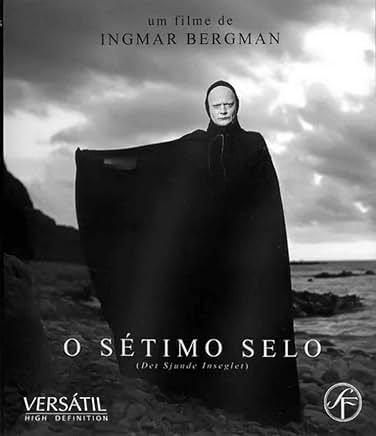
The Seventh Seal (original title: Det Sjunde Inseglet) is a 1957 Swedish film written and directed by Ingmar Bergman. Set in medieval Sweden during a plague outbreak, the film follows a knight returning from the Crusades who plays chess with Death to gain time and grapples with existential themes such as God, faith, the meaning of life, and death. Named after the seventh seal from the Book of Revelation in the Bible, which heralds the apocalypse, the film is regarded as one of the most important and influential masterpieces in cinema history.
The Seventh Seal Trailer (HD Retro Trailers)
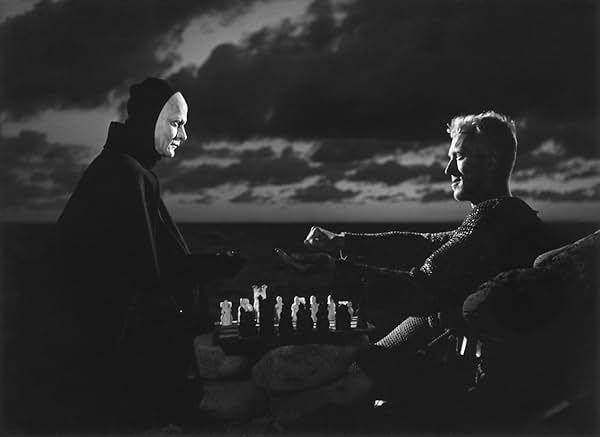
The film opens with a gloomy sky and a drifting bird. The knight Antonius Block and his pragmatic, materialist squire Jöns return to Sweden from the Crusades, disillusioned and with their faith shaken. They encounter a world ravaged by plague. One morning on the shore, Block meets Death, who has come for him. Hoping to gain time and perform a meaningful act, Block challenges Death to a game of chess: if Death wins, Block will die; if Block wins, he will be set free. This symbolic chess game continues throughout the film and becomes the foundation of the knight’s existential quest.
During their journey, Block and Jöns encounter various characters: a gentle and loving family of traveling actors, Jof and his wife Mia with their son Mikael; a young mystic girl condemned to be burned at the stake by religious and political authorities who accuse her of consorting with the devil; and a devout community that whips itself in the name of protection against the plague. These characters represent different ways of living, believing, and existing.
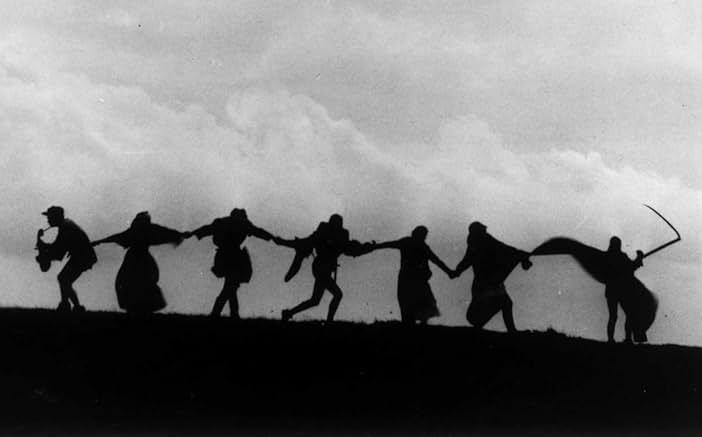
The film concludes with Block’s arrival at his castle and his final chess match with Death. Block knowingly loses, allowing Jof, Mia, and Mikael to escape. In the final scene, Death leads Block and his companions away in a “dance of death,” while the artist family continues their journey toward a sunlit horizon, symbolizing hope and life.
Filmden Bir Kesit (IMDb)
The Seventh Seal centers on existential questioning. Knight Antonius Block harbors deep doubts about God’s existence, silence, and the meaning of life. The brutality he witnessed during the Crusades has shattered his faith. Throughout the film, he seeks “knowledge,” searching not for blind belief but for concrete, rational proof of God’s presence. He expresses this quest in dialogues with Death and the condemned girl. Bergman was influenced by 20th-century existentialist philosophy, particularly Nietzsche’s declaration that “God is dead.”
Death is portrayed as a tangible character (played by Bengt Ekerot). Block’s chess match with Death is a powerful allegory for humanity’s attempt to delay and confront its inevitable end. This metaphor is also interpreted as Bergman’s own struggle with his fear of death. The film presents various responses to death: Block’s intellectual resistance, Jöns’s cynical acceptance, the devout’s terror, and the girl’s mystical surrender.
The film examines different models of individual-God relationships found in theistic religions through its characters:
The family of Jof, Mia, and Mikael serves as a source of hope and vitality against the film’s gloomy and pessimistic atmosphere. In the scene where Block drinks the wild strawberries and milk offered by Mia, he experiences genuine peace and happiness for the first time. This moment underscores the importance of simple human joys and love beyond intellectual inquiry. Art (Jof’s visions and performances) and familial love are presented as forms of resistance against meaninglessness and death.
Filmden Bir Kesit (IMDb)
Bergman stated that the film’s inspiration came from a 15th-century wall painting by Albertus Pictor in Täby Church in Sweden, depicting a man playing chess with Death. Shot in black and white, the film employs a strong visual language characterized by intense interplay of shadow and light. The knight’s black cloak and the composition of scenes emphasize the film’s allegorical and spiritual atmosphere. The contrast between the opening gloomy sky and the final bright, hopeful scene visually reinforces the film’s thematic transition.
The Seventh Seal is recognized as one of the pioneering films in cinema history to explore philosophical themes. It won the Special Jury Prize at the 1957 Cannes Film Festival and established Bergman’s international reputation. The final scene, in which Death leads the knight away in a “dance of death,” has become one of the most iconic moments in film history. The film is frequently referenced in academic studies on existentialism, philosophy of religion, and death, and consistently appears on lists of “films to see before you die.” Traces of Bergman’s personal conflicts with authority, religion, and the figure of the father are also evident in the film.
Beyazperde. “Yedinci Mühür (The Seventh Seal).” Beyazperde. Accessed October 10, 2025.https://www.beyazperde.com/filmler/film-548/
GZT. "Yedinci Mühür." *Cins.* Accessed October 10, 2025.https://www.gzt.com/cins/yedinci-muhur-3486265
HD Retro Trailers. “The Seventh Seal (1957) ORIGINAL TRAILER [HD 1080p].” YouTube video. Accessed October 10, 2025.https://www.youtube.com/watch?v=vZucwtdSvJ8
IMDb. “The Seventh Seal (1957).” IMDb. Accessed October 10, 2025.https://www.imdb.com/title/tt0050976/
Küçükhemek, Murat. “İnanmak mı, Bilmek mi? Yedinci Mühür Filminde Birey–Tanrı İlişki Biçimleri.” SineFilozofi 6, no. 11 (2021): 22–50.https://doi.org/10.31122/sinefilozofi.872059

Original Name | The Seventh Seal | ||||||||
|---|---|---|---|---|---|---|---|---|---|
Director | Ingmar Bergman | ||||||||
Screenwriter | Ingmar Bergman | ||||||||
Duration | 96 Minutes | ||||||||
Release Year | 1957 | ||||||||
Genre | Philosophical Drama Fantasy | ||||||||
Country | Sweden | ||||||||
Language | Latin Swedish | ||||||||
Award | 1957 Cannes Film Festival Jury Special Prize | ||||||||
No Discussion Added Yet
Start discussion for "The Seventh Seal (Film)" article
Plot
Themes and Symbolism
Existential Inquiry and the Search for God
Confronting Death
Forms of Individual-Deity Relationships
Art, Love, and the Simple Joys of Life
Production and Cinematography
Characters
Influence and Legacy