This article was automatically translated from the original Turkish version.
“Did I really deserve this success? No, no—it was pure luck…”
“I’m not actually that good…”
Think about it… You’ve been working for years. Theses, papers, experiments, presentations… You’re praised, invited to events, talked about by others. Yet deep inside, you tell yourself:
“Actually, I don’t know much at all.”
“This project got accepted, but I was just lucky.”
“One day everyone will realize… I don’t really know how to do this.”
If these phrases sound familiar, you’re not alone. Because these feelings have a name: Impostor Syndrome. In Turkish, it’s called Sahtekârlık Sendromu. Whether you believe it or not… this feeling is most common among those who are truly qualified and successful.
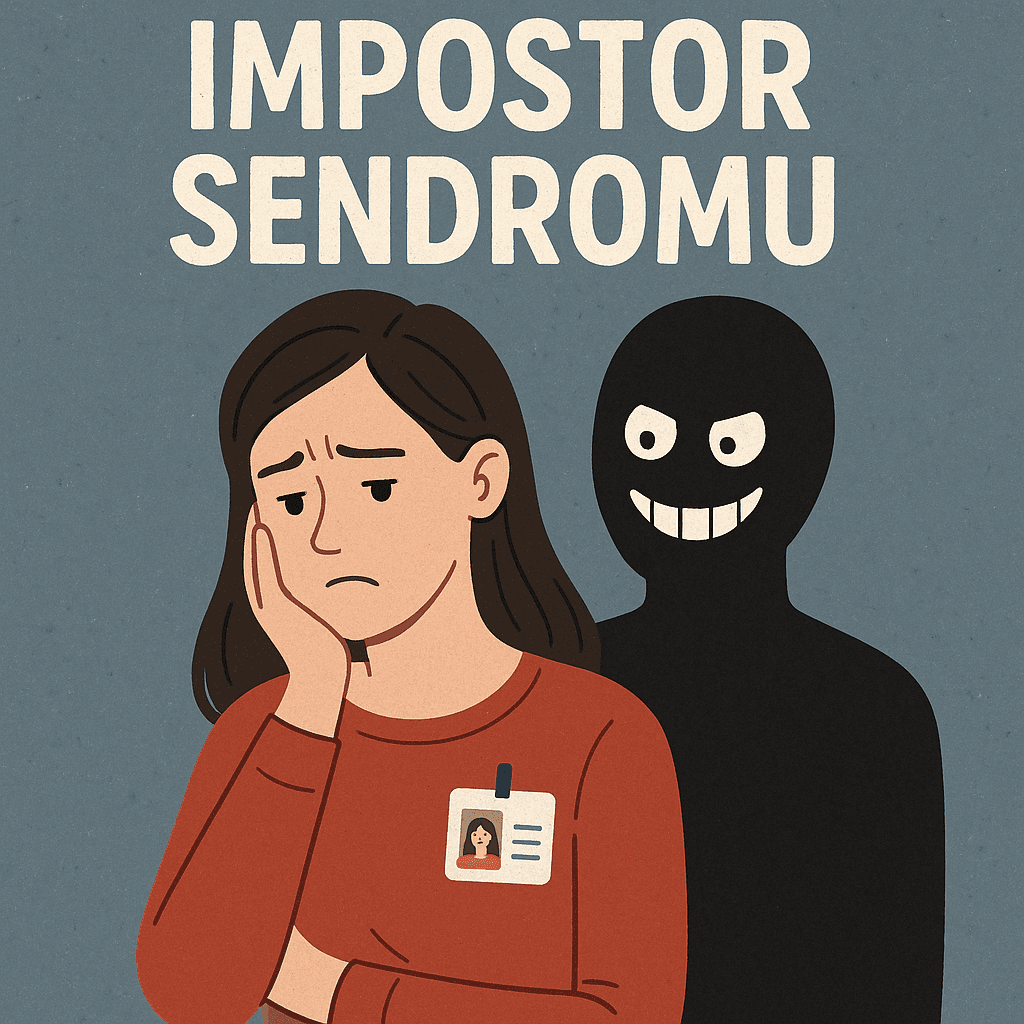
Impostor Syndrome (Generated by Artificial Intelligence)
In short: A person achieves things but does not believe they deserve it. Deep down, they fear: “I didn’t earn this, people are overestimating me, and one day the truth will come out.”
This is not mere humility. It is a feeling that, over time, wears you down, prevents you from recognizing your own efforts, and kills your desire to create. Especially among scientists, in academia and research communities, this syndrome moves silently. No one speaks up, but most people fight inner battles alone at night.
Because the world of science moves so fast. New knowledge, new publications, success stories keep appearing every day…
And whether we like it or not, we constantly compare ourselves to others:
The more we think like this, the more we begin to downplay our achievements and dismiss our hard work.
And our minds whisper to us constantly:
“You’re not really that good.”
Even some Nobel Prize-winning scientists have at times asked themselves: “Did I really deserve this award?” So this is not a weakness. Quite the opposite—it is a consequence of high self-awareness, deep thinking, and perfectionism. But if left unchecked, it can lead to burnout, lack of self-confidence, and loss of productivity.
No feeling disappears on its own without being acknowledged and confronted. Impostor Syndrome is no different. But don’t worry—there are ways to overcome it. The first step is accepting that experiencing this is extremely common and deeply human. You are not alone; many others feel the same way, but most never speak about it.
Take time for yourself. Get a notebook and write down everything you have accomplished so far. Small or large, it doesn’t matter. As you write, you will find moments where you ask yourself: “Did I really do all this?” That notebook may one day become your strongest proof of self-worth.
And please… stop comparing yourself to others. Everyone has a different life path, starting point, and even motivation. Some run fast, others move quietly. But everyone’s journey is unique. Focus only on your own path.
And never keep this feeling inside. Talk to someone you trust. Maybe they too are struggling with similar feelings but, like you, have never voiced them. Sharing lightens the burden and strengthens you.
Most importantly, be kind to yourself. Struggling with science, creation, and thought is already a tremendous effort. The very fact that you can do this shows how strong and valuable you are. Be a little more understanding, a little gentler with yourself. Above all, you deserve this.
If you are where you are, if you have achieved what you have, it is not coincidence. You are there because of the sleepless nights, because you never gave up, because you questioned and believed. Impostor Syndrome may tell you: “You’re not enough.” But your true self must respond:
“Yes, I still have much to learn.”
“But I have accomplished a great deal to get here.”
“And I am proud of the person I have become on this journey.”
Because Impostor Syndrome is simply a small but powerful game our inner voice plays on us. It minimizes our successes, magnifies our mistakes, and leaves us constantly feeling “not enough.” It thrives on fears rather than facts, filling our minds with doubt.
But remember: everything this voice says is not your truth. Along the way, you have learned, created, and achieved so much. Recognize this voice—but do not surrender to it. Because you, deserve to be here.
American Psychological Association. “Feel Like a Fraud?” *GradPsych Magazine*, November 2013. Accessed June 25, 2025. https://www.apa.org/gradpsych/2013/11/fraud.
Clance, Pauline Rose, and Suzanne Imes. “The Impostor Phenomenon in High Achieving Women: Dynamics and Therapeutic Intervention.” *Psychotherapy: Theory, Research & Practice* 15, no. 3 (1978): 241–247. Accessed June 25, 2025. https://doi.org/10.1037/h0086006.
Sakulku, Jaruwan. “The Impostor Phenomenon.” *International Journal of Behavioral Science* 6, no. 1 (2011): 73–92. Accessed June 25, 2025. https://www.tci-thaijo.org/index.php/IJBS/article/view/521.
Vergauwe, Jasmine, Bart Wille, Filip De Fruyt, Joeri C. Lievens, and Barbara Anseel. “Fear of Being Exposed: The Trait-Relatedness of the Impostor Phenomenon and Its Relevance in the Work Context.” *Journal of Business and Psychology* 30, no. 3 (2015): 565–581. Accessed June 25, 2025. https://doi.org/10.1007/s10869-014-9382-5.
So what exactly is Impostor Syndrome?
Why Do We Feel This Way Despite Academic Success?
Know This: These Feelings Are Extremely Common
So What Can We Do?
You Didn’t Get Here by Chance