


This article was automatically translated from the original Turkish version.

Ottoman Empire weddings, circumcision ceremonies, and festivals are most iconically associated with towering, elaborately decorated trees rising toward the sky. The Nahıl, derived from the Arabic term meaning “date palm tree,” was more than just a decorative element; it was a public manifestation of abundance, power, and artistry.
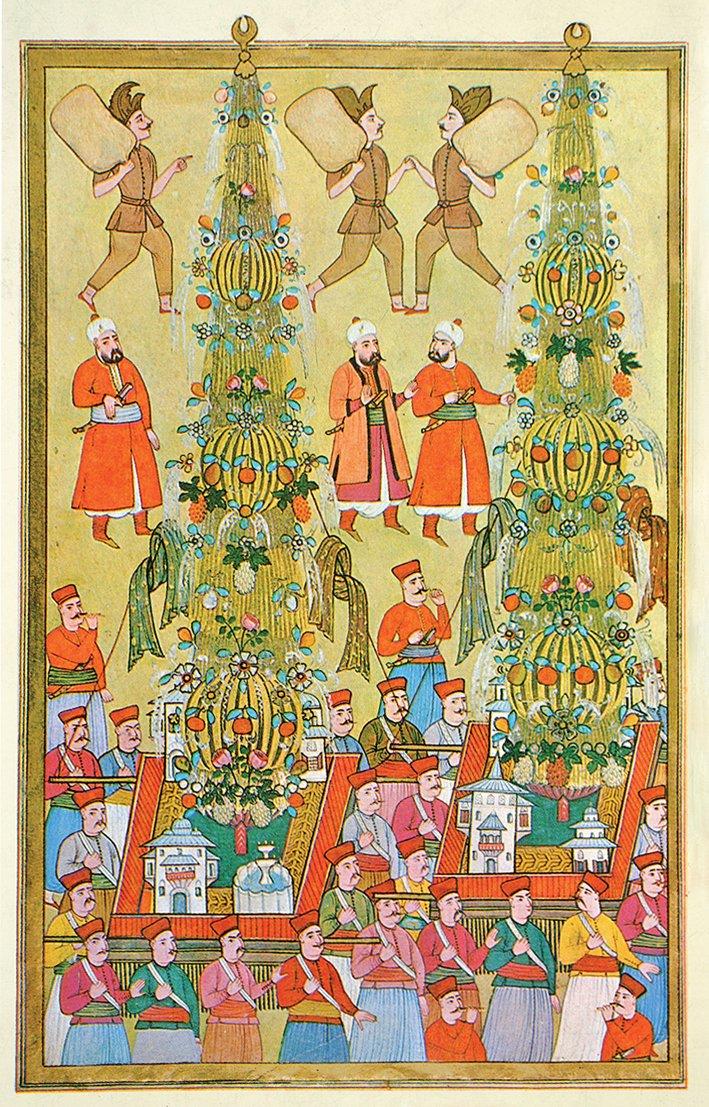
Sünnet alayında taşınan iki nahıl (Surname-i Vehbi,TSMK.,III.Ahmed,nr3593,vr.161-DİA)
Nahıl’s most exhilarating aspect is the Nahıl Procession ceremony. These massive structures, sometimes reaching 10 to 15 meters in height, were carried through the streets on specially constructed wheeled platforms with the assistance of dozens of people.
Not only their physical scale but also their intricate details served as forms of praise. The decorations adorning a Nahıl reflected the aesthetic values and cultural priorities of the era:
Today, this tradition is being preserved as a local cultural heritage, particularly in regions such as Edirne and Muğla. These monumental “trees of life” from the past continue to remind us how art can be deeply intertwined with society.
Nutku, Özdemir. "Nahıl." *TDV İslâm Ansiklopedisi*, Volume 32. Istanbul: TDV Yayınları, 2006. Accessed January 8, 2026.https://islamansiklopedisi.org.tr/nahil
Uzunçarşılı, İsmail Hakkı. “Nahil ve Nakıl Alayları.” *Belleten* 40, no. 157 (1976): 55–69. Accessed January 8, 2026.https://dergipark.org.tr/tr/pub/ttkbelleten/issue/72279/1166182
Öngen Corsini, Duygu Ebru. “Osmanlı Saray Şenliklerinden Günümüze Bir Kültür Ürünü: Nahıl.” İzmir Ekonomi Üniversitesi GCRIS Veri Tabanı, (2015). Accessed January 8, 2026.https://gcris.ieu.edu.tr/handle/20.500.14365/4448
İşçen, Yavuz. "Ürgüp Folklorundan Bir Kesit: Nahıl ve Nahıl Övme." Düşler Ülkesinde Bir Kültür Yolculuğu: ÜRGÜP, Nevşehir: Ürgüp Tanıtma Vakfı Kültür Yayınları, pp. 143-152.
Nahıl Procession: A Carnival at the Heart of the City
Nahıl Praise: The Language of Art and Elegance