


This article was automatically translated from the original Turkish version.
+2 More
Turtles, have been living on Earth since the Triassic Period and are among the planet’s oldest living creatures. Their long evolutionary history has provided the foundation for turtles to carry various symbolic meanings throughout human history. Their calm and slow movements, long lifespans, ability to carry their shells as a shelter like, and capacity for self-protection have led to their association with specific concepts in different civilizations. Among these concepts, patience, wisdom, the continuity of life, and balance stand out.
Turtles have acquired diverse meanings and assumed various symbolic roles across many cultures. The attribution of these values stems largely from their long lifespans, which make them representations of time and eternity; their slow movements, which offer a counterbalance to fast-paced and impulsive lifestyles; and their protective shells, which evoke themes of introspection and awareness of personal boundaries. Place is also given to the fact that their bodies are constantly in contact with the ground and their closeness to the earth link them to ideas of connection with nature and unity with the terrestrial world. Their ability to withdraw into their shells during moments of danger is interpreted as symbolizing self-awareness, protection, and attention to inner limits.
In light of all these qualities, turtles have been revered by different societies throughout history and have found a place in mythological narratives.
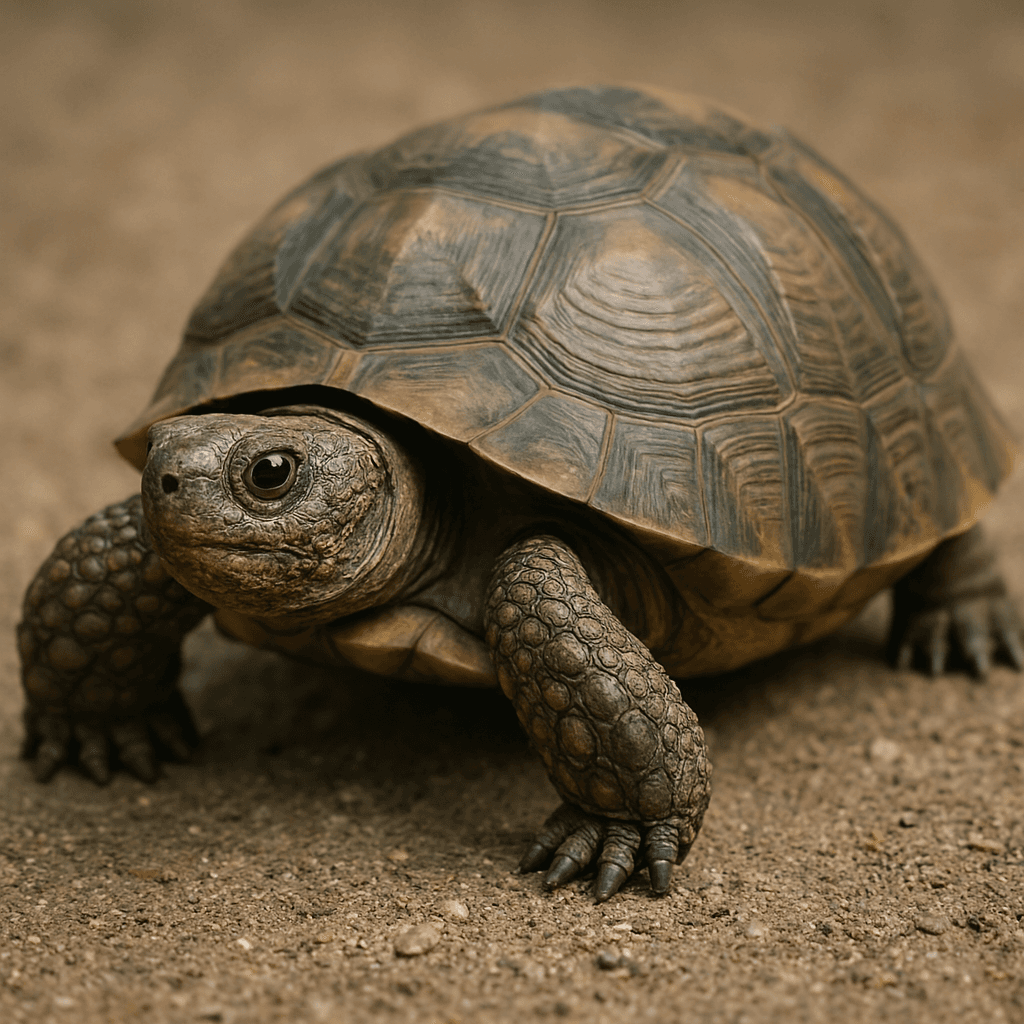
Image generated by artificial intelligence.
In Chinese mythology, the turtle is one of the four sacred creatures and is regarded as the wisest among them. The four sacred beings are the dragon, the phoenix, the tiger, and the turtle. In particular, the black turtle (Xuanwu) is an important figure in Chinese culture associated with wisdom, long life, cosmic balance, and the earth element. These symbolic meanings have also been reflected in Chinese architecture. Turtle carvings found at the foundations of temples symbolized the belief that the structures would endure for a long time.
According to a widely accepted folk legend in Chinese culture, one of the nine sons of the dragon is a turtle, believed to possess the strength to carry heavy loads due to the hardness of its back. Another reason turtles are seen as auspicious animals lies in the cosmological meanings attributed to their physical form by Chinese thinkers. The turtle’s rounded shell is identified with the sky, while its flat belly is associated with the earth; thus, the shell is interpreted as “yang” and the belly as “yin.” This symbolism has become integrated into the Chinese philosophical system of Yin-Yang.
It is believed that the turtle also entered Turkish mythology through Chinese and Indian belief systems. In Chinese history, this creature was not only a mythological or symbolic figure but was also used in practical and administrative contexts. Turtle shells were used for divination. The Chinese emperors consulted the turtle when determining the years of their reigns, assigning personal names and surnames, and naming cities, mountains, and rivers.
In Chinese culture, the turtle has established a powerful presence both in the physical world—in architectural elements such as temples and statues—and in the spiritual realm—in myths, the Yin-Yang doctrine, and Feng Shui practices.
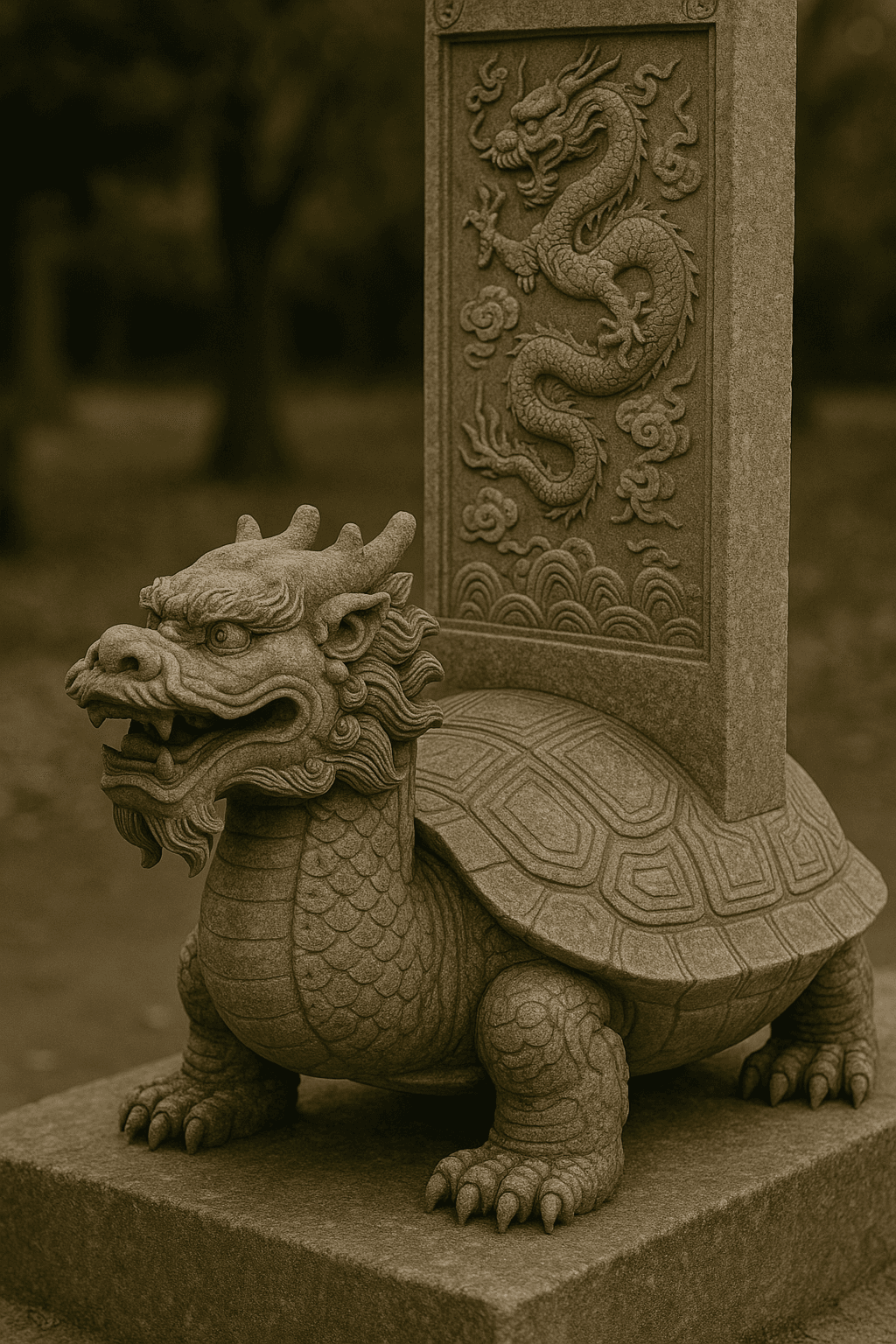
Image generated by artificial intelligence.
In Indian mythology, the turtle figure has acquired profound meaning within the framework of Hindu belief systems, particularly on cosmic and divine levels. According to Hinduism, Vishnu, one of the principal deities, took his second avatar (incarnation) as Kurma, depicted as a giant turtle. According to the mythological narrative, during the churning of the cosmic ocean of milk, Vishnu transformed into a turtle to support the mountain on his back, ensuring its stability and thus maintaining the balance of the universe. In this context, the turtle is regarded in Indian mythology as a divine instrument that contributes to cosmic equilibrium.
This myth has led to the turtle being associated not only with physical resilience but also with divine support and self-sacrifice. Additionally, in Indian mythology, there is a belief that the earth rests upon the back of a turtle. This cosmological depiction appears similarly in Chinese mythology and some Indigenous American cultures.
The turtle figure also appears in Indian architecture; stone turtle statues are commonly found at the entrances of many Hindu temples. These figures are interpreted as symbols of sanctity and spiritual protection. Furthermore, the yoga system, another component of Indian thought, also references the turtle. In Hatha yoga practice, the posture known as “Kurmasana” (Turtle Pose) symbolizes the attainment of mental stillness and inward focus. This posture, like the turtle withdrawing into its shell, represents the individual’s retreat from the external world to explore inner depth.
In Indian mythology, the turtle has assumed a symbolic role in creation narratives and religious rituals, associated with themes of cosmic balance, divine support, self-sacrifice, and inner transformation.
In African mythology and oral folk literature, the turtle emerges as a prominent figure associated with themes of intelligence and cunning. In many African folktales, the turtle, despite lacking physical strength, overcomes obstacles and outwits rivals through its ability to reason and develop strategies. In this sense, the turtle serves as the vehicle for didactic narratives that emphasize intelligence over brute force.
West African cultures, particularly in Nigeria, Ghana, and Benin, feature the turtle alongside or in contrast to the mythological character Anansi, the spider. Anansi is a widely known figure in West African storytelling traditions, typically associated with knowledge and trickery. Stories involving Anansi and the turtle use their competition to underscore the importance of intelligence, patience, and strategy. In these tales, the turtle is portrayed as a figure lacking physical power but possessing mental agility.
In African oral narratives, the turtle represents not only individual success but also the transmission of social lessons and collective wisdom. These folktales have been passed down from generation to generation within traditional oral culture, establishing the turtle as a cultural memory element.
In Indigenous American belief systems, the turtle is regarded as a sacred figure at the center of cosmogonic narratives and directly involved in the creation of the universe. Many Native American tribes believe that the earth rests upon the back of a giant turtle. This belief has led to the North American continent being called “Turtle Island,” a name rooted in mythological accounts of its origin.
In this belief structure, the turtle is viewed as a sacred element sustaining the continuity of life and nature. According to one widespread narrative, a woman who fell from the sky (Sky Woman) was brought to the surface of the water by birds. To enable her survival, animals dove beneath the water to retrieve earth. During this process, the turtle extended its back to provide a foundation upon which life could be established. The earth brought up by the animals gradually expanded on the turtle’s back to form the landmass known as “Turtle Island.”
The role assigned to the turtle in these narratives transforms it into a symbol of creation and the continuity of life. In Indigenous American cultures, the turtle holds a sacred place as a representative of harmonious living with nature and the origin of the world. In this context, the turtle is positioned as one of the fundamental building blocks of the universe, both physically and spiritually.

Image generated by artificial intelligence.
In Turkish mythology, the turtle is regarded as an auspicious and sacred being due to its ability to carry its home on its back and its long lifespan. The turtle figure symbolizes strength, protection, immortality, wisdom, patience, perseverance, and stability. It has acquired particular importance in Turkish Islamic thought and Sufi symbolism. The turtle’s act of withdrawing into its shell is interpreted as a metaphor for turning away from worldly anxieties and pursuing inner transformation.
The turtle also appears in folk beliefs with various attributes, including the power to bring rain, ward off the evil eye, and cure certain illnesses. It is also a frequently used figure in Turkish folk literature. Turkish folk narratives often depict individuals who cheat in trade, are stingy, or show disrespect toward blessings or ancestors being transformed into turtles.
In Anatolia, the turtle is known by local names such as “tuşbağa,” “tuşbaa,” “toşkaba,” and “tostos.” It is widely used in Anatolian folk art, especially in kilim patterns, ceramic, and tile decorations. One significant artistic representation of turtle symbolism in Turkish culture is Osman Hamdi Bey’s painting titled “The Turtle Trainer.” This work is an important example of how the turtle’s symbolic meanings have been reflected in art.
Among Turkic tribes, the turtle has been linked to myths of cosmic creation and the belief in Gök Tengri. It was believed that the upper part of the turtle represented the sky and its lower part the earth. Shamanistic communities in regions such as Mongolia, Kyrgyzstan, Tuva, Khakassia, and Altai are said to have attributed special meanings to the turtle for driving away evil spirits.
Historically, turtle symbolism has also been honored. The placement of the inscriptions of Bilge Kağan, Kül Tigin, and Moyun Çor on turtle-shaped pedestals is interpreted as a symbolic representation of peace, tranquility, long life, and continuity. Additionally, in architecture, the turtle symbol has been used as a geometric motif and decorative element.
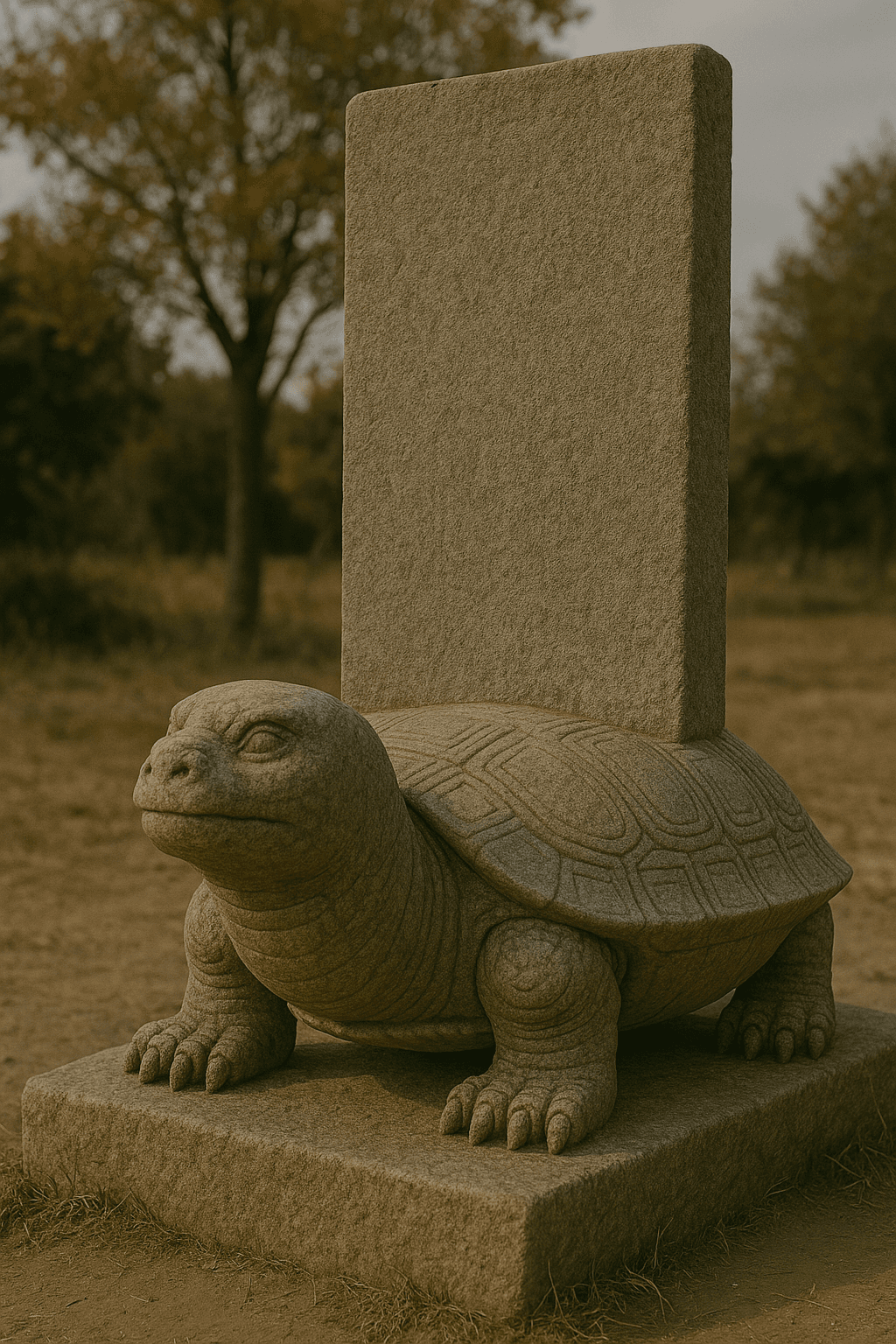
Image generated by artificial intelligence.
Acar, Zeynep. *Kaplumbağalar: Sessizliğin İçindeki Bilgelik*. İzmir: Ege Üniversitesi Yayınları, 2022.https://basimveyayinevi.ege.edu.tr/files/basimveyayinevi/icerik/kaplumbagalarekitap.pdf#page=58Aslan, Ahmet Ali. “Amerika Yerli Kızılderili ve Türk Halk Kültüründe Destanlaşmış Şamanlar, Gün Ana ve Toprak Ana.” *BELGÜ*, 2015.https://dergipark.org.tr/tr/download/article-file/495349Aydın, Ahmet. “Türk Destanlarında Kadın Figürü: Toprak Ana ve Gün Ana.” *Akra Journal* 3, no. 2 (2017): 99–110.https://dergipark.org.tr/tr/pub/akrajournal/issue/29977/328202Korkmaz, Serdar. “Kaplumbağa Figürünün Türk Mitolojisindeki Yeri.” *Yüzüncü Yıl Üniversitesi Sosyal Bilimler Enstitüsü Dergisi* 11, no. 2 (2021): 56–70.https://dergipark.org.tr/en/pub/yyusbed/article/1111578Miller, J. “Why the World Is on the Back of a Turtle.” *Man* 9 (1974): 306–308. Patyal, H. C. “Tortoise in Mythology and Ritual.” *East and West* 45, no. 1/4 (1995): 97–107. Pearce, R. J. “Turtles from Turtle Island: An Archaeological Perspective from Iroquoia.” *Ontario Archaeology*, 2005. Rappenglück, Michael A. “The Whole World Put Between Two Shells: The Cosmic Symbolism of Tortoises and Turtles.” *Mediterranean Archaeology and Archaeometry* 6, no. 3 (2006): 223–230. Yılmaz, Ahmet. “Türk Edebiyatında Kaplumbağa Figürü.” *Ege Eğitim Dergisi* 21, no. 2 (2020): 45–61.https://dergipark.org.tr/en/pub/egetdid/issue/78061/1243466

No Discussion Added Yet
Start discussion for "The Meaning of the Turtle in Various Mythologies" article
The Turtle in Chinese Mythology
The Turtle in Indian Mythology
The Turtle in African Mythology
The Turtle in Indigenous American Mythology
The Turtle in Turkish Mythology