


This article was automatically translated from the original Turkish version.

One of the first phrases that comes to mind when thinking about the French Revolution is: “If they have no bread, let them eat cake.” In French: “S’ils n’ont pas de pain, qu’ils mangent de la brioche.” 【1】 This expression has become a symbol of an era in which the general population could not access basic necessities while the ruling class remained oblivious to them. It is commonly attributed to Queen Marie Antoinette of France, but there is no definitive evidence that she actually said it.
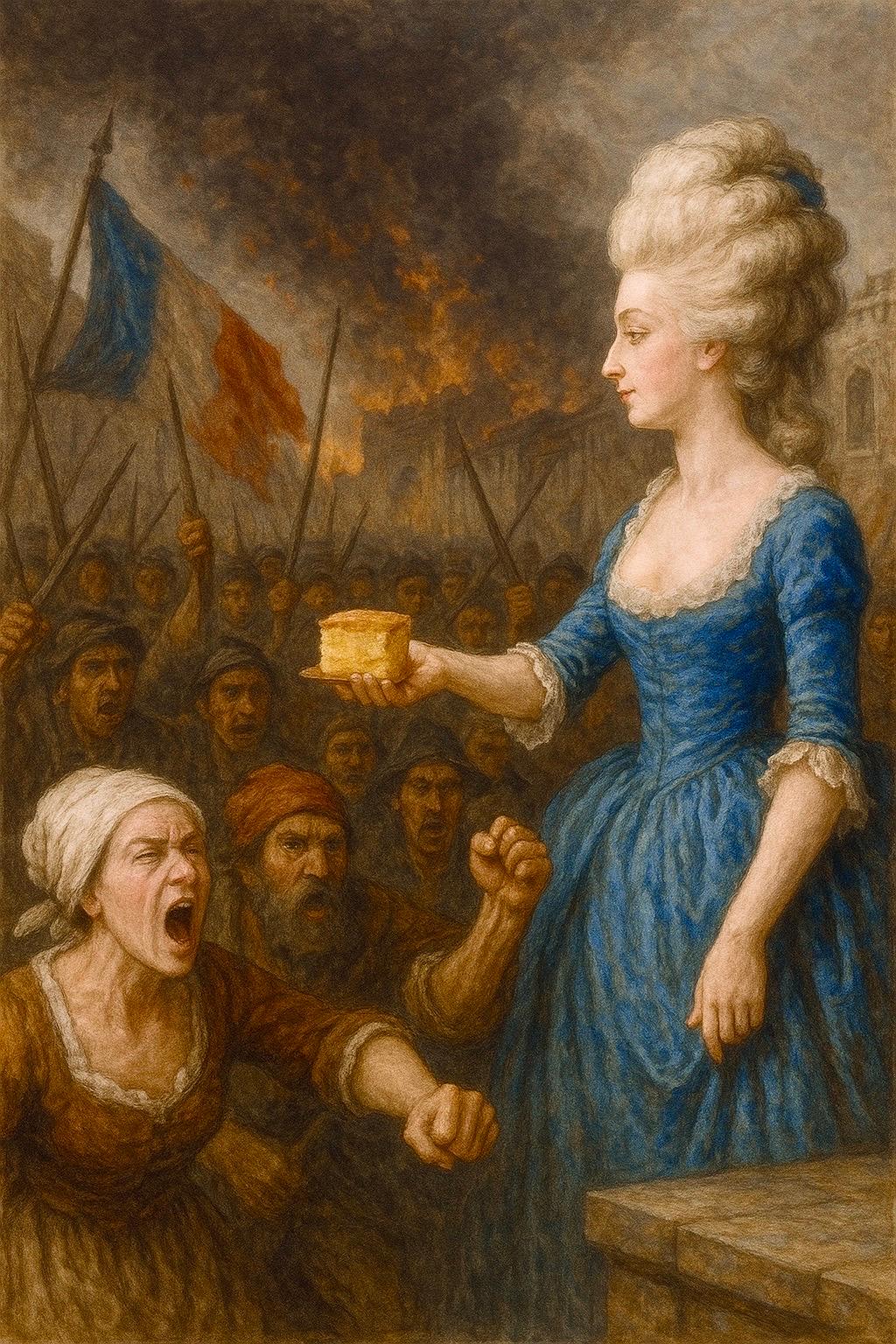
Queen of France and the French People (Generated by Artificial Intelligence)
In the late 18th century, France faced a severe economic crisis. Grain prices had risen sharply, famine had begun, and the population could no longer afford bread. Meanwhile, the royal court continued to live in luxury and extravagance. This divide created not only an economic but also a profound social rupture.
It was within this atmosphere that this famous phrase gained its place in historical memory, as it dramatically captured the class gap between the monarchy and the people.
When we deepen our understanding of the historical context, we see that the crisis was not only economic or political but also triggered by climatic factors. The Little Ice Age, which affected Europe between 1300 and 1850, caused a drop in temperatures and a significant decline in agricultural production. This negatively impacted wheat yields in France, worsening the famine. Since bread was one of the primary sources of sustenance for the population, this situation directly threatened daily life.
Some phrases become symbols of an era regardless of who actually uttered them. The saying “If they have no bread, let them eat cake” is precisely such an example. Although it is unclear who said it, the expression powerfully reflects the class structure of the time, social inequality, and the helplessness of the people. In this sense, it is not merely an individual remark but has become the voice of a historical attitude and a critique of the system.
Does it matter who said it? Perhaps not so much. Because this phrase has transformed into a universal symbol revealing how detached the ruling class in France was from the people and how profoundly they ignored their suffering. Even today, we continue to reflect on injustice, class disparities, and social indifference through this very phrase.
Pektaş, Ebru. Kadın Kurtuluş Hareketi: Ütopyalar ve Devrimler. İstanbul: Yordam Kitap, 2021.
Vassaf, Gündüz. *Tarihi Yargılıyorum.* İstanbul: İletişim Yayınları, 2016.
Vural, Güneyi. *Fiziki Özellikleri ve Beşeri Etkileriyle Küçük Buzul Çağı.* Master's thesis, İstanbul Üniversitesi Sosyal Bilimler Enstitüsü, 2015. https://tez.yok.gov.tr/UlusalTezMerkezi/TezGoster?key=DPTyuy3wRPq_qvCPSqUB6wX-5NQjGaj-sPVzJxQZfJlfd9TJZgzfEsPWk7tlgVHi
Çavuş, Remzi. *Tarihte İlginç Gerçekler.* İstanbul: Işık Yayıncılık Ticaret, 2014.
İnce, Yunus. “Bir Görgü Tanığının Gözünden Kabakçı Mustafa İsyanı.” Hacettepe Üniversitesi Türkiyat Araştırmaları Dergisi (HÜTAD), no. 23 (2008). https://dergipark.org.tr/en/download/article-file/641010
[1]
Yunus İnce “Bir Görgü Tanığının Gözünden Kabakçı Mustafa İsyanı.” Hacettepe Üniversitesi Türkiyat Araştırmaları Dergisi (HÜTAD) no. 23 (2008). s. 285. https://dergipark.org.tr/en/download/article-file/641010.
Historical Context
A Symbol in Collective Memory