


This article was automatically translated from the original Turkish version.
+2 More

The Four Dungeons of Man, İşaret Yayınları, March 1997
Author | Dr. Ali Şeriati | ||||||||
|---|---|---|---|---|---|---|---|---|---|
Country | İran | ||||||||
Type | Compilation work | ||||||||
Publication Year | June 1984 | ||||||||
The Four Prisons of Man is the written record of a lecture delivered in 1970 by Dr. Ali Şeriati, in which he examines the four fundamental limiting and oppressive forces surrounding human existence. The author identifies the obstacles encountered by the individual in the pursuit of liberation as the prisons of nature, history, society, and the self. This approach reveals that the very forces enclosing the human being are also integral to the struggle of recognizing and realizing one’s own potential.
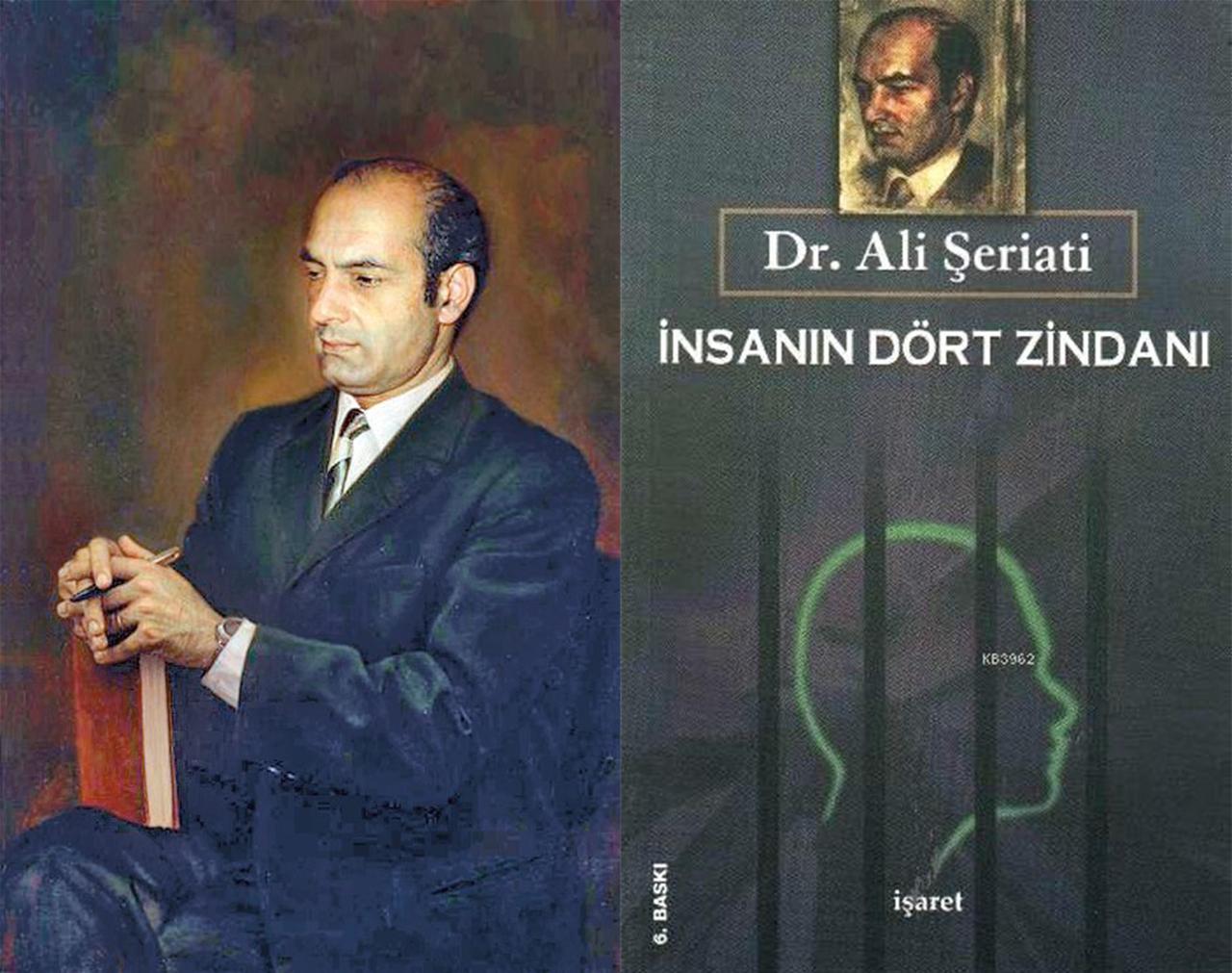
Dr. Ali Şeriati and the Book The Four Prisons of Man, 5th Edition 1997 (Photo: TDV Islamic Encyclopedia)
“The Four Prisons of Man” is a work by Ali Şeriati that analyzes the fundamental factors limiting individual existence. In the text, four major “prisons” that restrict human free will and intellectual development are outlined: nature, history, society, and the self’s nafs (self). Şeriati examines how these four forces enclose the human being and argues that liberation is possible only through recognizing these constraints.
The first prison, nature, relates to the biological and physical limitations of human beings. The second prison, history, emphasizes the imprint left by the accumulation of the past and collective memory on the individual. The third prison, society, addresses the role of traditions, social structures, and environment in shaping individual identity. The final prison is the self’s nafs, which questions the influence of internal tendencies, passions, and self-perception on the pursuit of freedom.
The overall aim of the work is to highlight the necessity for the individual to become aware of these four elements in order to understand oneself and consciously direct one’s life. Şeriati contends that comprehending and overcoming each prison is critical to the process of liberation and the search for truth. In this regard, he emphasizes that the human being must recognize the factors limiting them—both internal and external—and demonstrate the will to transcend them. This perspective forms the core theme of the work.
Within the context of “The Four Prisons of Man,” Dr. Ali Şeriati distinguishes between the concepts of “beşer” and “insan” as two related yet distinct dimensions. “Beşer” emphasizes the physical and biological aspects of human existence—the fundamental traits inherited at birth and shared with other living beings. From this perspective, beşer emerges as a being driven by needs and instincts, highly dependent on external factors. According to Şeriati, beşer fully represents the restrictive qualities of nature and the body, signifying the stage in which the human being has not yet realized its ideal potential as “insan.”
On the other hand, “insan” transcends mere physical existence through consciousness, free will, and moral responsibility, distinguishing itself from beşer. Şeriati underscores the spiritual and intellectual ascent of the human being as it strives to overcome the prisons of nature, history, society, and the self. This ascent begins with the individual gaining self-awareness and recognizing the obstacles to freedom. Thus, while beşer represents the biological and material dimension, insan symbolizes a higher plane—one that rises above this dimension, acts through free will, generates values, assumes responsibility, and transforms existence through the development of consciousness.
In “The Four Prisons of Man,” Dr. Ali Şeriati defines the obstacles encountered by the human being in the pursuit of liberation as the prisons of nature, history, society, and the self. These four elements express limitations originating both from the external world and from within. According to Şeriati, the central issue is not merely identifying these prisons but actively using one’s consciousness and will to break free from them. At its core, human liberation begins with awareness of these constraints and continues through spiritual and intellectual development aimed at realizing one’s potential.
The prison of nature refers to the constraints imposed by geographical and physical conditions. Throughout historical time, human beings struggled to survive when they could not meet basic needs such as water, clean air, and habitable climate conditions. This situation became especially pronounced in regions with harsh natural environments such as deserts. However, through scientific knowledge and technology, it is now possible to establish large industrial centers even in the midst of deserts, partially overcoming the natural limitations imposed by geography.
These developments are seen as the result of humanity’s desire to reduce pressure from nature or escape it entirely. Yet this quest for liberation may also bring a new form of submission. The industrial order produced by technological progress fuels consumption, trapping the individual in a cycle of ever-increasing production, thereby replacing the pressure of nature with the pressures of economic and social conditions. Thus, the prison of nature cannot be explained solely by physical environmental constraints; it also includes the new necessities generated by the technology and industry that were meant to overcome those constraints.
Human beings are largely shaped by historical and cultural currents beyond their own choice. The language, religion, and values of the environment into which an individual is born—geographically, temporally, and culturally—are presented as given. For instance, a person born into a Persian-speaking society does not choose that language, yet due to the process of history, they have no alternative. Similarly, religious or moral attitudes are determined by the historical legacy passed down from previous generations.
These conditions transform the individual’s “self” and mode of thought into products of a historical fabric. Only by understanding the laws and determining factors of history can the individual become aware of this prison and begin the struggle for liberation. To perceive the influence of history, one must engage with the science and philosophy of history. Only then can the individual question the language, beliefs, and cultural elements imposed upon them and transcend the boundaries of the historical prison.
The environment in which a person lives exerts various pressures through social norms, traditions, roles, and expectations. The prison of society is a condition that hinders the individual from discovering their authentic self, often reinforced by the desire for approval and conformity. Şeriati does not advocate complete detachment from society but rather the cultivation of a consciousness capable of transforming it. When the rigid rules and impositions of society are questioned, it becomes possible for the individual to reorganize their social context in a more free manner. In this process, the individual’s courage and will to transform society are of great importance.
The prison of the self is described as the heaviest and most hidden form of bondage. Even a person who has escaped the prisons of nature, history, and society may confront profound emptiness and meaninglessness if they fail to overcome this fourth and most difficult captivity. For when individuals believe they are free after shedding external pressures, they suddenly find themselves unable to determine what to do once confronted with the internal barrier of the self. The existential crisis of “I do not know what to do” arises precisely at this point.
From an Islamic perspective, liberation from this prison cannot be achieved through science, reason, or logic alone. Overcoming the selfish passions and egoism that enclose the self requires a higher power: a sincere closeness and love nourished by the heart and faith. The love referred to here is a transcendent force that drives self-sacrifice solely for the sake of truth, devoid of worldly interests, material gain, status, or the expectation of approval. This power initiates an inner revolution, enabling the individual to rebel against their own self.
In Islamic teachings, the virtue of self-sacrifice for the sake of others, expressed by the term “iysar,” is the concrete manifestation of this process. Through faith and love, as the individual shatters the idol of the self, the shackles of the fourth prison loosen. Reason and scientific methods prove inadequate here; liberation from the prison of the self occurs only through an inner explosion, a surrender that transcends the nafs, and a faith strong enough to place all worldly interests in the background. Thus, the human being undergoes an inner revolution and turns toward true freedom in the presence of Allah. On this path illuminated by faith and love, the person liberated from the prison of the self achieves freedom not only in the external world but also in the inner realm, approaching the rank of true “insan.”
Abdulhakim, Çiftçi. “İnsanın Dört Zindanı (Ali Şeriati).” Derin Düşünce. Accessed February 16, 2025.https://www.derindusunce.org/2012/02/22/insanin-dort-zindani-ali-seriati-2/
Damka steel, doors. "İnsanın Dört Zindanı (CS_1_)." Academia.edu. Accessed February 16, 2025.https://www.academia.edu/24144547/İNSANIN_DÖRT_ZİNDANI_CS_1_
Durali, Yılmaz. “İnsanın Dört Zindanı – Dr. Ali Şeriati (Özetleyen: Durali Yılmaz).” Hertaraf. Accessed February 16, 2025.https://hertaraf.com/haber-insanin-dort-zindani--dr-ali-seriati-ozetleyen-durali-yilmaz-4110
Kırkpınar, Leyla. "77 Sy". Çağdaş Türkiye Tarihi Araştırmaları Dergisi 18, no. 36 (October 2018): 435-37.
Metin, Kazan. "İnsanın Dört Zindanı." Dibace.net. Accessed February 16, 2025.https://www.dibace.net/metin-kazan/insanin-dort-zindani/
Söz ve Kalem. "Ali Şeriati’de İnsanın Dört Zindanı." Accessed February 16, 2025.https://sozvekalem.com/ali-seriatide-insanin-dort-zindani--tr-1000.html
TDV İslam Ansiklopedisi. ŞERÎATÎ, Ali [JPG]. Accessedhttps://islamansiklopedisi.org.tr/seriati-ali.

The Four Dungeons of Man, İşaret Yayınları, March 1997
Author | Dr. Ali Şeriati | ||||||||
|---|---|---|---|---|---|---|---|---|---|
Country | İran | ||||||||
Type | Compilation work | ||||||||
Publication Year | June 1984 | ||||||||
No Discussion Added Yet
Start discussion for "The Four Dungeons of Man (Book)" article
Subject
Defining the Human Being
The Four Prisons from Which Humanity Must Be Liberated
The Prison of Nature
The Prison of History
The Prison of Society
The Prison of the Self