This article was automatically translated from the original Turkish version.
The Balkans’s dusty pages sometimes reveal a figure whose legacy evokes both profound admiration and melancholic astonishment. Bogdan Filov stands as one of the most captivating and tragic examples of such a personality. On one hand, he demonstrated immense passion for art by rescuing a masterpiece like the Selimiye Camii from certain destruction; on the other, he vanished into the dark corridors of politics. In this article, we will undertake a chronological journey, guided by objective data from historical sources, to examine his life, his admirable stance in preserving the priceless Ottoman heritage in Edirne, and his archaeological odyssey shaped under the shadow of the Balkan Wars, evaluating his identity as a scholar alongside his political end as a unified whole.
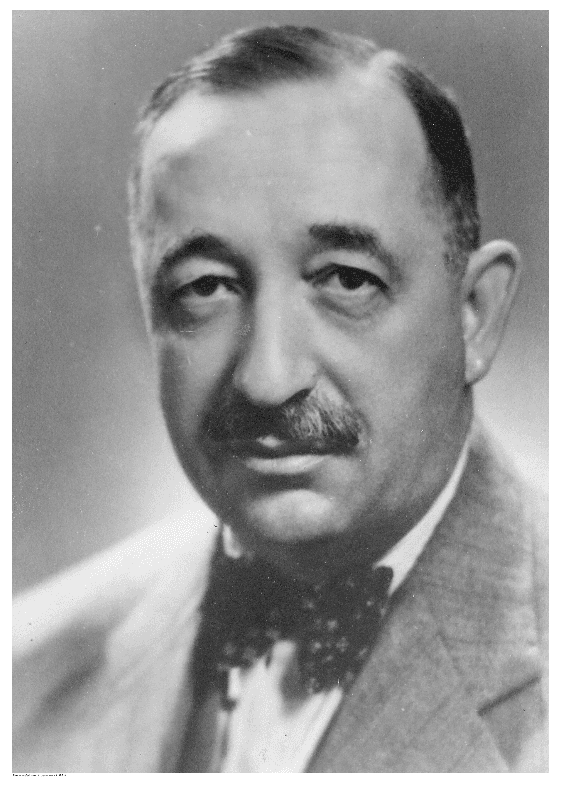
Bogdan Filov (Store Norske Leksikon)
Bogdan Filov was born on 28 March 1883 in the town of Stara Zagora, Bulgaria, into a distinguished family. He began his education at the Sofia Male High School and, following his outstanding academic performance, was sent to Germany on a scholarship from the Ministry of National Education. He studied Classical Philology and Archaeology at prestigious universities including Würzburg and Freiburg, and in 1906 earned his doctorate in science after successfully defending his dissertation on Roman history at the University of Freiburg. In 1906, Filov began his service at the National Archaeological Museum and further developed his expertise by attending numismatic and archaeological courses in Bonn, Paris, and Rome. By 1911, at the age of just 28, he was appointed the first Bulgarian director of the National Archaeological Museum in Sofia. Throughout his academic career, he held the highest positions in Bulgarian science, including professorship, rectorship at Sofia University, and presidency of the Bulgarian Academy of Sciences, becoming one of the most important figures in Bulgarian scientific life.
With the outbreak of the Balkan Wars in 1912, Bogdan Filov was commissioned by the Ministry of National Education to identify and protect archaeological and ethnographic artifacts in occupied territories. During this period, Filov worked tirelessly to prevent the looting and destruction of cultural heritage amid the chaos of war. In 1913, when Edirne was occupied by the Bulgarian army, sources indicate that the Bulgarian government decided to demolish the Selimiye Camii, a symbol of Islamic architecture. Filov opposed this decision, arguing that Selimiye was not merely a religious structure but a universal cultural heritage. Using his academic and personal influence, he succeeded in having the demolition order rescinded and saved the building from certain annihilation. In his report dated 30 January 1913, he also documented witnessing Turkish properties abandoned by their owners being looted by military administrators, emphasizing the ethical and legal wrongfulness of such actions.【1】
Filov’s activities in Edirne extended beyond the preservation of architectural structures to include safeguarding the library’s rare manuscripts. In a letter to the Chief of Staff of the Action Army, he demanded the immediate closure of the Selimiye Camii library to prevent the burning or damage of its valuable documents, and insisted that the manuscripts be preserved under expert supervision until thoroughly examined. According to Filov’s diaries, on 4 April he visited the library and noted with sorrow that many of the manuscripts were already damaged or torn. On 5 April, he selected 44 elaborately illuminated and decorated manuscripts, recorded them, and had them transported to a secure storage facility. During this process, he assigned experts Kostov and Penčev to inventory and protect the valuable carpets in the mosque. In total, 49 selected items were cataloged for transfer to Sofia: 44 from Selimiye, 2 from the Üç Şerefeli Camii, 2 from the Sultan II Bayezid Camii, and 1 from the Eski Camii.
As the war continued, the hasty conversion of mosques into churches became widespread in occupied territories. Filov, with the impartiality of a scholar, opposed this practice, arguing that it contradicted historical reality. On 29 January 1913, he described the conversion of the Çarşı Mosque in Kavala as “an erroneous and inconsistent approach,” and demonstrated that objects claimed to be baptismal fonts were in fact merely bases for candle holders located beside the mihrab, thereby refuting the justification for the conversion. He displayed a similar stance in Sofia, where he blocked a plan to demolish the Great Mosque (Koca Mahmut Paşa Camii) and replace it with a museum, arguing that the structure was the most significant Ottoman monument on Bulgarian soil. He ensured the museum would operate within the existing building. His conviction that artistic heritage must be preserved regardless of ethnic or religious identity is regarded as a manifestation of his academic composure.
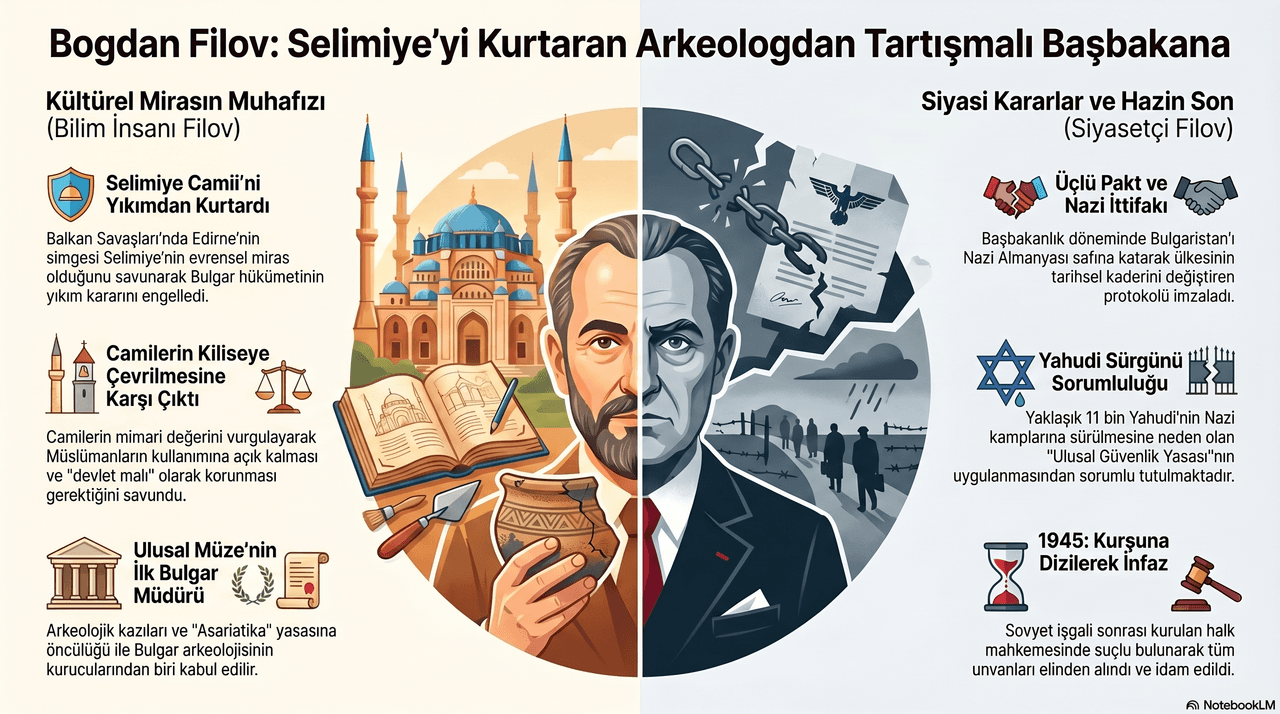
Bogdan Filov Infographic (Visual Generated by Artificial Intelligence)
Bogdan Filov’s scientific expeditions between 1912 and 1918 were meticulously recorded in his published diaries under the title “The Captive Days of Rumelia.” These diaries, divided into four main sections, cover Thrace, Macedonia, the Aegean, and the Vardar regions. The texts present not only archaeological findings but also the social structure of the era, the destructive impact of war, and geographical characteristics, supported by photographs and copies. During his travels, Filov either purchased or compiled reports recommending the collection of numerous historical artifacts for museum preservation. Today, these diaries serve as an invaluable primary source for researchers seeking to understand the state of Ottoman and Byzantine heritage in the Balkans during that period.
In the late 1930s, Filov abandoned his academic career to enter active politics. From 1940 to 1944, he served as Minister of National Education and as the 28th Prime Minister of Bulgaria. His premiership coincided with Bulgaria’s most turbulent years, which determined its historical trajectory. Under pressure from Nazi Germany, he played a role in the adoption of the “National Security Law,” which restricted the rights of the Jewish community and later led to deportations. On 1 March 1941, he signed the protocol for Bulgaria’s accession to the Tripartite Pact in Vienna, aligning the country with the Axis Powers. As a result of this strategic choice, the United States and Britain declared war on Bulgaria on 12 December 1941, leading to the bombing of Sofia by Allied aircraft. Filov’s decisions during this period remain a subject of intense debate among Bulgarian historians today.【2】
Following the coup in Bulgaria in September 1944, Bogdan Filov was arrested and subjected to a three-month interrogation in the Soviet Union. Tried by the newly established People’s Court, Filov, unlike many other politicians, made no attempt to flee and maintained an unwavering stance during the trial, refusing to admit guilt. Nevertheless, the court found him guilty and executed him by firing squad on 2 February 1945. After his death, all his property was confiscated, his academic titles were revoked, and efforts were made to erase his name from the scientific community. This period of near-total oblivion lasted approximately 45 years, ending in the early 1990s with the republication of his works. Finally, in 1996, the Supreme Court of Bulgaria annulled all judgments against Filov and restored his legal and scientific reputation.【3】
Engin, Seda Nur. “Rumeli’nin Esaret Günleri.” Tarih Kritik Dergisi 3, no. 2 (2017): 74–76. Accessed April 6, 2026. https://dergipark.org.tr/tr/pub/tarihkritik/article/304573
Filov, Bogdan. *Rumeli’nin Esaret Günleri*. Haz. Hüseyin Mevsim. İstanbul: Timaş Yayınları, 2010. Accessed April 6, 2026. https://www.academia.edu/6477944/Bogdan_Filov_Rumelinin_Esaret_G%C3%BCnleri_haz_H%C3%BCseyin_Mevsim
Store Norske Leksikon. "Bogdan Filov." Accessed April 6, 2026. https://snl.no/Bogdan_Filov
Çolakoğlu, Bayram. “Cami Katliamına Direnen Bir Bulgar: Bogdan Filov.” *Bal-Türk*. Accessed April 6, 2026. https://www.balturk.org.tr/cami-katliamina-direnen-bir-bulgar-bogdan-filov/
[1]
Bayram Çolakoğlu, “Cami Katliamına Direnen Bir Bulgar: Bogdan Filov,” Bal-Türk, accessed 6 April 2026. https://www.balturk.org.tr/cami-katliamina-direnen-bir-bulgar-bogdan-filov/
[2]
Seda Nur Zengin, “Rumeli’nin Esaret Günleri,” Tarih Kritik Dergisi 3, no. 2 (2017): 75. https://dergipark.org.tr/tr/pub/tarihkritik/article/304573
[3]
Zengin, “Rumeli’nin Esaret Günleri.” 75.
The Beginning of Bogdan Filov’s Career
The Balkan Wars and Efforts to Preserve the Ottoman Heritage in Edirne
The Fate of the Selimiye Library and Manuscripts
Scientific Opposition to the Conversion of Mosques into Churches
The Rumeli Diaries and Documentation of Scientific Expeditions
Political Career and Decisions Under the Shadow of the Second World War
People’s Court, Execution, and the Process of Scientific Rehabilitation