


This article was automatically translated from the original Turkish version.
The Banality of Evil is a concept in political philosophy developed by Hannah Arendt, one of the leading political theorists of the 20th century, based on her observations during the trial of Nazi officer Adolf Eichmann. It posits that the origin of evil lies not in supernatural monstrousness or diabolical intent but in the absence of thought and the blind obedience to authority.
The concept entered the literature through Hannah Arendt’s coverage of Adolf Eichmann’s 1961 trial in Jerusalem for The New Yorker and her subsequent book Eichmann in Jerusalem: A Report on the Banality of Evil (1963). Eichmann, responsible for organizing the gathering of Jews in Nazi Germany and their transport to extermination camps, defended himself during the trial as merely a civil servant executing laws and orders. Contrary to public expectations, Arendt found that Eichmann was not a “monster,” “sadist,” or “psychopath,” but rather an alarmingly ordinary and banal bureaucrat. Despite the enormity of his crimes, Eichmann carried out his actions with a sense of duty and exhibited no clear motivation beyond career advancement, such as fanatical antisemitism.
The banality of evil describes the condition in which an individual loses the capacity to reflect on the consequences of their actions and blindly obeys the rules of the system without engaging in moral judgment.
According to Arendt, Eichmann’s most defining trait was not stupidity but thoughtlessness. This condition reflects an inability to see things from another’s perspective and a lack of capacity to deliberate on the moral consequences of one’s actions. The perpetrator speaks in clichés and severs all connection with reality, focusing solely on the mechanics of the system.

The Mind World of Eichmann: The Disabling of the Moral Judgment Mechanism and the Process of Absolute Obedience (Generated by Artificial Intelligence)
Modern bureaucratic systems and division of labor sever the link between an individual’s action and its ultimate outcome, such as mass murder. The individual sees themselves as merely a “cog in the machine” and transfers responsibility to higher authorities or legal mandates. This mechanism prevents the perpetrator from engaging in moral accounting.
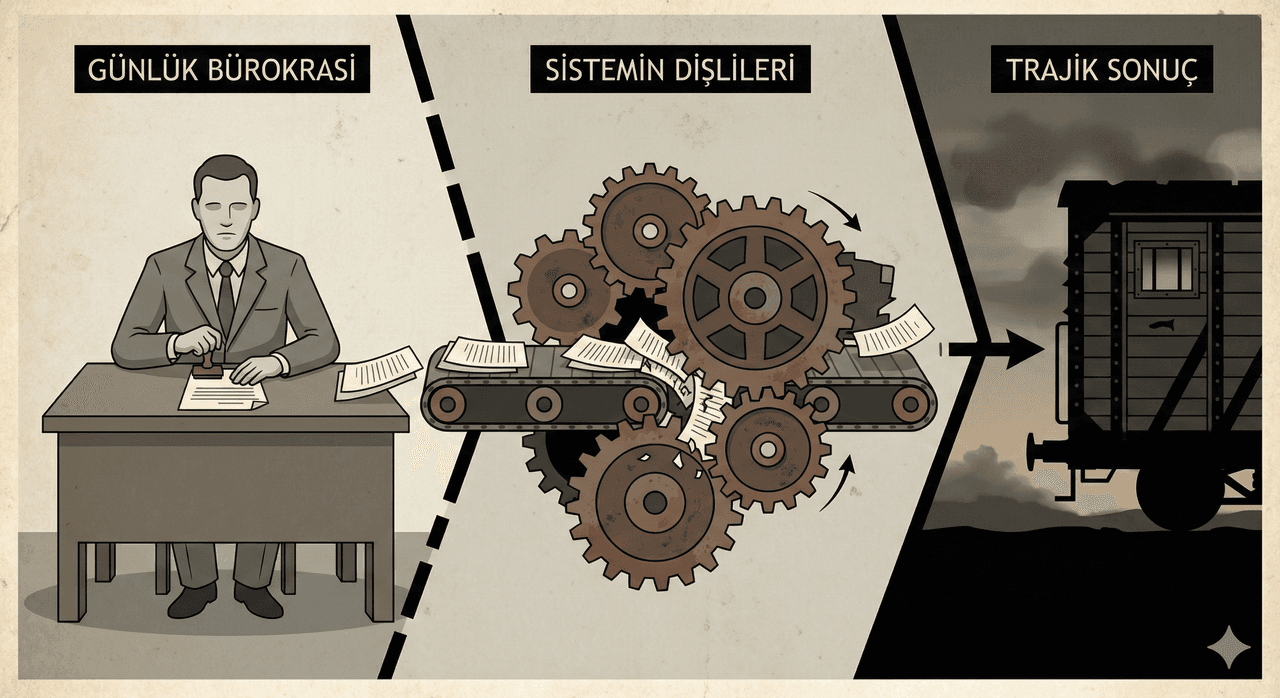
Modern Bürokraside Sorumluluğun Parçalanması: Fail İle Eylemin Sonucu Arasındaki Kopukluk (Yapay Zeka İle Oluşturulmuştur)
In totalitarian regimes, the distinction between what is legal and what is moral becomes blurred. As in Eichmann’s case, perpetrators believe themselves innocent as long as they act in accordance with the law, since during that period “not killing” was interpreted as defiance of the law.
Arendt initially embraced Kant’s concept of “Radical Evil” (evil with deep roots), but revised this view after the Eichmann trial. To her, evil is not a diabolical force with depth but rather a surface phenomenon like a “mold.” The “banal” nature of evil does not imply its insignificance; on the contrary, its capacity to be carried out by ordinary individuals devoid of thought and moral judgment makes it more widespread and destructive.

Kötülüğün Doğası Üzerine Karşılaştırma: Derin Kökleri Olan Radikal Kötülük Ve Yüzeyde Yayılan Sıradan Kötülük (Yapay Zeka İle Oluşturulmuştur)
The concept has been revisited in various contexts in art and literature:
In the film adaptation of Bernhard Schlink’s novel, the character Hanna Schmitz, a guard at a Nazi collection camp, exhibits a similar “sense of duty” as Eichmann. Schmitz justifies her failure to open the door of a locked church as inmates burned to death, arguing that “it would have caused chaos and prevented us from carrying out our duties.” Her actions illustrate that evil is linked not to monstrosity but to ignorance, shame, and conformity to the system.
The work narrates the “banality of evil” in Soviet Gulag camps through the mechanics of the system. People were sent to camps under vague laws like Article 58, accused of “treason to the homeland,” and reduced to mere numbers. This bureaucratic institutionalization of evil turns cruelty into the routine of daily life.
In the novel, violence and evil are associated not with a totalitarian regime but with a social “bystander effect.” The silence of individuals who witness evil—friends, neighbors, relatives—due to fear or self-interest, and their normalization of violence, exemplifies how evil becomes banal through widespread social complicity.
Advances in communication technologies today have created conditions for a new form of the banality of evil.

Kötülüğün Sıradanlığının Dönüşümü: Bürokratik Mesafeden Dijital Ekranların Yarattığı Duyarsızlığa Geçiş (Yapay Zeka İle Oluşturulmuştur)
Just as bureaucracy creates distance between perpetrator and victim, digital screens render the consequences of actions invisible. A lynching or hate speech carried out with a single click does not trigger a physical sense of violence in the perpetrator, thereby diminishing moral responsibility.
Hate speech directed at Syrian refugees on platforms like Twitter operates through a mechanism that aligns with Arendt’s concept of “thoughtlessness.” Users code refugees as “the other” and target them with derogatory hashtags, becoming absorbed in the flow of content rather than questioning the moral dimensions of their actions. In this environment, evil spreads rapidly and becomes normalized through anonymity and the speed of interaction.
Aldemir, Ayşe. "Kötülüğün Sıradanlığı ve Sosyal Medya: Twitter’da Suriyeli Mülteciler Örneği." Dumlupınar Üniversitesi Sosyal Bilimler Dergisi, no. 66 (October 2020): 200–219. Accessed January 5, 2026.
Başok Diş, Sebile. "Kötülüğün Sıradanlığı Karşısında Özerk Birey." FLSF Felsefe ve Sosyal Bilimler Dergisi, no. 23 (May 2017): 180–200. Accessed January 5, 2026.
Clarke, Barry. "Beyond ‘The Banality of Evil.’" British Journal of Political Science 10, no. 4 (1980): 417–439. Accessed January 5, 2026.
Dalaylı, Feyza Ünlü. "Hannah Arendt ve Kötülüğün Sıradanlığı: The Reader ve Hannah Arendt Filmleri Kapsamında Bir Değerlendirme." Al Farabi Uluslararası Sosyal Bilimler Dergisi 6, no. 4 (2021): 113–125. Accessed January 5, 2026.
Enser, R. Kandemir. "Şiddet, ‘Kötülüğün Sıradanlığı’ ve ‘Seyirci Etkisi’ Bağlamında Hasan Ali Toptaş’ın Beni Kör Kuyularda Romanı." FSM İlmî Araştırmalar İnsan ve Toplum Bilimleri Dergisi 16 (2020): 251–278. Accessed January 5, 2026.
Özakın, Duygu. "‘Kötülüğün Sıradanlığı’: Aleksandr Soljenitsın’ın Sovyet Çalışma Kampı İzlenimlerini Hannah Arendt’in Kavramlarıyla Okumak." RumeliDE Dil ve Edebiyat Araştırmaları Dergisi 15 (2019): 431–449. Accessed January 5, 2026.

No Discussion Added Yet
Start discussion for "The Banality of Evil" article
Historical Context and Emergence
Conceptual Framework and Core Dynamics
Thoughtlessness
Bureaucracy and the Diffusion of Responsibility
Law and Obedience
Transition from Radical Evil to the Banality of Evil
Reflections in Literature and Cinema
The Reader
One Day in the Life of Ivan Denisovich (Aleksandr Solzhenitsyn)
Blind in the Blind Alleys (Hasan Ali Toptaş)
The Digital Age and Social Media Context
Technological Distance and Desensitization
Social Media and Refugees