


This article was automatically translated from the original Turkish version.
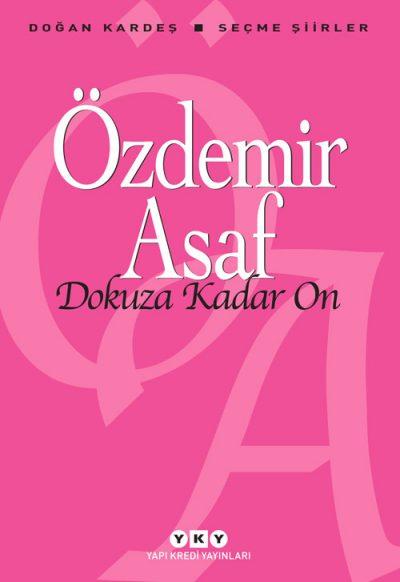
Nine to Ten
Author(s) | Özdemir Asaf | ||||||||
|---|---|---|---|---|---|---|---|---|---|
Page | 112 | ||||||||
Category | Poetry | ||||||||
Publisher(s) | Yapı Kredi Yayınları | ||||||||
Prepared by | Doğan Hızlan | ||||||||
Dokuza Kadar On is a collection of poems by Özdemir Asaf. The poems in this work, linked through place, are constructed with concise and intense lines that adhere to Asaf’s principle of linguistic economy, exploring the inner world of the individual, human relationships, and existential inquiries, as seen in short. Work was first published in 1957 and has since been reprinted by various publishers. Today, the most widely known edition is presented by Building Credit Yayınları.
Özdemir Asaf (1923–1981) is one of the poets of the Republican era Turkish poetry. Known for his short lines, Asaf’s poems emphasize irony, paradox and philosophical allusions. His poems commonly address universal themes such as individual solitude, love, freedom, justice and death like.
Dokuza Kadar On draws attention through its unique structure in which poem titles are numbered. The use of number as a metaphor throughout the work is not merely a formal choice but also introduces a mathematical rhythm and philosophical structure within the poetry itself. The main themes in the book are as follows:
Asaf’s poetic language is open to allusion. His short lines are woven with wordplay and unexpected associations. His punctuation choices depart from conventional norms and are shaped according to the internal rhythm of the poetry, as indicated by classical.
Asaf, Özdemir. Dokuza Kadar On. İstanbul: Yapı Kredi Yayınları, 2010.

Nine to Ten
Author(s) | Özdemir Asaf | ||||||||
|---|---|---|---|---|---|---|---|---|---|
Page | 112 | ||||||||
Category | Poetry | ||||||||
Publisher(s) | Yapı Kredi Yayınları | ||||||||
Prepared by | Doğan Hızlan | ||||||||
No Discussion Added Yet
Start discussion for "Ten to Nine - Selected Poems (Book)" article
Content and Thematic Structure
Poetic Language and Formal Features