


This article was automatically translated from the original Turkish version.
The Rocket Competition, organized under the leadership of TEKNOFEST and ROKETSAN, is a platform designed to increase young generations’ interest in space technologies, develop their skills, familiarize them with professional design processes, and encourage research into future technologies. It also aims to raise public awareness in the fields of aerospace and technology and to support interested youth.
The TEKNOFEST Rocket Competition consists of two main categories—Group A and Group B—with a total of nine subcategories. These categories are structured to enable participants to compete in areas such as rocket design and manufacturing as well as rocket control systems and motor technologies. Group A focuses on altitude-based performance of rockets, while Group B emphasizes rocket control systems and motor development processes.
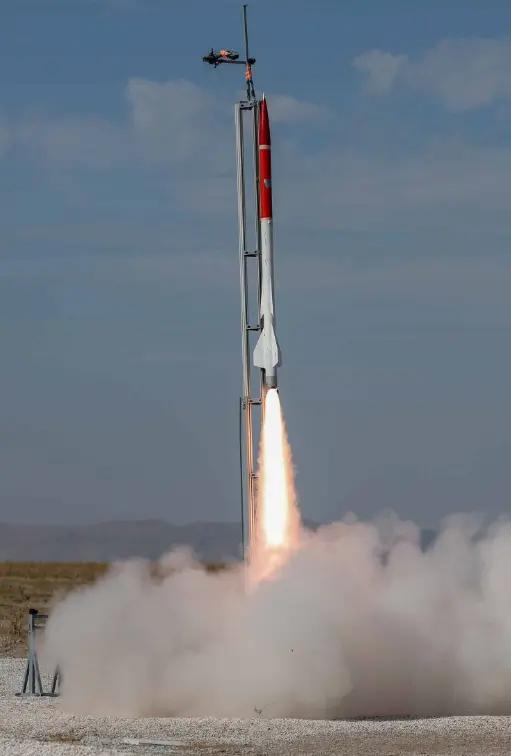
TEKNOFEST Rocket Competition (Photo: T3 Foundation)
Group A categories include the High School Category (minimum 4,000 feet), Medium Altitude Category (minimum 8,000 feet), High Altitude Category (minimum 15,000 feet), International Category (minimum 8,000 feet), Challenging Mission Category (minimum 15,000 feet), and Original Hybrid Motor Rocket Category (minimum 8,000 feet). Group B provides participants with opportunities to compete in the development of Rocket Control Systems, Hybrid Propellant Rocket Motors, and Liquid Propellant Rocket Motors.
The competition process includes stages designed to enhance technical proficiency. Participants must demonstrate the technical accuracy and engineering competence of their projects at each stage. Group A competitors submit technical reports such as the Preliminary Design Report (PDR), Critical Design Report (CDR), and Launch Readiness Report (LRR) to present their projects, and they must test their rockets during assembly, integration, and flight phases.
TEKNOFEST Rocket Competition (Photo: T3 Foundation)
In addition, the process of recovering the rocket together with its payload is also an evaluation criterion. Group B competitors must demonstrate their projects by passing engineering milestones such as component acceptance tests, subsystem acceptance tests, and system acceptance tests. Throughout each stage, participants develop engineering solutions while gaining experience in documentation processes that reinforce their mastery of design methodologies. Templates and Rocket Motor catalogs announced via the TEKNOFEST website are intended to guide participants in their technical preparations.
TEKNOFEST. "Roket Yarışması." TEKNOFEST. Accessed May 9, 2025. https://www.teknofest.org/tr/yarismalar/roket-yarismasi/

No Discussion Added Yet
Start discussion for "TEKNOFEST Rocket Competition" article
Competition Content
Competition Process