+1 More

Registration Number | 1228 | ||||||||
|---|---|---|---|---|---|---|---|---|---|
Registration Date | September 21, 2022 | ||||||||
Application Number | C2021/040 | ||||||||
Application Date | January 29, 2021 | ||||||||
Name of Geographical Indication | Tekirdağ Onion | ||||||||
Product / Product Group(s) | Onion / Processed and Unprocessed Fruits and Vegetables and Mushrooms | ||||||||
Type of Geographical Indication | Designation of Origin | ||||||||
Applicant/Registrant(s) | Tekirdağ Chamber of Commerce and Industry | ||||||||
Registrant’s Address | Turgut Neighborhood, Atatürk Boulevard No: 2, Süleymanpaşa, Tekirdağ | ||||||||
Geographical Boundary | Saray and Şarköy Marmaraereğlisi Muratlı Hayrabolu Malkara Çorlu Including The Districts of Süleymanpaşa Tekirdağ Province | ||||||||
Tekirdağ Onion, belonging to the Allium cepa L. species, is a culinary onion cultivated exclusively within Tekirdağ province and its districts. It possesses unique morphological and biochemical characteristics. It is registered as a designation of origin under the Industrial Property Law No. 6769 and is protected by a geographical indication.
The production area covers the districts of Süleymanpaşa, Çorlu, Hayrabolu, Malkara, Muratlı, Marmaraereğlisi, Saray, and Şarköy within the provincial borders of Tekirdağ. The region is located within the Marmara and Meriç basins and has a semi-humid climate. The soil is rich in organic matter with a light clay-loam texture. These conditions directly affect the distinctive structure and durability of Tekirdağ Onion.
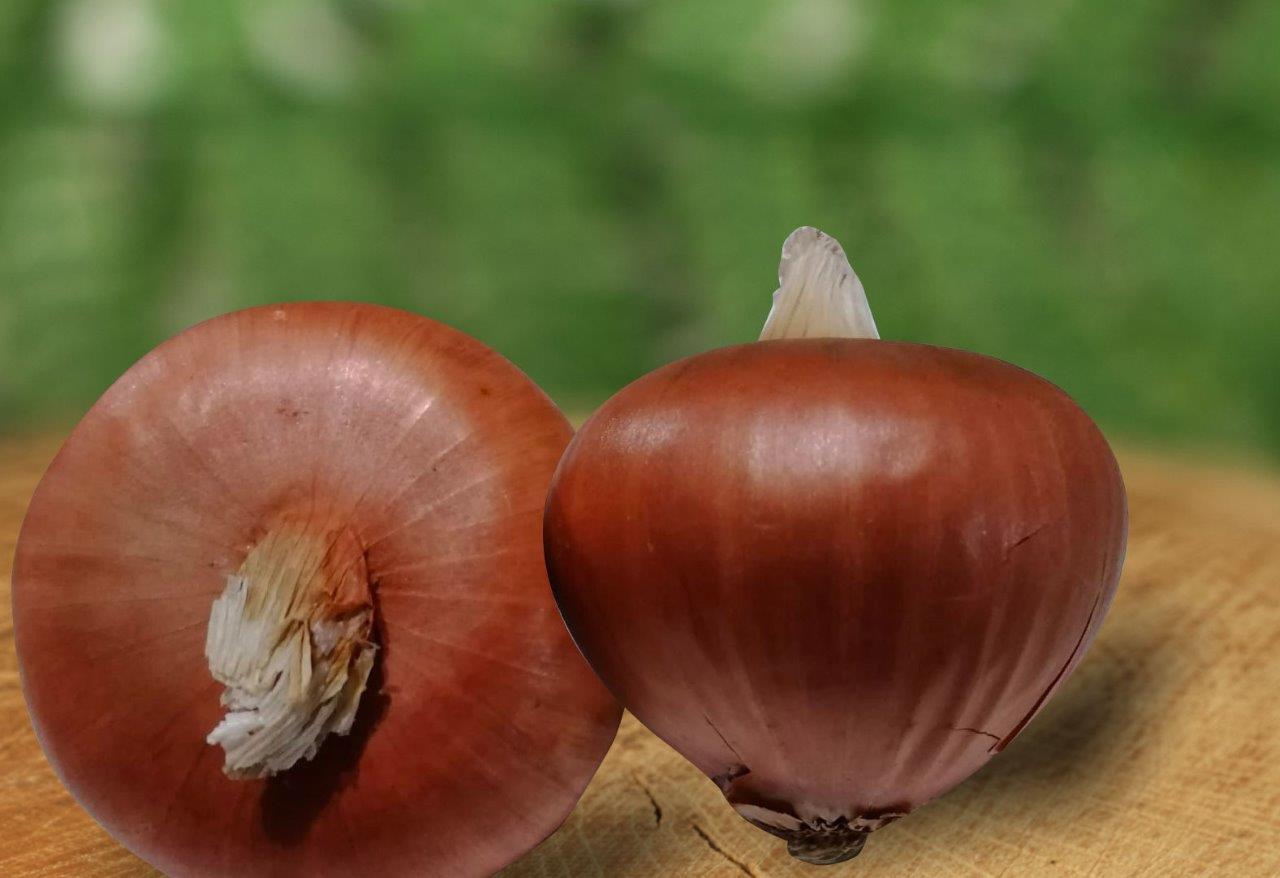
Tekirdağ Onion belongs to the family Alliaceae, the genus Allium, and the species Allium cepa L. It is classified within the A. cepa L. var. cepa variety. In shape, it appears slightly inversely conical when viewed from the side and round when viewed from above. It has a thin neck, with bright orange-copper colored outer skins. The flesh color ranges between pink and light purple, with fleshy leaves that are compact in texture and of medium thickness.
Tekirdağ Onion is notable for its low number of outer skins (2–4 layers), its slightly bitter taste, and pungent aroma. It exhibits 3–6 tillers and forms a white stem (“leg”), which allows it to be used as a mother plant for green onion production. The average bulb diameter is 69.45 mm, with bulb weight and bulb height meeting the species standard. The flesh tissue is dense and durable.
Tekirdağ Onion follows a three-year production cycle:
Tekirdağ Onion has a high water-soluble dry matter content (17.50%). Its moisture content is 83.72%, and total dry matter is 16.28%. Additionally, per 100 g of product, it contains approximately 1.88 g of protein, 18.72 mg of vitamin C, and 5.52 g of invert sugar. These components contribute to its storability and structural resilience.
After drying, the onions can be stored at 0–2 °C and 64% relative humidity for 6–8 months. It is crucial that the bulbs are fully dried and free from disease or mechanical damage prior to storage; otherwise, sprouting risk increases. The relative humidity in storage areas must not exceed 70%.
Tekirdağ Onion is protected as a designation of origin. It was officially registered on 21 September 2022, under Registration No. 1228, Application No. C2021/040. The registering body is the Tekirdağ Chamber of Commerce and Industry. The geographical indication label and the designation of origin emblem must appear on the product or its packaging. If not on the packaging, they must be visibly displayed at the sales location.
The product is generally sold after drying, packed in 50-kg sacks or crates. The geographical indication logo and the designation of origin emblem must be clearly displayed on the packaging or at the point of sale. This practice helps prevent imitation and misleading use of Tekirdağ Onion.
Production, storage, and labeling processes are inspected at least twice a year under the coordination of the Tekirdağ Chamber of Commerce and Industry by a four-member control authority. This authority includes representatives from the Provincial Directorate of Agriculture and Forestry, Süleymanpaşa Chamber of Agriculture, and Süleymanpaşa Municipality. Additional inspections may be conducted if necessary, and services may be obtained from public or private institutions.
Turkish Patent and Trademark Office. Tekirdağ Onion. Accessed July 17, 2025. https://ci.turkpatent.gov.tr/cografi-isaretler/detay/3355.
Turkish Patent and Trademark Office. Tekirdağ Onion Geographical Indication Registration Certificate. PDF file. Accessed July 17, 2025. https://ci.turkpatent.gov.tr/Files/GeographicalSigns/aac4c57e-2e9e-4ac9-8c2d-bbc17c268f92.pdf.

Registration Number | 1228 | ||||||||
|---|---|---|---|---|---|---|---|---|---|
Registration Date | September 21, 2022 | ||||||||
Application Number | C2021/040 | ||||||||
Application Date | January 29, 2021 | ||||||||
Name of Geographical Indication | Tekirdağ Onion | ||||||||
Product / Product Group(s) | Onion / Processed and Unprocessed Fruits and Vegetables and Mushrooms | ||||||||
Type of Geographical Indication | Designation of Origin | ||||||||
Applicant/Registrant(s) | Tekirdağ Chamber of Commerce and Industry | ||||||||
Registrant’s Address | Turgut Neighborhood, Atatürk Boulevard No: 2, Süleymanpaşa, Tekirdağ | ||||||||
Geographical Boundary | Saray and Şarköy Marmaraereğlisi Muratlı Hayrabolu Malkara Çorlu Including The Districts of Süleymanpaşa Tekirdağ Province | ||||||||
Geographical Boundaries and Climatic Features
Botanical Classification and Species Characteristics
Morphological Features and Distinguishing Qualities
Production Method
Chemical and Nutritional Composition
Storage and Preservation Conditions
Geographical Indication and Legal Status
Usage and Marketing
Inspection and Quality Control Mechanism
This article was created with the support of artificial intelligence.