


This article was automatically translated from the original Turkish version.
+2 More
Tarhunza (Hittite and Luwian: Tarḫunt-, Tarhuntas) was the most important storm god in Anatolia during the Late Bronze Age and Iron Age. Revered as the protector deity of the state and ruler of the heavens and storms by the Hattians, Hittites, and Luwians, his name derives from the verb tarḫu-, meaning “to strike powerfully, to defeat, to conquer,” and carries the sense of “invincible, victorious.”
The origins of Tarhunza can be traced back to the Proto-Indo-European storm god Perkwunos. The Indo-European groups that entered Anatolia identified this deity with the local Hattian storm god Taru, elevating Tarhunza to one of the chief deities of the Hittite pantheon. Mythological narratives involving Tarhunza, such as his battle against the serpent Illuyanka, were recorded in the archives of Hattusa, the Hittite capital, during the 2nd millennium BCE; these myths later resonated in Greek and Roman poetry.
After the collapse of the Hittite Empire (12th century BCE), the Late Hittite kingdoms continued the cult of Tarhunza, absorbing many attributes of the Hurrian god Teššub and ascending to the position of chief deity in their pantheon. With the rise of Luwian cultural dominance, Tarhunza acquired dual identities as both a god of war and a god of fertility.
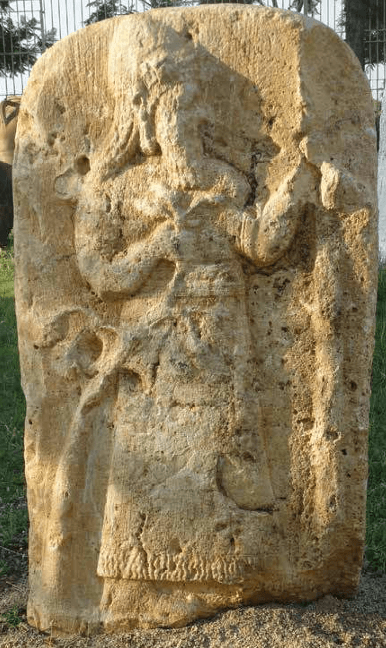
Tarhunza/Tarhuntas (Hawkins, Tosun, Akdoğan
【1】
In Late Hittite art and inscriptions, Tarhunza is depicted with distinct characteristics:
The cult of Tarhunza is attested in numerous centers across Anatolia:
Tarhunza was not merely the god of thunder and storms; he was also perceived as:
During the Late Hittite period, his cult absorbed characteristics of the Hurrian-influenced cult of Teššub, enabling him to emerge prominently as both ruler of the heavens and god of fertility.
The mythological and iconographic legacy of Tarhunza extended beyond Anatolia. He shares significant parallels with Zeus in Greek mythology, particularly in themes of storm, battle against a serpent, and celestial sovereignty. Many rock reliefs and inscriptions from Anatolia remained meaningful to local populations even during the Roman and Byzantine periods, continuing to inspire legends and traditions.
Anaz, Efecan. "The Iconographic Continuity Between the Depictions of Storm Gods in the Late Hittite Period and the Hittite Period." *Akademik Tarih ve Düşünce Dergisi* 12, no. 2 (2025): 774-797. Accessed October 7, 2025. https://dergipark.org.tr/tr/download/article-file/4549046
Demir, Faris. "Karatepe’nin Fırtına Tanrısı Tarhunza Usanuwami ve Baal Krntryš Üzerine Notlar." *Anadolu Araştırmaları*, 25 (2022): 87–101. Accessed October 7, 2025. https://dergipark.org.tr/en/pub/iuanadolu/issue/68204/925349
Hawkins, J. David, Kazım Tosun, Rukiye Akdoğan. "A New Hieroglyphic Luwian Stele in Adana Museum." Höyük, no. 6 (2013): 1-5. Accessed October 7, 2025. https://www.academia.edu/36532585/A_NEW_HIEROGLYPHIC_LUWIAN_STELE_IN_ADANA_MUSEUM
Rojas, Felipe, and Valeria Sergueenkova. "Traces of Tarhuntas: Greek, Roman, and Byzantine Interaction with Hittite Monuments." *Journal of Mediterranean Archaeology* 27, no. 2 (2014): 135–160. Accessed October 7, 2025. https://www.academia.edu/4370889/Traces_of_Tarhuntas_Greek_Roman_and_Byzantine_Interaction_with_Hittite_Monuments
de Hoz, María-Paz, Juan Pablo Sánchez Hernández, and Carlos Molina Valero, ed. Between Tarhuntas and Zeus Polieus: Cultural Crossroads in the Temples and Cults of Graeco-Roman Anatolia. Leuven–Paris–Bristol, CT: Peeters, 2016.
[1]
J. David Hawkins, Kazım Tosun, Rukiye Akdoğan. "A New Hieroglyphic Luwian Stele in Adana Museum" Höyük. Sayı 6 (2013): 1-5. Erişim Tarihi: 7 Ekim 2025. Erişim Bağlantısı

Origin and Historical Development
Iconography
Cult and Worship
Function and Meaning
Legacy