This article was automatically translated from the original Turkish version.
Scientific Name(s) | Chelidonichthys lucerna | ||||||||
|---|---|---|---|---|---|---|---|---|---|
Family | Triglidae | ||||||||
Diet(s) | Small fish crab shrimp | ||||||||
Habitat | Demersal (bottom-dwelling) | ||||||||
Egg Structure | Pelagic, transparent and spherical | ||||||||
Development | Positive allometric growth ( | ||||||||
Substrate Preference | Rocky or sandy areas | ||||||||
Common Names | Gurnard, Flying gurnard | ||||||||
Kırlangıç balığı (Chelidonichthys lucerna, Linnaeus, 1758) is a demersal marine fish species belonging to the family Triglidae. Some species within the order Trigliformes, due to their morphological structure, are referred to as "flying gurnard". The most commonly known species in the literature is the Mediterranean gurnard, and C. lucernus is synonymous with C. lucerna.
The gurnard is widely distributed in the Eastern Atlantic from the coasts of Norway to those of Africa (Senegal), as well as in the English Channel and the North Sea. In Turkish waters it is found in the Marmara, Aegean and Mediterranean Seas, and also in the Black Sea. Although this species is rarely encountered in the Black Sea, it typically occurs at depths of 50 to 100 metres, though its habitat range extends from 5 to 318 metres.【1】
These fish migrate seasonally and are generally concentrated at depths of 20 to 70 metres. They prefer rocky, muddy, pebbly or sandy substrates. The species known as "flying gurnard" typically inhabit sandy and muddy bottoms at depths of 10 to 30 metres but can descend to depths of up to 300 metres. These species occur in waters with temperatures ranging from 8 to 24 °C.【2】 【3】
Gurnards can reach a maximum length of 75 cm and a weight of 6 to 8 kg, but their average length is typically 25 to 30 cm. Studies have identified positive allometric growth (b>3) in examined individuals.【4】
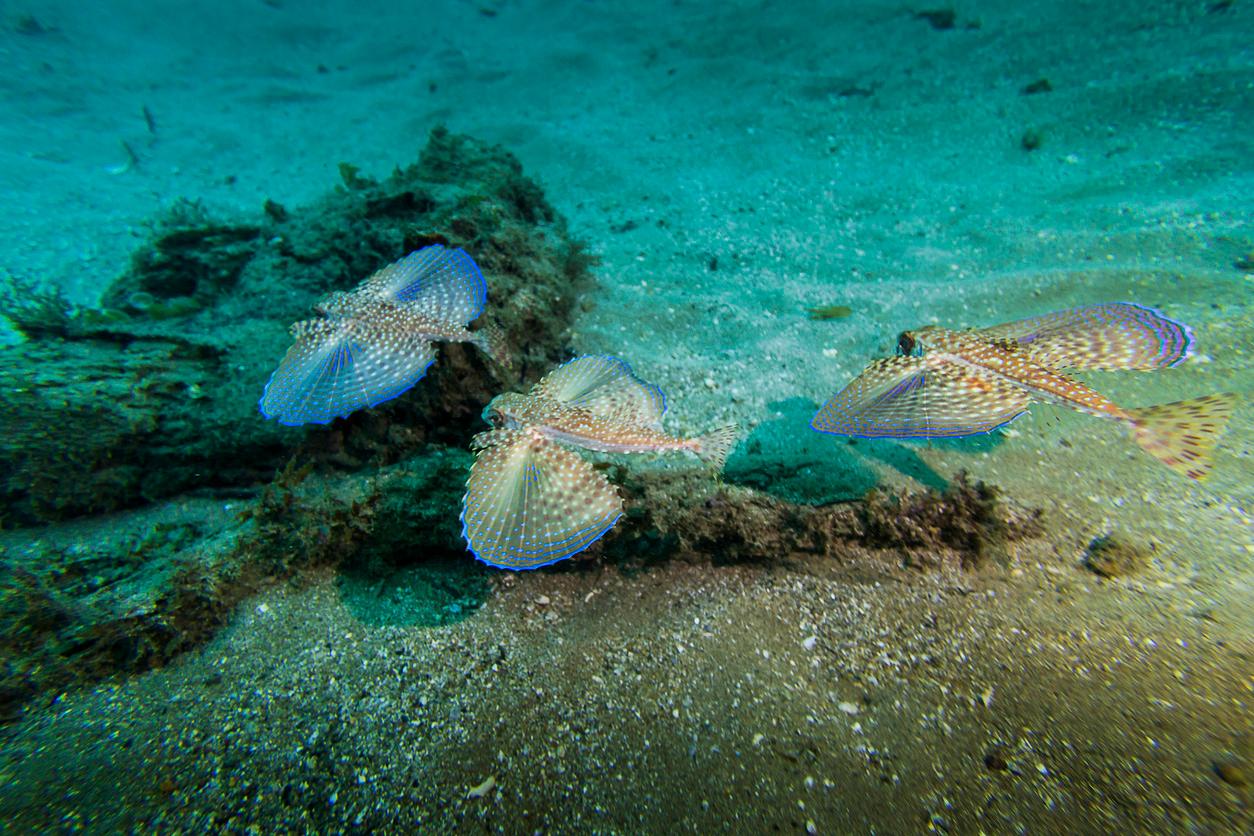
The most distinctive feature of the species known as "flying gurnard" is its wing-like pectoral fins. A blue stripe is visible only when these fins are fully extended. Juveniles are dark brown, while adults are lighter brown with speckles of pale blue and dark brown on their dorsal regions. Additionally, specialized organs located beside the ventral fins enable them to move along the seabed as if walking.
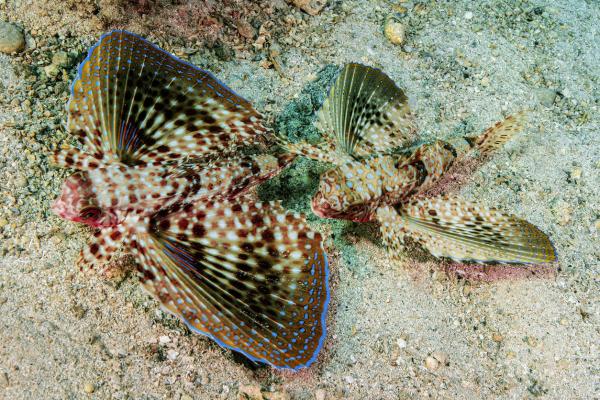
Deniz tabanında yaşayan bir kırlangıç balığı(TUBİTAK)
Demersal gurnards primarily feed on small fish, crustaceans (crabs and shrimp), and molluscs (snails). Other prey species include sea robin, hake and red mullet. Flying gurnards similarly feed on small crabs, shrimp, starfish and worms.
The spawning period of the gurnard varies by geographical region:
• Central Aegean Sea: Begins in February and lasts until June.
• Black Sea (Georgian coasts): Begins in May and continues until the end of September.
• Turkish Studies (SUMAE): Spawning has been recorded from November to January.
Eggs are transparent, pelagic and spherical. Their average diameter is 1.25±0.25 mm (ranging from 1.20 to 1.32 mm) and contain one or more oil globules averaging 0.27 mm in diameter. Approximately 841 eggs are found per gram of gurnard roe. At a water temperature of 15 °C, pre-larvae emerge from fertilized eggs after approximately five days, with newly hatched larvae averaging 3.12 mm in length.【5】
Gurnards captured from natural habitats (using gillnets, trawls and longlines) can be successfully adapted to aquaculture environments. Although initial adaptation is accompanied by stress, jumping out of tanks and excessive activity, feeding on fresh feed typically begins after approximately three days.
Studies have shown that survival rates, initially at 46%, can be increased to 93.5% through fish marking and provision of appropriate husbandry conditions. Adaptation is more successful in individuals larger than 30 cm. Successful hormone induction using LHRH-a has been achieved for egg collection in captivity. These findings indicate that the gurnard has potential as an alternative aquaculture species.【6】
Okatan, Ayşenur. “Türkiye’nin Uçan Kırlangıç Balığı.” TÜBİTAK BilimGenç, August 20, 2020. Accessed February 14, 2026. https://bilimgenc.tubitak.gov.tr/yeryuzu-turkiyenin-ucan-kirlangic-baligi-0
T.C. Ministry of Agriculture and Forestry, Center for Fisheries Research (SUMAE). "Kırlangıç Balığı Araştırılıyor." February 18, 2015. Accessed February 14, 2026. https://arastirma.tarimorman.gov.tr/sumae/Haber/222/Kirlangic-Baligi-Arastiriliyor
Çakmak, Eyüp, Hamza Polat, Zafer Akpınar, Nilgün Aksungur, and Orhan Ak. “Kırlangıç Balığının (Chelidonichthys lucerna L., 1758)’nın Kültür Ortamına Uyumu.” Yunus Araştırma Bülteni 8, no. 1 (2013): 3–9. Accessed February 14, 2026. https://dergipark.org.tr/en/download/article-file/204224
[1]
Eyüp Çakmak, Hamza Polat, Zafer Akpınar, Nilgün Aksungur ve Orhan Ak, “Kırlangıç Balığının (Chelidonichthys lucerna L., 1758)’nın Kültür Ortamına Uyumu,” erişim 9 Mart 2026, https://dergipark.org.tr/en/download/article-file/204224.
[2]
Ayşenur Okatan, “Türkiye’nin Uçan Kırlangıç Balığı,” TÜBİTAK Bilim Genç, 7 Haziran 2019, erişim 9 Mart 2026, https://bilimgenc.tubitak.gov.tr/yeryuzu-turkiyenin-ucan-kirlangic-baligi-0.
[3]
Eyüp Çakmak, Hamza Polat, Zafer Akpınar, Nilgün Aksungur ve Orhan Ak, “Kırlangıç Balığının (Chelidonichthys lucerna L., 1758)’nın Kültür Ortamına Uyumu,” erişim 9 Mart 2026, https://dergipark.org.tr/en/download/article-file/204224.
[4]
Eyüp Çakmak, Hamza Polat, Zafer Akpınar, Nilgün Aksungur ve Orhan Ak, “Kırlangıç Balığının (Chelidonichthys lucerna L., 1758)’nın Kültür Ortamına Uyumu,” erişim 9 Mart 2026, https://dergipark.org.tr/en/download/article-file/204224.
[5]
Hamza Polat ve Eyüp Çakmak, “Kültür Şartlarına Adapte Edilen Kırlangıç Balığı (Chelidonichthys lucernaLinnaeus, 1758)’ndan Döl Alımı,” erişim 9 Mart 2026, https://dergipark.org.tr/en/download/article-file/204234.
[6]
Eyüp Çakmak, Hamza Polat, Zafer Akpınar, Nilgün Aksungur ve Orhan Ak, “Kırlangıç Balığının (Chelidonichthys lucerna L., 1758)’nın Kültür Ortamına Uyumu,” erişim 9 Mart 2026, https://dergipark.org.tr/en/download/article-file/204224.

Scientific Name(s) | Chelidonichthys lucerna | ||||||||
|---|---|---|---|---|---|---|---|---|---|
Family | Triglidae | ||||||||
Diet(s) | Small fish crab shrimp | ||||||||
Habitat | Demersal (bottom-dwelling) | ||||||||
Egg Structure | Pelagic, transparent and spherical | ||||||||
Development | Positive allometric growth ( | ||||||||
Substrate Preference | Rocky or sandy areas | ||||||||
Common Names | Gurnard, Flying gurnard | ||||||||
Geographical Distribution and Habitat
Morphological Characteristics
Feeding Biology
Reproductive Characteristics
Cultivation and Adaptation Studies