badge icon

This article was automatically translated from the original Turkish version.

Article

Superrotation

Astronomy

+2 More

Quote

Planet atmospheric general circulation patterns are typically closely related to the planet’s own rotation speed. However, in some celestial bodies, a peculiar case known as superrotation is observed, in which the atmosphere rotates faster than the solid surface 【1】. This phenomenon attracts intense interest from planetary scientists due to its significant effects on atmospheric momentum transport, heat transfer, and planetary climate 【2】.

Main Celestial Bodies Exhibiting Superrotation

Sun System examples of superrotation are most prominent on Venus and Titan【3】.
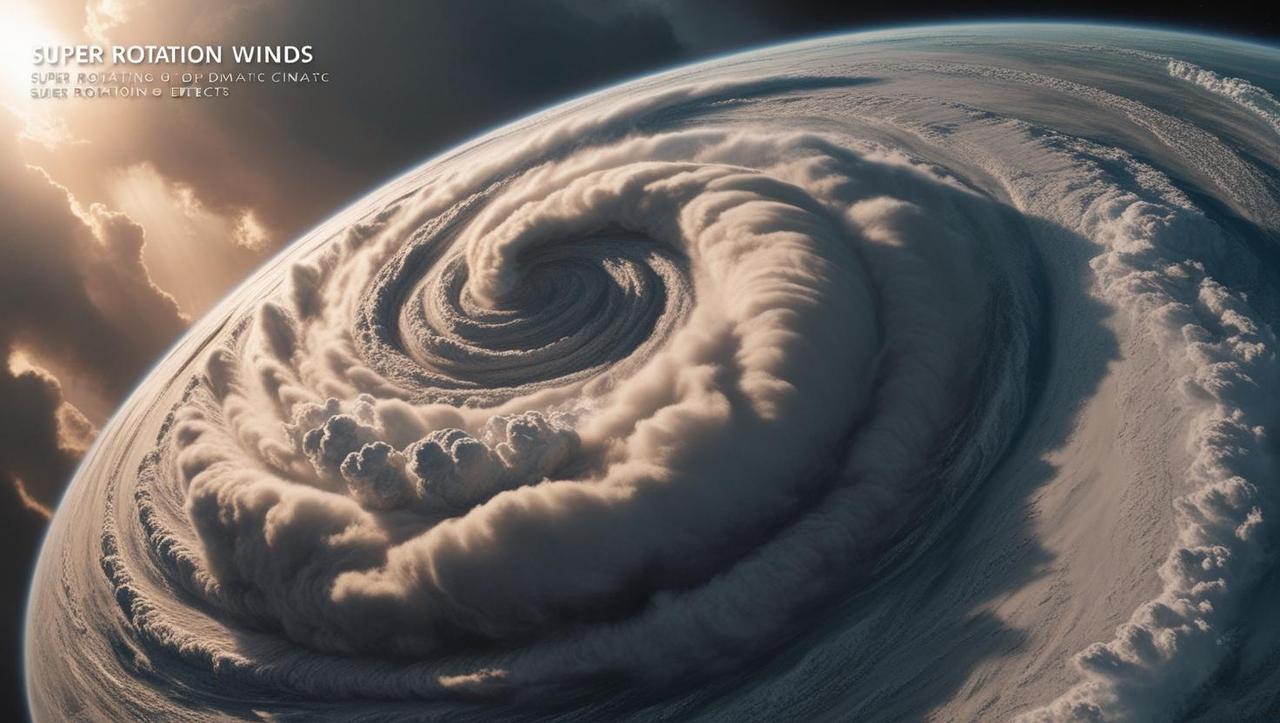

  • Venus: Venus exhibits the most striking example of superrotation in the Solar System. Its atmosphere rotates approximately 60 times faster than the solid surface 【4】. This rapidly rotating atmosphere generates zonal winds reaching speeds of about 100 m/s (360 km/h) at the equator. These winds significantly reduce temperature differences between the day and night sides of the planet, contributing to a relatively uniform surface temperature. The vertical structure and latitudinal dependence of superrotation in Venus’s atmosphere have also been the subject of intensive research.


  • Titan: Titan’s atmosphere also displays a clear superrotation, though not as extreme as on Venus. Data from the Huygens probe and the Cassini spacecraft have shown that Titan’s upper atmosphere rotates faster than its surface. This superrotation plays a crucial role in the distribution of methane clouds and the overall atmospheric circulation. The mechanisms behind superrotation on Titan may differ from those on Venus, and interactions with the methane cycle must also be considered【5】.


Superrotation winds, AI-generated image

Proposed Mechanisms for Superrotation

The underlying physical mechanisms of superrotation are not yet fully understood, but various theories and models have been proposed in the literature. These mechanisms generally focus on momentum transfer processes within the atmosphere.


  • Thermal Tide Theory: According to this theory, thermal tides (atmospheric tides) generated by asymmetric solar heating can drive momentum transfer from the equator toward the poles and vertically. This momentum transfer can contribute to the formation of zonal winds and thus superrotation. It is considered a key component of the strong superrotation observed on Venus 【6】.


  • Wave-Flow Interactions: The interaction of various waves in the atmosphere—such as Kelvin waves, Rossby waves, and gravity waves—with the mean flow can redistribute momentum. The transfer of energy and momentum from these waves to the zonal flow may play a vital role in sustaining superrotation. These mechanisms are thought to be particularly effective in explaining superrotation in Titan’s atmosphere【7】.


  • Viscous Friction and Boundary Layer Effects: Viscous friction between the lower atmospheric layers and the planetary surface may cause the upper atmosphere to rotate faster. Boundary layer theory predicts momentum transfer upward from slow-moving air masses near the surface. However, this mechanism alone is considered insufficient to explain the extreme superrotation observed on Venus.


  • Chaotic Advection and Turbulence: Turbulent flows and chaotic advection processes in the atmosphere can facilitate efficient large-scale momentum transport. These processes may play an indirect role in the formation and maintenance of zonal flows.

Effects of Superrotation on Atmospheric Dynamics

Superrotation significantly influences the general circulation patterns and climates of planetary atmospheres.


  • Heat Transfer: Fast zonal winds can greatly enhance heat transfer between different latitudes and longitudes. Superrotation on Venus is thought to play a critical role in maintaining the planet’s relatively uniform surface temperature 【8】.


  • Cloud Formation and Distribution: Superrotation can affect the formation, movement, and distribution of clouds in the atmosphere. Zonal winds can lead to the formation and latitudinal spreading of cloud bands. Observations have shown that superrotation on Titan influences the transport of methane clouds toward the poles.


  • Atmospheric Chemistry: Rapid atmospheric motions can influence the mixing and reactions of different chemical species. Superrotation can alter the distribution and concentration of atmospheric components.


Superrotation remains a fundamental challenge in understanding planetary atmospheres. This phenomenon, observed on diverse celestial bodies such as Venus and Titan, highlights the complexity of atmospheric dynamics and the diversity of planetary climate systems. Identifying universal mechanisms underlying superrotation and comparing its manifestations across different planets are important research goals in planetary science.

Bibliographies

Andrews, D. G., & McIntyre, M. E. (1978). Generalized Eliassen–Palm theorem and its applications to middle atmosphere dynamics. Journal of Atmospheric and Terrestrial Physics, 40(2), 185-217.

Correia, J. C., Forget, F., Hourdin, F., Lebonnois, S., & тренировки, М. (2014). Superrotation in планетарных атмосферах: A review. Space Science Reviews, 186(1-4), 179-212.

Del Genio, A. D.,窯元, 孝行, Houze Jr, R. A., & Ingersoll, A. P. (2007). Titan's atmospheric circulation. Nature, 445(7123), 66-69.

Mitchell, C. J., Müller-Wodarg, I. C. F., Yelle, R. V., & Müller, J. (2006). Zonally averaged dynamical model of Titan's thermosphere and ionosphere. Journal of Geophysical Research: Space Physics, 111(A12).

Richard, E., & Vallis, G. K. (2011). Mechanisms of superrotation in planetary atmospheres. Journal of the Atmospheric Sciences, 68(8), 1725-1742.

TÜBİTAK Bilim Genç. (n.d.). Dünya'nın Çekirdeği Dönmeyi Durdurursa Ne Olur? Accessed April 10, 2025.https://bilimgenc.tubitak.gov.tr/makale/dunyanin-cekirdegi-donmeyi-durdurursa-ne-olur

Citations

  • [1]

    Read & Lebonnois, 2018

  • [2]

    Schubert et al., 2007

  • [3]

    Satürn'ün en büyük uydusu

  • [4]

    Schubert &ным, 1983

  • [5]

    Tokano, 2005

  • [6]

    Gierasch, 1975 - Correia et al., 2014

  • [7]

    Andrews & McIntyre, 1978 - Del Genio et al., 2007

  • [8]

    Bullock & Grinspoon, 2001

Author Information

Avatar
AuthorCaner Sefa KoçyiğitJuly 21, 2026 at 4:47 PM

Discussions

No Discussion Added Yet

Start discussion for "Superrotation" article

View Discussions

Contents

  • Main Celestial Bodies Exhibiting Superrotation

  • Proposed Mechanisms for Superrotation

  • Effects of Superrotation on Atmospheric Dynamics