

This article is not approved yet.
+1 More
Key Components | Compressor, Turbine, Recuperator, Heat Exchangers | ||||||||
|---|---|---|---|---|---|---|---|---|---|
Primary Applications | Nuclear, Solar, Fossil Fuels | ||||||||
Efficiency Range | 45–55% | ||||||||
Critical Point | 7.38 MPa, 31.1°C | ||||||||
Working Fluid | Supercritical Carbon Dioxide (sCO₂) | ||||||||
Cycle Name | Supercritical CO₂ Brayton Cycle | ||||||||
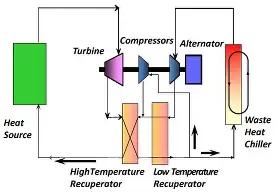
The supercritical carbon dioxide (sCO₂) Brayton cycle is a power generation technology that uses carbon dioxide above its critical point (7.38 MPa, 31.1°C) as a working fluid. This cycle converts thermal energy into electricity through a closed-loop process, leveraging CO₂’s liquid-like density and gas-like transport properties near its critical region. Developed initially for nuclear applications, it now serves solar thermal, waste heat recovery, and fossil fuel systems due to its high efficiency (exceeding 50%), compact turbomachinery, and reduced water consumption.
CO₂’s critical point enables operation with low compression work near the pseudocritical region, where density sharply decreases with minor temperature increases. This property reduces compressor energy by 20–30% compared to air-based systems. CO₂’s high density also allows smaller turbomachinery (e.g., turbines 10x smaller than steam equivalents), lowering capital costs. Additionally, its inert nature permits operation at high temperatures (up to 750°C) without corrosion.
sCO₂ cycles serve as primary power converters for Generation IV reactors (e.g., sodium-cooled fast reactors) due to compactness and safety. They also function as passive decay heat removal systems. Projects include Sandia National Laboratories’ 780 kW prototype (32% efficiency) and China’s 5 MW test unit.
Concentrating solar power (CSP) plants use sCO₂ cycles for high efficiency (≈30%) at moderate temperatures (450–600°C). CSIRO’s pilot project reduced costs to <10¢/kWh by integrating thermal storage and dry cooling.
Fluctuations in heat source power or mass flow cause efficiency variations (e.g., ±1.5% during transients). Dynamic models in Simulink optimize control strategies for stability. Material degradation remains problematic, particularly for seals exposed to sCO₂, prompting research into carbon-resistant composites.
Ahn, Y., and Lee, J. “Dynamic Characteristic Study of Supercritical CO2 Recompression Brayton Cycle System.” Frontiers in Energy Research. Accessed August 16, 2025. https://www.frontiersin.org/journals/energy-research/articles/10.3389/fenrg.2022.843237/full.
Crespi, F., et al. “Performance Improvement Overview of the Supercritical Carbon Dioxide Brayton Cycle.” Processes. Accessed August 16, 2025. https://www.mdpi.com/2227-9717/11/9/2795.
DOE. “SCO2 Power Cycles.” U.S. Department of Energy. Accessed August 16, 2025. https://www.energy.gov/sco2-power-cycles.
Guo, J., et al. “New Knowledge on the Performance of Supercritical Brayton Cycle with CO2-Based Mixtures.” Energies. Accessed August 16, 2025. https://www.mdpi.com/1996-1073/13/7/1741.
NETL. “Supercritical CO2 Power Cycles.” National Energy Technology Laboratory. Accessed August 16, 2025. https://netl.doe.gov/node/7548.
Sciencedirect. “Supercritical CO2 Brayton Cycle: A State-of-the-Art Review.” Energy. Accessed August 16, 2025. https://www.sciencedirect.com/science/article/pii/S0360544219315786.

Key Components | Compressor, Turbine, Recuperator, Heat Exchangers | ||||||||
|---|---|---|---|---|---|---|---|---|---|
Primary Applications | Nuclear, Solar, Fossil Fuels | ||||||||
Efficiency Range | 45–55% | ||||||||
Critical Point | 7.38 MPa, 31.1°C | ||||||||
Working Fluid | Supercritical Carbon Dioxide (sCO₂) | ||||||||
Cycle Name | Supercritical CO₂ Brayton Cycle | ||||||||
No Discussion Added Yet
Start discussion for "Supercritical CO₂ Brayton Cycle" article
Thermodynamic Fundamentals and Working Fluid Properties
Critical Point Advantages
Thermodynamic Analysis Methods
Cycle Configurations and Performance Enhancement
Common Layouts
Performance Improvement Methods
Applications and Heat Source Integration
Nuclear Power
Solar Thermal Energy
Fossil Fuels and Waste Heat
Key Components and Technical Challenges
Turbomachinery and Heat Exchangers
Dynamic Control and Material Compatibility
Research and Development Status
Global Pilot Projects
Recent Advances
This article was created with the support of artificial intelligence.