

This article is not approved yet.
+2 More
Primary Use | Supercapacitor Electrodes | ||||||||
|---|---|---|---|---|---|---|---|---|---|
Material Source | Food Waste | ||||||||
Environmental Impact | Reduces Landfill Waste, Methane Emissions | ||||||||
Applications | Electric Vehicles, Portable Electronics, Renewable Energy | ||||||||
Specific Capacitance | 205.8–812.8 F/g | ||||||||
Key Processes | Hydrothermal Carbonization, Pyrolysis, KOH Activation | ||||||||
Challenge(s) | Scalability Raw Material Variability | ||||||||
Advantage(s) | Sustainability Cost-Effectiveness High Surface Area | ||||||||
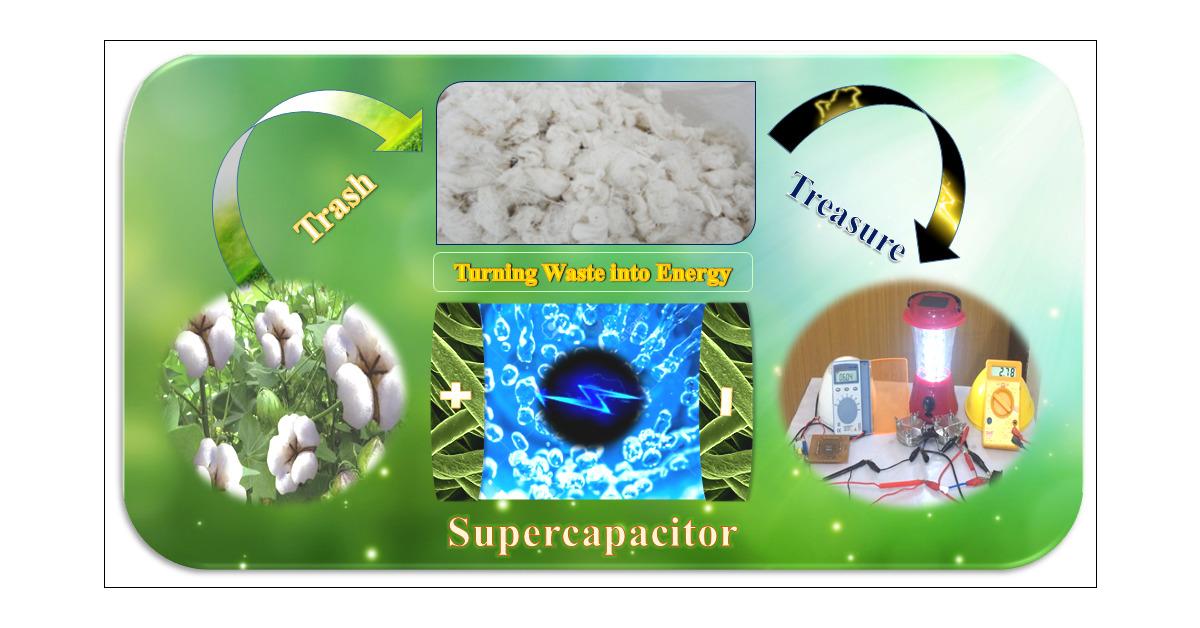
The development of supercapacitor electrodes from food waste involves converting carbon-rich biomass into high-performance porous carbon materials. This process provides a sustainable and low-cost alternative to conventional electrode materials derived from fossil fuels. Various types of food waste, such as fruit peels, nut shells, and coffee grounds, are used as precursors. The conversion is typically achieved through pyrolysis and an activation process, resulting in activated carbon with a high surface area and tailored porosity, which are critical properties for efficient electrochemical energy storage.
The transformation of food waste into electrode material is a multi-step thermochemical process. The first stage is pyrolysis, where the raw biomass is heated to high temperatures (typically 400–800°C) in an inert atmosphere, devoid of oxygen. This process, known as carbonization, thermally decomposes the organic matter, removing volatile components and leaving behind a solid, carbon-rich residue called biochar. The second stage is activation, which is performed to dramatically increase the surface area and create a network of pores within the biochar. This can be done through physical activation, using agents like steam or carbon dioxide at elevated temperatures, or chemical activation, which involves impregnating the biochar with a chemical agent (e.g., potassium hydroxide, phosphoric acid) followed by heat treatment. Chemical activation is widely used as it can produce carbons with exceptionally high surface areas (over 2000 m²/g) and a hierarchical pore structure, making them highly suitable for supercapacitor applications.
The performance of a supercapacitor electrode is directly linked to the physical and chemical properties of its constituent material. The primary energy storage mechanism in these devices is the formation of an electric double-layer (EDL) at the electrode-electrolyte interface. A larger electrode surface area allows for a greater accumulation of ions, resulting in higher capacitance and energy density. The porous structure of food waste-derived activated carbon is also critical; micropores (less than 2 nm) provide the primary sites for ion adsorption, while mesopores (2–50 nm) serve as channels for efficient ion transport, enabling rapid charging and discharging (high power density). Furthermore, food waste often contains naturally occurring elements like nitrogen, oxygen, and phosphorus. During pyrolysis, these elements can become incorporated into the carbon lattice, a process known as heteroatom doping. This doping can enhance the material's wettability and introduce pseudocapacitance, an additional charge storage mechanism based on fast surface redox reactions, which further increases the total energy storage capacity of the electrode.
Utilizing food waste as a precursor for supercapacitor electrodes aligns with the principles of a circular economy by valorizing a low-value, abundant resource. This approach helps divert significant amounts of organic waste from landfills, where it would otherwise decompose and release methane, a potent greenhouse gas. A wide variety of food waste materials have been successfully converted into high-performance activated carbons, including durian shells, banana peels, coffee grounds, rice husks, and walnut shells. Each precursor yields carbon with unique morphological and chemical characteristics depending on its intrinsic composition and the processing conditions. While this method presents a sustainable and cost-effective route for producing energy storage materials, challenges remain. The inherent variability in the composition of food waste can lead to inconsistencies in the final product's properties. Therefore, standardizing the process and ensuring consistent quality at an industrial scale are key areas of ongoing research.
"Flour food waste derived activated carbon for high-performance supercapacitors." RSC Advances 6 (2016). Accessed August 16, 2025. https://pubs.rsc.org/en/content/articlelanding/2016/ra/c6ra18056f
"High supercapacitive performance of food waste extracted activated carbon." Bioresource Technology Reports 20 (2022). Accessed August 16, 2025. https://www.sciencedirect.com/science/article/abs/pii/S2589014X22002985
"Preparation of Supercapacitor Carbon Electrode Materials by Low-Temperature Carbonization of High-Nitrogen-Doped Raw Materials from Food Waste." Materials 17, no. 16 (2024). Accessed August 16, 2025. https://www.mdpi.com/1996-1944/17/16/3984
"Recent advances in food waste-derived nanoporous carbon for energy storage applications." Science and Technology of Advanced Materials 25, no. 1 (2024). Accessed August 16, 2025. https://www.ncbi.nlm.nih.gov/pmc/articles/PMC11149580/
"Recycling Black Tea Waste Biomass as Activated Porous Carbon for Supercapacitors." Materials 14, no. 21 (2021). Accessed August 16, 2025. https://www.ncbi.nlm.nih.gov/pmc/articles/PMC8585355/
Guo, Yao, Chang Liu, Xiao-Xiao Zhang, Lin-Xin Yin, Ya-Qi Shan, and Pei-Gao Duan. "Preparation of supercapacitor carbon materials from food waste via low-temperature pyrolysis." Journal of Analytical and Applied Pyrolysis (2023). Accessed August 16, 2025. https://www.sciencedirect.com/science/article/abs/pii/S0165237023000244
Tripathy, Alekhika, Piyusha Priyadarshini Pradhan, Ankita Mohanty, Smita Mohanty, and Ananthakumar Ramadoss. "High supercapacitive performance of food waste extracted activated carbon." Bioresource Technology Reports (2022). Accessed August 16, 2025. https://ui.adsabs.harvard.edu/abs/2022BiTeR..2001241T/abstract

Primary Use | Supercapacitor Electrodes | ||||||||
|---|---|---|---|---|---|---|---|---|---|
Material Source | Food Waste | ||||||||
Environmental Impact | Reduces Landfill Waste, Methane Emissions | ||||||||
Applications | Electric Vehicles, Portable Electronics, Renewable Energy | ||||||||
Specific Capacitance | 205.8–812.8 F/g | ||||||||
Key Processes | Hydrothermal Carbonization, Pyrolysis, KOH Activation | ||||||||
Challenge(s) | Scalability Raw Material Variability | ||||||||
Advantage(s) | Sustainability Cost-Effectiveness High Surface Area | ||||||||
No Discussion Added Yet
Start discussion for "Supercapacitor Electrodes from Food Waste" article
Conversion of Food Waste to Activated Carbon
Electrochemical Properties and Performance
Sustainability and Feedstock Sources
This article was created with the support of artificial intelligence.