


This article was automatically translated from the original Turkish version.
Submarines have become one of the most sophisticated and strategic elements of naval warfare technology. Their ability to conduct prolonged operations underwater, their advantage of invisibility, and their potential to carry missiles have secured them a vital place among the indispensable assets of modern naval forces.
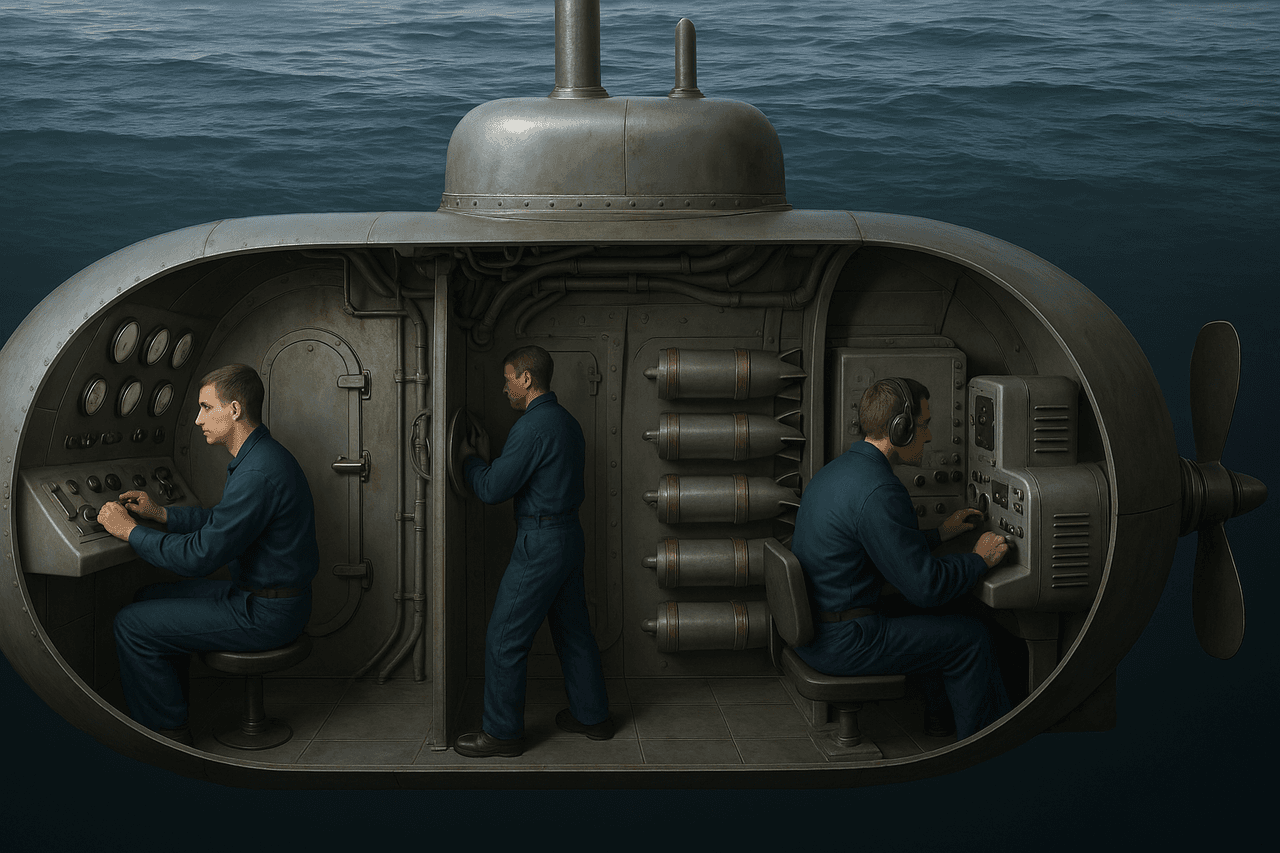
Visual generated by artificial intelligence
The concept of submarines extends historically back to the 16th century. Leonardo da Vinci’s sketches contain the earliest designs for vehicles capable of traveling underwater. However, the first practical and operational submarine was built in 1620 by Cornelius Drebbel. During tests on the River Thames, this human-powered vessel succeeded in moving short distances underwater (Konur, 2019).
The 18th and 19th centuries were a period of trial and error in submarine development. In 1863, France developed the “Plongeur,” a steam-powered submarine that entered history as the first mechanically propelled submarine. This era also marked the beginning of recognition of the submarine’s potential military impact with the development of torpedo systems.
At the beginning of the 20th century, the development of diesel-electric engines increased both the range and submerged endurance of submarines. These engines operated on diesel fuel while surfaced and switched to electric motors when submerged, enabling quieter and more covert operations.
In 1954, the United States developed the USS Nautilus, which became the first nuclear-powered submarine in history. Nuclear submarines can remain operational for years without refueling, significantly enhancing their strategic advantage (Polmar & Moore, 2004). Additionally, the energy provided by nuclear reactors enables them to travel long distances at high speeds.
Today, submarines operate integrated with artificial intelligence-assisted navigation systems, advanced sonars, acoustic camouflage systems, fiber-optic communication technologies, and unmanned underwater vehicles. These technologies have rendered the detection of submarines underwater nearly impossible.
During World War II, particularly German “U-Boat” submarines had a significant impact in the Atlantic. These submarines, used to disrupt trade routes, became one of the war’s decisive elements (Blair, 1996). During the Cold War, submarines acquired the capability to carry nuclear-tipped ballistic missiles, providing a “second-strike” capability.
Modern submarines serve various mission profiles:
Many countries, including Türkiye, are developing modern submarines to establish strategic superiority in this domain. Türkiye’s Reis-class submarine project is an example of this strategy.
Because submarines operate in enclosed, pressure-resistant environments, interior design is of great importance. In military submarines, ergonomic design, alongside military hierarchy, task allocation, and security factors, plays a decisive role (Kılıç, 2020).
Additionally, the arrangement of living spaces, lighting, and sound insulation are critical factors for maintaining psychological resilience during prolonged missions.
Submarines are not only used for military purposes but also in civilian fields such as deep-sea research, mining, cable laying, and natural disaster investigations. In particular, vessels capable of reaching the deepest regions of the ocean, such as the Mariana Trench, provide valuable data about Earth’s unknown areas.
Submarine technologies are becoming more autonomous thanks to advances in artificial intelligence and unmanned systems. Countries such as the United States, China, and Russia continue research and development efforts on fully unmanned and AI-controlled submarines.
In addition, magnetic propulsion systems, advanced carbon-composite hulls, and biomimetic designs (fish-like shapes) are gaining prominence to enhance stealth and reduce noise.
Submarines are vessels of high historical and strategic importance whose technological evolution continues to shape modern warfare. Their capabilities in both military and civilian domains have made them one of the most significant engineering achievements of the 21st century. In the coming years, submarines integrated with artificial intelligence and robotic systems are expected to reshape global military balances.
Arslan, K., and Tokol, H. T. “Harp ve Denizaltı Filo Bağlısı Gemilerde Yaşam Mahallerinin İç Mekân Tasarımını Etkileyen Kriterler: Askeri Hiyerarşik Sistem.” *Bodrum Journal of Art and Design* 2, no. 1 (2022): 59–75. Accessed April 8, 2025.
Blair, Clay. *Silent Victory: The U.S. Submarine War Against Japan.* New York: Bantam Books, 1976. Accessed April 8, 2025.https://archive.org/details/silentvictoryuss0000blai
Kılıç, O. “Askeri Denizaltıların İç Mekân Kurgularının Ergonomi Kapsamında İrdelenmesi.” *Elektronik Sosyal Bilimler Dergisi* 19, no. 73 (2020): 383–394. Accessed April 8, 2025.https://dergipark.org.tr/tr/pub/esosder/issue/50289/569923
Polmar, Norman, and Kenneth J. Moore. *Cold War Submarines: The Design and Construction of U.S. and Soviet Submarines.* Dulles, VA: Brassey’s, 2004. Accessed April 8, 2025.

Historical Background and Early Developments
Technological Evolution: From Diesel to Nuclear
Diesel-Electric Systems
The Nuclear Energy Era
Modern Technologies and Silence
Military Applications
World War II and Beyond
Strategic Role Today
Ergonomics and Interior Design
Civilian Use and Scientific Research
Future Developments