


This article was automatically translated from the original Turkish version.
+1 More
Stratosphere
Altitude Range | 10 km (poles) - 50 km (equator) | ||||||||
|---|---|---|---|---|---|---|---|---|---|
Temperature Profile | Temperature increases with altitude | ||||||||
Main Component | Nitrogen (%78) Trace Gases Water Vapor Ozone Oxygen (%21) | ||||||||
Key Features | Stratosphere-Troposphere Interaction Horizontal Wind Systems Ozone Layer | ||||||||
Impact of Climate Change | Stratospheric Cooling Ozone Layer Depletion Aerosol Effects | ||||||||
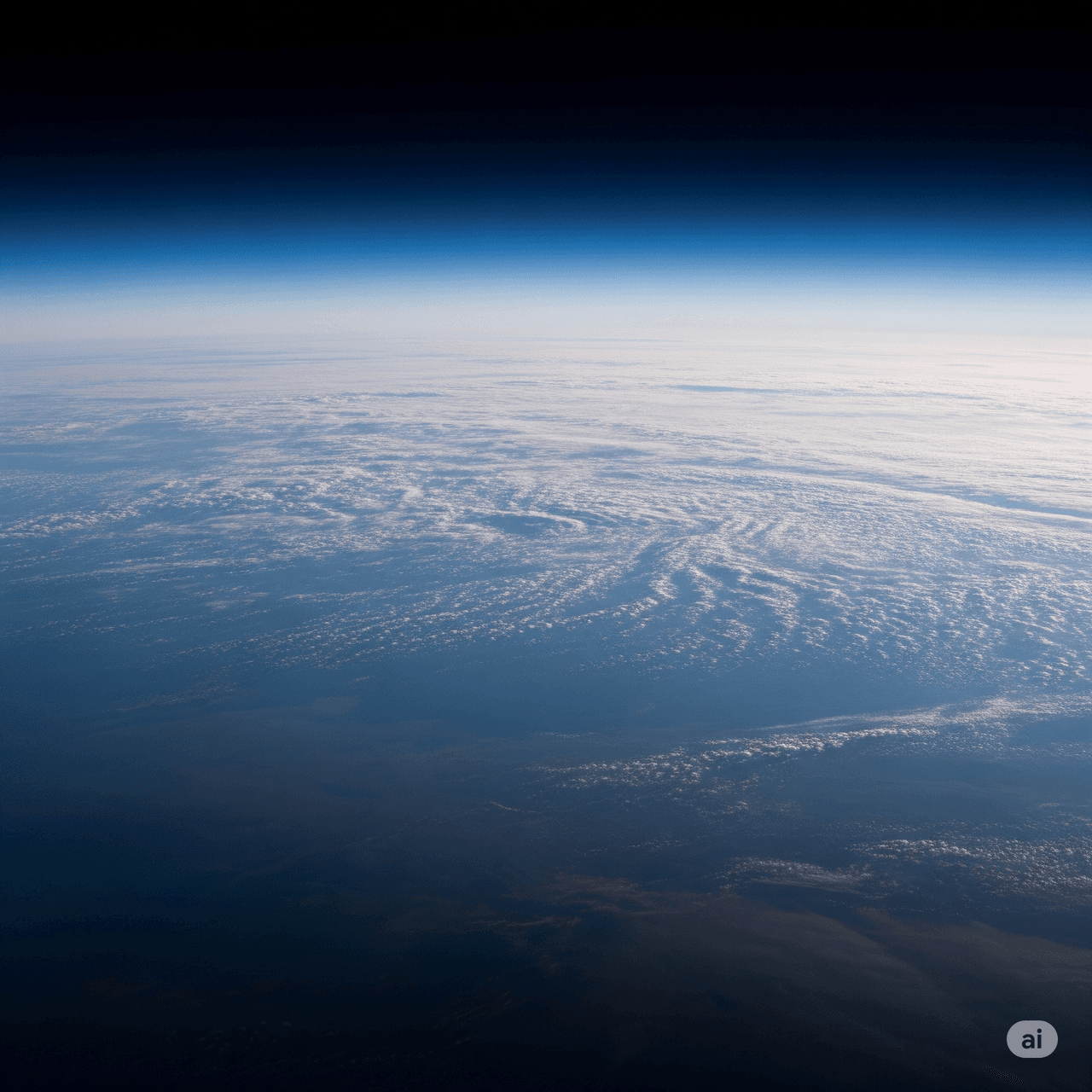
The stratosphere is a layer extending immediately above the Earth’s atmosphere’s troposphere, between the tropopause and the stratopause. Unlike the troposphere near the Earth’s surface, temperature in the stratosphere increases with altitude; this structure suppresses vertical air movements and renders the layer dependent on horizontal flows. The warming caused by ozone molecules absorbing harmful ultraviolet radiation from the Sun forms the primary thermal engine of the stratosphere. The stratosphere plays a decisive role in atmospheric chemistry, climate dynamics, and communication systems.
Until the late 19th century, the atmosphere was considered a single homogeneous mass. Léon Teisserenc de Bort, through more than 200 balloon soundings conducted between 1898 and 1902, identified a layer above the troposphere where temperature stabilized and then rose again at higher altitudes. In his experiments on 28 April 1902, he named this second layer the “stratosphere.” Independent balloon studies by Richard Assmann during the same period confirmed the stratospheric temperature profile. This discovery marked a turning point in understanding the vertical structure of the atmosphere and paved the way for the development of meteorology and atmospheric physics.
Teisserenc de Bort’s findings were first published in Comptes Rendus de l’Académie des Sciences and summarized as a “warmer air current at altitudes of 10–15 km.” In subsequent years, studies based on radiosonde data refined the boundaries of the tropopause and stratopause. During the 20th century, the widespread use of atmospheric sounding instruments enriched stratospheric research quantitatively and enabled more detailed investigation of this layer’s impact on the climate system.
Stratosfer (MGM)
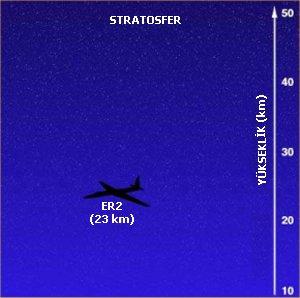
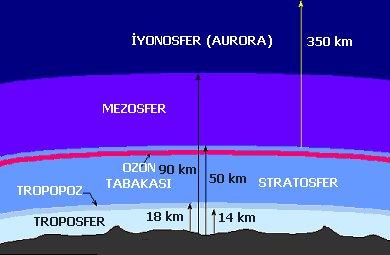
The stratosphere lies between the tropopause (~10–17 km) and the stratopause (~50 km). While the average temperature at the tropopause is around –60 °C, it rises to approximately –2 °C near the stratopause. Pressure decreases rapidly with altitude: it is about 100 mbar at the tropopause and drops to ~1 mbar at the stratopause. This inverted temperature gradient promotes horizontal flows and wave propagation in the stratosphere, replacing convection dominant in the troposphere.
Radiosonde analyses clearly reveal the thermal structure between the tropopause and stratopause. In the lower stratosphere (~17–25 km), the rate of temperature increase is more rapid; the upper stratosphere (~25–50 km) exhibits a more gradual gradient. These structural differences determine how chemical processes and energy transfer operate within the layer.
The main gases are nitrogen (~78%) and oxygen (~21%), while water vapor, argon, and trace gases together account for about 1% of the composition. Ozone (O₃) is concentrated in the stratospheric layer between 15 and 35 km and is continuously replenished through photochemical cycles. Ozone concentration is lower in equatorial regions and higher at mid and polar latitudes. Chlorofluorocarbons released by human activities break down ozone molecules in the stratosphere, leading to thinning of the ozone layer.
These values directly influence the stability of the stratosphere and the rates of chemical reactions. The distribution of pressure and temperature determines the role of wave motions in troposphere–stratosphere interactions.
The ozone layer protects life on Earth by absorbing UV-B (280–315 nm) and UV-C (100–280 nm) radiation. The average column ozone density is 300 Dobson Units (DU), but during Antarctic “ozone hole” periods it falls below 220 DU. Geographic and seasonal variations in ozone concentration reflect the nature of stratospheric chemistry and dynamic processes. The latitudinal distribution of stratospheric ozone is shaped by the Brewer-Dobson circulation, which limits ozone production in the tropics while promoting its accumulation at the poles.
During winter months in the Northern Hemisphere, tropospheric waves penetrating into the stratosphere trigger sudden stratospheric warming events. During these events, stratospheric temperatures can rise by dozens of degrees within days, disrupting the structure of the polar vortex. SSW events influence surface weather conditions, particularly cold air outbreaks at mid-latitudes.
The severe SSW event observed in 2009 caused extreme cold air outbreaks across Europe. These events alter wind patterns in the stratosphere, inducing abrupt phase shifts in the North Atlantic Oscillation (NAO) and Arctic Oscillation (AO) indices in the troposphere.
Wave energy generated in the stratosphere propagates downward into the troposphere, directing surface weather systems. Particularly after SSW events, pressure changes at the tropopause and deviations in jet streams can lead to climatic anomalies. This interlayer energy transfer is a critical parameter in climate modeling. Stratospheric waves, especially Rossby and gravity waves, play a major role in energy transfer to the troposphere. During this process, potential vorticity gradients at the tropopause modulate the momentum flux from the stratosphere, influencing the direction of surface pressure systems.
Atmosfer (MGM)
In the equatorial stratosphere (~16–35 km), easterly and westerly winds alternate in cycles of 22 to 34 months. The QBO regulates tropical wave motions and stratosphere–troposphere interactions. This oscillation has indirect effects on global mean temperature distribution and tropical cyclone activity. The influence of the QBO extends beyond the tropics; by affecting the stability of the polar vortex, it exerts indirect control over the winter stratosphere. The probability of SSW events increases significantly during the easterly phase of the QBO.
A large-scale circulation characterized by strong westerly winds during winter in polar regions. Wind speeds reach 20–60 m/s at pressure levels of 10–50 hPa. The polar vortex is the primary driver of seasonal variations in SSW events and ozone distribution.
Volcanic eruptions or anthropogenic pollutants inject aerosols into the stratosphere, reflecting solar radiation. This causes short-term surface cooling while also altering stratospheric chemistry. Aerosol particles can enhance ozone destruction and accelerate chemical reaction rates. Sulfate-based aerosols increase the formation of polar stratospheric clouds (PSCs), thereby boosting the ozone-depleting capacity of chlorine compounds. For example, after the 1991 eruption of Mount Pinatubo, stratospheric sulfate concentrations rose and global temperatures temporarily decreased by approximately 0.5 °C.
Añel, Juan A. 2015. “The Stratosphere: History and Future a Century after Its Discovery: A Review of The Physics of the Stratosphere, by Goody.” *Contemporary Physics* 57 (2): 230–33. Accessed May 26, 2025.https://doi.org/10.1080/00107514.2015.1029521
Baldwin, M. P., L. J. Gray, T. J. Dunkerton, K. Hamilton, P. H. Haynes, W. J. Randel, J. R. Holton, et al. "The Quasi-Biennial Oscillation." *Reviews of Geophysics* 39, no. 2 (2001): 179–229. Accessed May 26, 2025.https://doi.org/10.1029/1999rg000073
Gettelman, A., M. L. Salby, and F. Sassi. "Distribution and Influence of Convection in the Tropical Tropopause Region." *Journal of Geophysical Research: Atmospheres* 107, no. D10 (2002): ACL 6-1–ACL 6-15. Accessed May 26, 2025.https://doi.org/10.1029/2001jd001048
MGM. "Sıkça Sorulan Sorular." Meteoroloji Genel Müdürlüğü. Accessed May 26, 2025.https://www.mgm.gov.tr/genel/sss.aspx?s=atmosfer
Rempel, Matthias, and Rolf Schlichenmaier. "Sunspot Modeling: From Simplified Models to Radiative MHD Simulations." *Living Reviews in Solar Physics* 8, no. 3 (2011). Accessed May 26, 2025.https://doi.org/10.12942/lrsp-2011-3
World Meteorological Organization (WMO). *Scientific Assessment of Ozone Depletion: 2018*. Global Ozone Research and Monitoring Project—Report No. 58. Geneva: World Meteorological Organization, 2018. Accessed May 26, 2025.https://ozone.unep.org/sites/default/files/2019-05/SAP-2018-Assessment-report.pdf

Stratosphere
Altitude Range | 10 km (poles) - 50 km (equator) | ||||||||
|---|---|---|---|---|---|---|---|---|---|
Temperature Profile | Temperature increases with altitude | ||||||||
Main Component | Nitrogen (%78) Trace Gases Water Vapor Ozone Oxygen (%21) | ||||||||
Key Features | Stratosphere-Troposphere Interaction Horizontal Wind Systems Ozone Layer | ||||||||
Impact of Climate Change | Stratospheric Cooling Ozone Layer Depletion Aerosol Effects | ||||||||
Discovery and Historical Development
Structural and Chemical Properties
Vertical Temperature and Pressure Profile
Chemical Composition
Average Meteorological Parameters
Ozone Layer and Atmospheric Interactions
Protective Role of the Ozone Layer
Sudden Stratospheric Warming (SSW)
Stratosphere–Troposphere Interaction
Dynamic Processes and Global Circulation
Quasi-Biennial Oscillation (QBO)
Polar Vortex
Stratospheric Aerosols