


This article was automatically translated from the original Turkish version.
Strain refers to the amount of deformation a material exhibits when subjected to external forces. This deformation may manifest as elongation or contraction and varies with the applied external force.
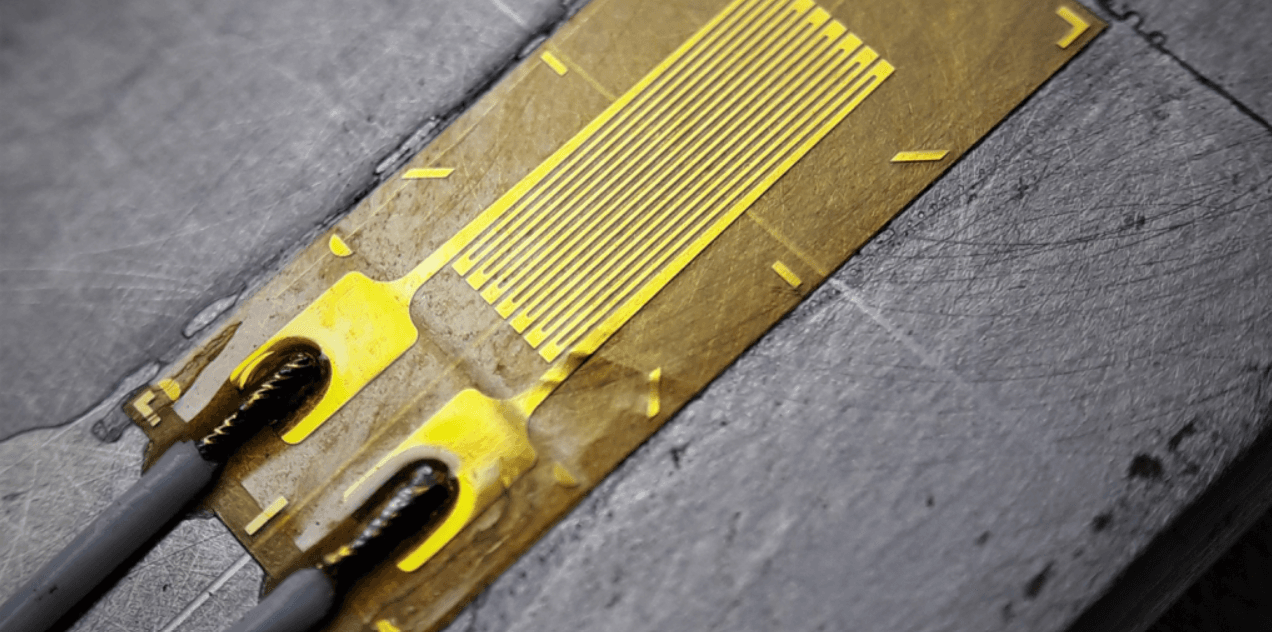
A strain gauge detects and measures this strain as an electrical signal. Numerous structures made from various materials in different sizes and shapes are employed, including transportation vehicles such as automobiles, aircraft, railway vehicles, and ships.
To verify the safety and durability of such structures under heavy operating conditions, stress measurements are conducted. Knowledge of stress is essential to ensure the strength and safety of structures, determine optimal designs, develop lighter structures, select appropriate materials, and implement innovative ideas. Today, computer-aided stress analysis techniques have been developed and are efficiently used in design processes. However, every theoretical and numerical calculation must be validated by experimental studies using strain gauges.
【1】
Metals experience changes in their electrical resistance when subjected to mechanical deformation. Strain gauges utilize this physical property as a measurement principle to detect strain.
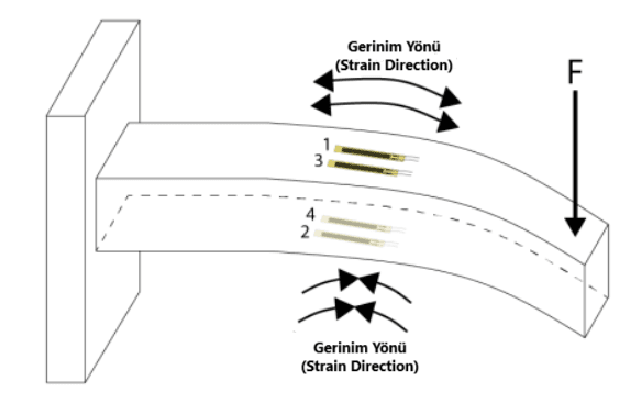
Electrical resistance is inversely proportional to the cross-sectional area of a metal and directly proportional to its length. When a metal wire is subjected to an axial tensile force, its cross-sectional area decreases while its length increases, resulting in an increase in electrical resistance. Conversely, when the wire is subjected to axial compression, its cross-sectional area expands, its length shortens, and resistance decreases.
The change in the metal’s electrical resistance is proportional to the amount of deformation at a constant factor. If a metal wire is securely bonded to the structure being measured, the elongation or contraction of the structure is directly transferred to the metal wire.
According to this principle, measuring the change in the metal wire’s electrical resistance enables precise detection of the strain experienced by the structure. Due to these properties, strain gauges are widely used in engineering and materials science for stress analysis, structural health monitoring, and the design of mechanical systems.
【2】
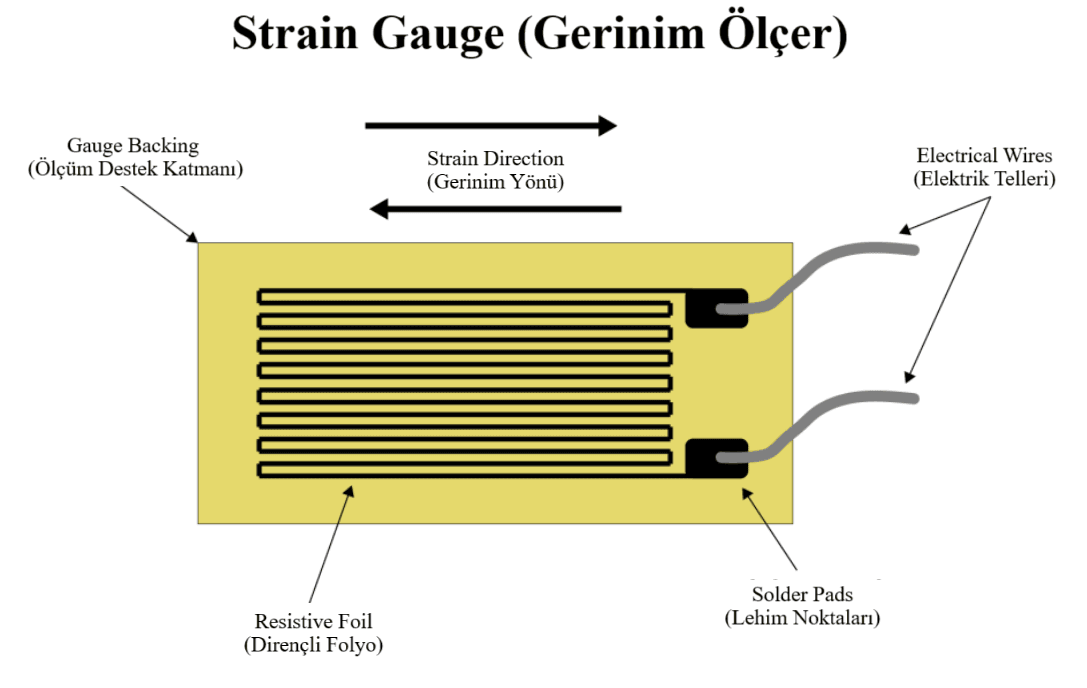
The electrical resistance changes of strain gauges are determined based on the object being measured, converted into a voltage signal, and amplified to facilitate easier analysis. To ensure that strain gauges accurately follow the elongation and contraction movements of the target structure, they must be securely attached to the surface using special adhesives.
To measure resistance changes with high precision, a bridge circuit is employed to convert these changes into voltage signals. However, since the resulting voltage level is typically in the microvolt (μV) range, the signal is amplified between 5,000 and 10,000 times to enhance measurement sensitivity.
【3】
Niu, Michael C.Y. Airframe Stress Analysis and Sizing. 3rd ed., Conmilit Press LTD, 1999.
[1]
"Strain Gauge: What It Is and How It Works." Michigan Scientific. Accessed February 21, 2025. https://www.michsci.com/what-is-a-strain-gauge/.
[2]
"Strain Gauge: What It Is and How It Works." Michigan Scientific. Accessed February 21, 2025. https://www.michsci.com/what-is-a-strain-gauge/.
[3]
"Strain Gauge: What It Is and How It Works." Michigan Scientific. Accessed February 21, 2025. https://www.michsci.com/what-is-a-strain-gauge/.

Strain and Its Measurement
Principle of Operation of Strain Gauges
Resistance Change and Measurement Process of Strain Gauges