This article was automatically translated from the original Turkish version.
+1 More
Building Type | Lighthouse, Keeper's House | ||||||||
|---|---|---|---|---|---|---|---|---|---|
Initial Construction Start | 1830 | ||||||||
Location | Florida United States of America | ||||||||
Building Completion | 1842 | ||||||||
First Keeper | Samuel Crosby | ||||||||
Automation Date | 1960 | ||||||||
Current Function | Special Navigation Aid, Historical and Cultural Area | ||||||||
Architectural Material | Brick, Limestone | ||||||||
Original Lighting System | Petroleum, Fuel Oil, Electricity | ||||||||
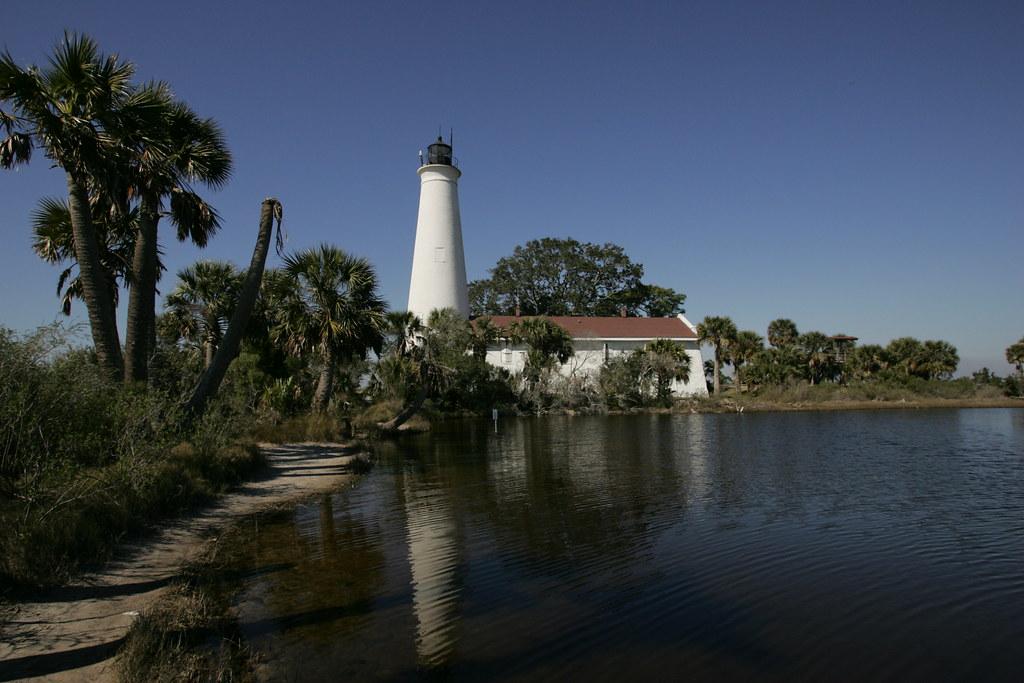
St. Marks Lighthouse is a National Historic Landmark that has served as a navigational light for over a century and a half, guiding military and commercial vessels to the entrance of the St. Marks River. Located within the St. Marks National Wildlife Refuge in Florida, the structure represents the region’s maritime history and natural conservation heritage.
The history of St. Marks begins in the 1820s when it served as a port for Florida.【1】 At that time, St. Marks functioned as a port for the fertile farmlands of Middle Florida and certain counties in southern Georgia. Farmers transported their goods by wagon along a road connecting Tallahassee, the regional capital, to the town of St. Marks. However, navigation challenges existed in Apalachee Bay and the St. Marks River; ships frequently ran aground or became stuck in shallow, muddy waters due to the region’s low depths.
These issues prompted Florida Territorial Governor William P. DuVal to write a letter in 1828 emphasizing the need for a lighthouse. The Territorial Legislature responded by passing a law on May 23, 1828, authorizing construction and appropriating $6,000. However, investigations into the chosen site revealed that this amount was insufficient, and the appropriation was increased to $14,000. A contract for the tower construction was signed with Winslow Lewis for $11,765, and the first light was activated in March 1830.【2】 However, because the initial tower was built of brick and stone, the government determined that the contract’s requirement for “brick or stone” had not been met and ordered its reconstruction. Calvin Knowlton oversaw the reconstruction process, and the tower was completed in 1831 in compliance with the contract. Samuel Crosby was the first lighthouse keeper assigned to the St. Marks Lighthouse and lit the whale oil lamps in the tower in 1831.
St. Marks Lighthouse (Bumble Bee Productions)
Samuel Crosby, the first keeper of the St. Marks Lighthouse, was still on duty in 1835 when the Second Seminole War broke out. Upon learning that Seminole attacks targeted lighthouses at Cape Florida and Mosquito Inlet, Crosby became concerned for his family’s safety and submitted a written appeal to authorities. In his first request, he asked for a small military detachment to be stationed near the lighthouse to protect both the structure and his family. This request was denied. Determined to emphasize the seriousness of the situation, Crosby wrote again, requesting a small boat be provided so his family could be evacuated in an emergency. This second request was also rejected. The Seminole warriors chose not to attack the St. Marks Lighthouse, and Crosby continued serving as head keeper for four more years after these events.
By 1842, the lighthouse structure was threatened by erosion. In response, Winslow Lewis, who had also overseen the original construction, was again contracted to relocate the tower to a safer location. Lewis’s contractors began by dismantling the lighthouse and its lighting apparatus, then completely demolished the original 1831 brick tower. A new site, further inland and away from the water, was selected for the new tower. After construction of the new tower was completed, the previously dismantled original lantern and lighting apparatus were reinstalled. This reconstructed structure withstood hurricanes during the 1840s and 1850s, including the particularly devastating September 1843 hurricane, which nearly destroyed the town of Port Leon and caused extensive damage to St. Marks.【3】
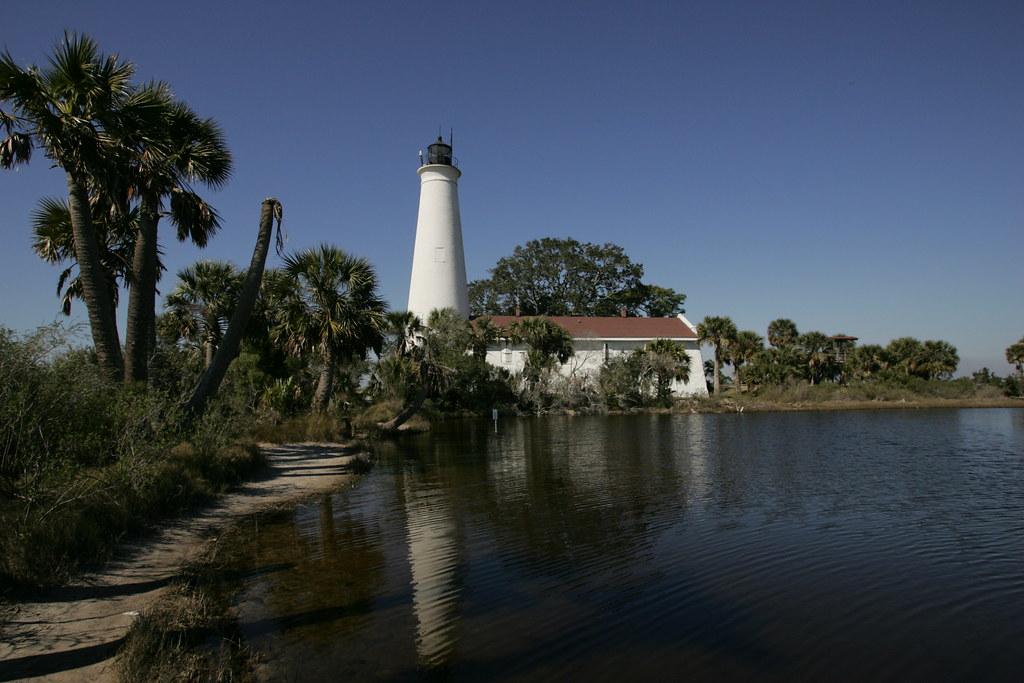
St. Marks Deniz Feneri (Flickr)
A new threat emerged for the lighthouse in the 1860s: the American Civil War. In 1865, Confederate forces were stationed near the lighthouse to protect the region from potential Union attacks.【4】 Prior to this, the lighthouse’s lighting mechanism had been removed to prevent it from aiding Union blockading ships patrolling Apalachee Bay. In March of the same year, a Federal fleet of sixteen ships appeared off the coast and began bombarding the area around the lighthouse in preparation for a landing force.
After the war ended, the tower underwent repairs during the fall and winter of 1866. The Annual Report for that period noted the installation of a fourth-order lens. The new Fresnel lens was first lit on January 8, 1867, by Keeper David Kennedy. This lens was removed from the tower in November 2014 for preservation. In 1883, the tower was extended by ten feet to raise the focal plane. This final modification brought the focal plane to its current height of 82 feet (approximately 25 meters) above sea level.【5】
Charles Fine served as keeper from 1892 to 1904, after which his wife Sarah Fine assumed the role. One of the Fine daughters, Lela, was born and raised in the lighthouse and later married John Y. Gresham, who became the lighthouse keeper. Gresham served longer than any other keeper at the St. Marks Lighthouse. The Gresham children grew up in relative isolation from other settlements and received their formal education from a private schoolteacher who lived with the family. One such teacher, E.W. Roberts from Mississippi, fell in love with one of the Gresham daughters and married her when she turned twenty-three. Another daughter, Eula, became involved with Jesse Bishop, a local fisherman from St. Marks who frequently fished near the lighthouse. Believing her father would disapprove of the relationship, Eula secretly met with Bishop and eventually eloped with him. As Gresham had predicted, their marriage ended in divorce.
During Gresham’s tenure, the land surrounding the lighthouse was incorporated into the St. Marks Migratory Bird Sanctuary, which later became known as the St. Marks National Wildlife Refuge. The refuge encompasses over 86,000 acres of land serving as a wintering ground for migratory birds. Although the United States Coast Guard assumed responsibility for all U.S. lighthouses in 1939, the Gresham family continued to serve as keepers until their retirement in 1949.【6】 Gresham’s son, Anton, also served as a member of the United States Coast Guard and followed his father as Keeper for two years.
The lighthouse was automated in 1960 and continued to serve as an active navigational aid for vessels in Apalachee Bay. Although the original Fresnel lens remained in the tower, it was deactivated during a 2001 renovation and replaced with a modern solar-powered beacon mounted outside the lantern room.
Congress passed legislation in 2006 to transfer the lighthouse from the Coast Guard, but the transfer was delayed until lead contamination was cleaned up. Finally, in October 2013, ownership of the St. Marks Lighthouse was officially transferred from the United States Coast Guard to the United States Fish and Wildlife Service (St. Marks NWR). The original Fresnel lens was removed from the tower during 2014 restoration efforts and relocated to the Ponce Inlet Lighthouse for preservation. It is currently on display at the refuge’s Visitor Center.【8】
With the Coast Guard’s removal of its own beacon in 2016, the St. Marks Lighthouse was dark for the first time since the Civil War. Between November 2017 and April 2018, restoration work was carried out on both the keeper’s house and the lighthouse tower. In 2019, a replica of the fourth-order Fresnel lens was installed on the tower, and this lens is now illuminated seasonally as a Special Aids to Navigation.
Bumble Bee Productions. "St Mark's Lighthouse 4K." YouTube, Video. Date Published: April 23, 2024. Accessed November 30, 2025.https://www.youtube.com/watch?v=aRFnQtW66w8
Friends of St. Marks Wildlife Refuge. "St. Marks Lighthouse." stmarksrefuge.org. Accessed November 30, 2025.
U.S. Fish & Wildlife Service. "St. Marks National Wildlife Refuge." fws.gov. Accessed November 30, 2025.https://www.fws.gov/refuge/st-marks/historic-st-marks-lighthouse
U.S. Fish and Wildlife Service Headquarters. “FL- St. Marks National Wildlife Refuge.” Flickr. Accessed November 30, 2025.https://www.flickr.com/photos/usfwshq/7256122386/in/photostream/
[1]
U.S. Fish & Wildlife Service, "St. Marks National Wildlife Refuge," fws.gov, erişim 30 Kasım 2025, https://www.fws.gov/refuge/st-marks/historic-st-marks-lighthouse
[2]
U.S. Fish & Wildlife Service, "St. Marks National Wildlife Refuge," fws.gov, erişim 30 Kasım 2025,
[3]
U.S. Fish & Wildlife Service, "St. Marks National Wildlife Refuge," fws.gov, erişim 30 Kasım 2025,
[4]
U.S. Fish & Wildlife Service, "St. Marks National Wildlife Refuge," fws.gov, erişim 30 Kasım 2025,
[5]
U.S. Fish & Wildlife Service, "St. Marks National Wildlife Refuge," fws.gov, erişim 30 Kasım 2025,
[6]
U.S. Fish & Wildlife Service, "St. Marks National Wildlife Refuge," fws.gov, erişim 30 Kasım 2025,
[7]
Joined the U.S. Coast Guard in 1939. U.S. Fish & Wildlife Service, "St. Marks National Wildlife Refuge," fws.gov, Accessed November 30, 2025.
[8]
U.S. Fish & Wildlife Service, "St. Marks National Wildlife Refuge," fws.gov, erişim 30 Kasım 2025,

Building Type | Lighthouse, Keeper's House | ||||||||
|---|---|---|---|---|---|---|---|---|---|
Initial Construction Start | 1830 | ||||||||
Location | Florida United States of America | ||||||||
Building Completion | 1842 | ||||||||
First Keeper | Samuel Crosby | ||||||||
Automation Date | 1960 | ||||||||
Current Function | Special Navigation Aid, Historical and Cultural Area | ||||||||
Architectural Material | Brick, Limestone | ||||||||
Original Lighting System | Petroleum, Fuel Oil, Electricity | ||||||||
No Discussion Added Yet
Start discussion for "St. Mark's Lighthouse" article
History
Reconstruction and Natural Threats
Civil War Era and Elevation
The Gresham Family and the National Refuge
St. Marks Lighthouse Keepers
Automation and Current Status