


This article was automatically translated from the original Turkish version.
Scale-Invariant Feature Transformation (Speeded-Up Robust Features - SURF) is a widely used feature extraction method in computer vision and image processing. SURF is effectively applied in applications such as object recognition, image matching, and 3D reconstruction. This method is preferred due to its robustness to scale changes and its fast computation speed.
Before the development of SURF, one of the most widely used methods in feature extraction was SIFT (Scale-Invariant Feature Transform). SIFT was developed by David Lowe in 1999 and published in detail in 2004. SIFT achieved significant success due to its robustness to scale changes and its rotation invariance properties.
However, SIFT had several limitations:
Due to these limitations, SURF was developed in 2006 by Herbert Bay, Tinne Tuytelaars, and Luc Van Gool. The primary goal in developing SURF was to retain the advantages of SIFT while increasing computational speed and reducing resource requirements.
The development of SURF incorporates various improvements designed to overcome the limitations of SIFT. The following steps were followed in this process:
SURF was published in 2006 by Herbert Bay, Tinne Tuytelaars, and Luc Van Gool in a paper titled "SURF: Speeded Up Robust Features". This paper attracted significant attention in the field of computer vision, and SURF quickly became widely adopted.
The publication of SURF had a major impact, particularly in real-time applications. Its fast computation and low resource requirements increased its applicability in areas such as video processing, object recognition, and image matching.
Today, SURF is still widely used in computer vision and image processing. However, in recent years, the rise of deep learning-based methods has led to a decline in the use of traditional feature extraction methods like SURF. Deep learning methods generally achieve higher performance on large data sets.
Nevertheless, SURF still has certain advantages. In particular, it remains effective in systems with limited computational resources and in real-time applications. Additionally, its simplicity and clarity have contributed to its widespread use in educational and research contexts.
Scale-Invariant Feature Transformation (Speeded-Up Robust Features - SURF) is a powerful feature extraction method used in computer vision and image processing. SURF’s success stems from its solid mathematical and algorithmic foundation.
Scale invariance is one of SURF’s most important features. It enables objects of different sizes or images captured from different distances to be described using the same features. Thanks to this property, SURF can correctly match objects even when their size changes in the image.
Scale invariance is based on the concept of scale space, which refers to representing an image at multiple scales. This is achieved by convolving the image with Gaussian filters of varying sizes. Gaussian filters smooth the image and represent it at different levels in scale space.
Gaussian filters are used to smooth images and reduce noise. A Gaussian filter has a bell-shaped distribution, controlled by its standard deviation (σ). Different σ values generate representations of the image at different scales.
Rotation invariance is another key feature of SURF. It ensures that features are correctly identified even when objects in the image are rotated. This property provides a significant advantage in applications such as object recognition and image matching.
Rotation invariance is achieved by determining the orientations of interest points. SURF computes gradient orientations around interest points to assign a consistent orientation, ensuring correct identification even under rotation.
The gradient represents the rate of intensity change in an image. Gradient computation involves calculating the derivatives of the image along the x and y directions. SURF computes gradients in regions around interest points to determine their orientations.
SURF significantly increases computational speed by using techniques such as integral images and the Hessian matrix. This enhances its usability in real-time applications. In particular, its fast performance is a major advantage in applications such as video processing and real-time object recognition.
Integral images enable fast filtering operations on an image. An integral image contains, at each pixel, the sum of all pixels from the top-left corner to that pixel. This allows the rapid computation of the total intensity within any rectangle region of the image.
The Hessian matrix contains the second-order derivatives of the image and is used to detect edges and corners. The determinant of the Hessian matrix is used to identify interest points. SURF uses the Hessian matrix to rapidly detect interest points in the image.
SURF extracts strong feature vectors from regions around interest points. These vectors uniquely describe the interest points. Feature vectors are constructed using histograms of gradients around interest points, capturing their orientations and magnitudes.
Feature vectors uniquely identify interest points. SURF extracts these vectors from regions surrounding interest points, encoding their orientations and magnitudes. These vectors enable accurate matching of objects across images.
Histograms represent the distribution of gradients around interest points. SURF uses these histograms to determine the orientations and magnitudes of interest points. Histograms are essential in constructing feature vectors.
SURF uses the Hessian matrix to detect interest points in the image. The Hessian matrix contains second-order derivatives used to identify edges and corners. The determinant of the Hessian matrix is used to locate interest points.
The Hessian matrix is a matrix containing the second-order partial derivatives of a function. SURF uses the Hessian matrix to detect interest points in the image. The determinant of the Hessian matrix is used to identify these points.
The determinant of the Hessian matrix is used to detect interest points. The determinant captures key properties of the matrix that indicate the presence of stable features. SURF uses the determinant to rapidly locate interest points in the image.
Original image:

(Credit: An analysis of the SURF method)
SURF keypoints detected in the image using OpenCV:
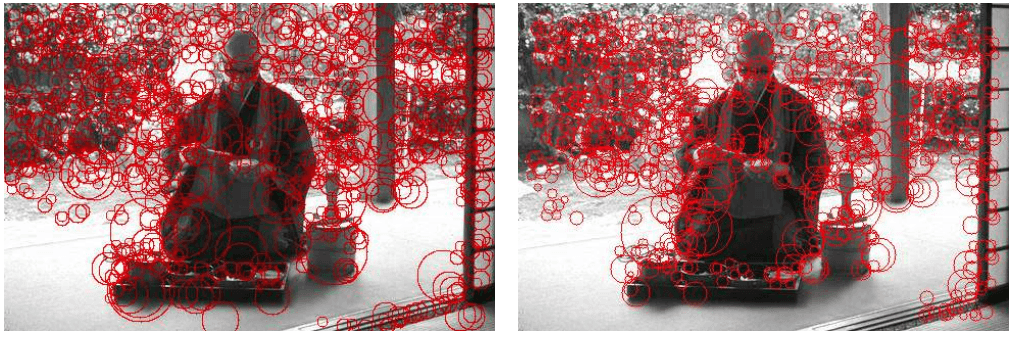
(Credit: An analysis of the SURF method)
Bay, H. "SURF: Speeded Up Robust Features"Accessed Adresi.
Konyalıoğulları, S., Ballı, S. "SURF (Speed-Up Robust Features) Yöntemi ile Yüz Tanıma"Accessed Adresi.
OpenCV. Open Source Computer Vision Documentation. "Introduction to SURF (Speeded-Up Robust Features)."
Oyallon, E., Rabin, J. (2015). "An Analysis of the SURF Method"Accessed Adresi.

No Discussion Added Yet
Start discussion for "Speeded-Up Robust Features (SURF)" article
Development of SURF
Primary Objectives of SURF
Development Process of SURF
Publication and Impact of SURF
SURF's Current Status
Fundamental Principles of SURF
Scale Invariance
Scale Space
Gaussian Filters
Rotation Invariance
Orientation Assignment
Gradient Computation
Fast Computation
Integral Images
Hessian Matrix
Strong Feature Extraction
Feature Vectors
Histograms
Detection of Interest Points
Hessian Matrix
Determinant Computation
Steps of the SURF Algorithm
Advantages of SURF
Applications of SURF
Limitations of SURF