


This article was automatically translated from the original Turkish version.
+1 More
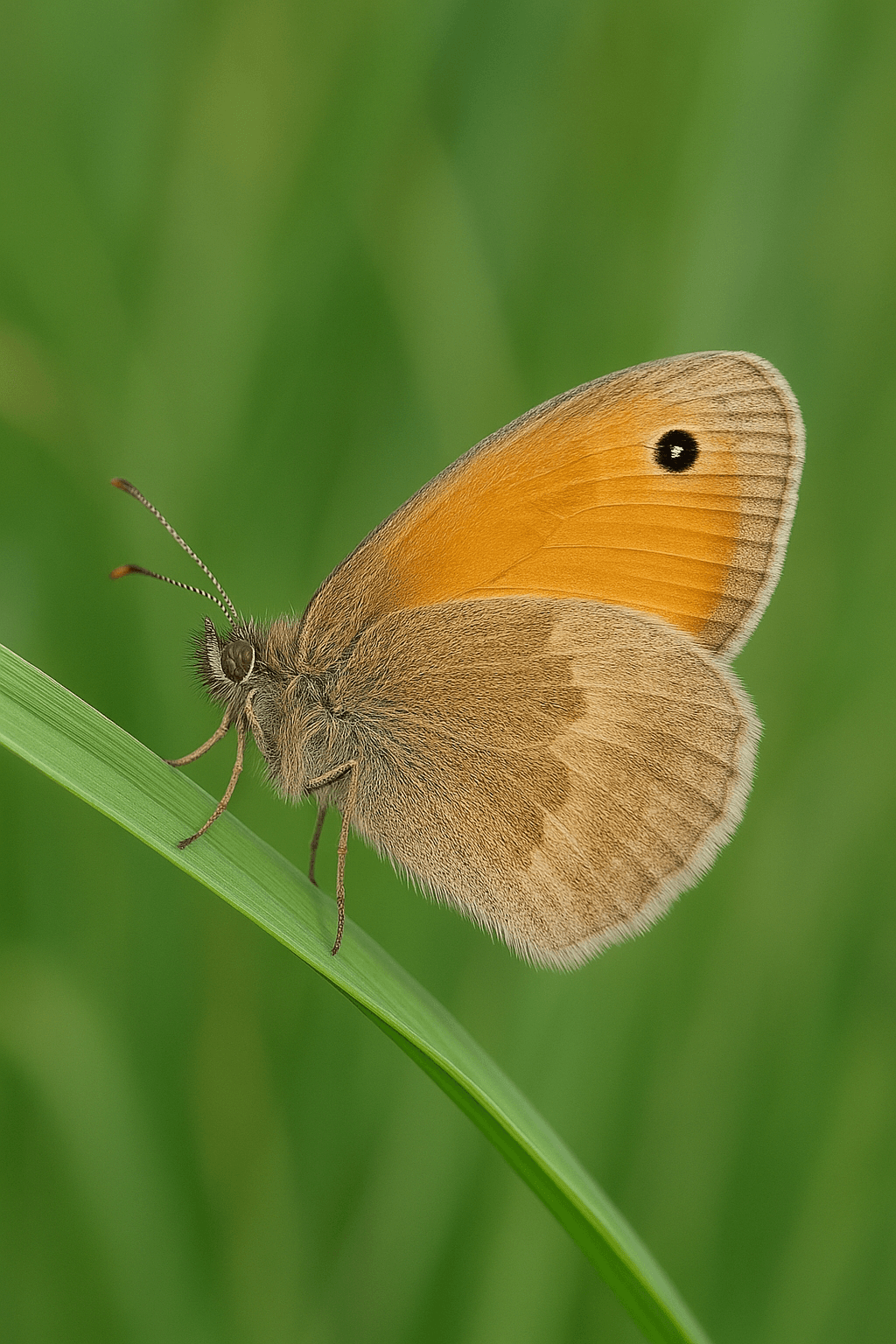
Coenonympha pamphilus (Generated by Artificial Intelligence)
Branch | Arthropoda | ||||||||
|---|---|---|---|---|---|---|---|---|---|
Class | Insecta | ||||||||
Team(s) | Lepidoptera | ||||||||
Family | Nymphalidae | ||||||||
Genus | Coenonympha | ||||||||
Common Names | Small Heath | ||||||||
Color and Appearance | Orange-brown tones, small eye spot on forewing, pale patterns on hindwing | ||||||||
Distribution(s) | Europe widespread throughout Türkiye Western Asia Middle East North Africa | ||||||||
Habitat | Grasslands steppes road verges fields | ||||||||
Conservation Status | IUCN – Least Concern (LC) | ||||||||
The Small Heath (Coenonympha pamphilus) is a small day-flying butterfly belonging to the Satyrinae subfamily of the Nymphalidae family. Its wingspan ranges from 27 to 35 mm. It is recognized by its delicate structure and simple appearance, with colors typically ranging from shades of orange and brown.
The upper side of the forewings is orange with brown-edged margins. A small dark spot resembling an eye is usually present at the wing tip. The hindwings are paler brown and on their underside the eye spots are either very small or appear as single dots. The antennae are clubbed. Females and males are quite similar in appearance, although males are generally slightly smaller.
This species is found across a large part of Europe, North Africa, the Middle East, and Western Asia. It is also one of the most commonly encountered butterflies in Türkiye, particularly in grasslands, roadside verges, fields, and steppe ecosystems.
The Small Heath is active from April to October and can produce several generations per year depending on climatic conditions. Adult individuals feed on nectar from a variety of herbaceous flowers. Larvae primarily feed on grasses of the Poaceae family. The pupal stage occurs camouflaged on plant stems.
This butterfly species is notable for its activity in open areas and sunny grasslands, performing low and short-distance flights. It contributes to pollination within its ecosystem and interacts with vegetation as a herbivore during its larval stage.
The Small Heath can be easily confused with other Coenonympha species, particularly Coenonympha arcania (Heath Ringlet). In C. arcania, the underside of the hindwings displays more distinct eye spots, whereas in C. pamphilus these spots are typically faint. Additionally, the Small Heath has lighter coloration overall.
Due to its wide distribution and high population density, the Small Heath is not considered threatened. It is classified as “Least Concern” (LC) by the International Union for Conservation of Nature (IUCN). However, intensive agricultural use and habitat loss may negatively impact local populations.
Goverde, M., Erhardt, A., and Niklaus, P. A. "In Situ Development of a Satyrid Butterfly on Calcareous Grassland Exposed to Elevated Carbon Dioxide." *Ecology* 83, no. 5 (2002): 1399–411. https://doi.org/10.1890/0012-9658(2002)083[1399:ISDOAS]2.0.CO;2
Wickman, P. O., Garcia-Barros, E., Rappe-George, C. "The Location of Landmark Leks in the Small Heath Butterfly, *Coenonympha pamphilus*: Evidence Against the Hot-Spot Model." *Behavioral Ecology*, 6(1) (1995): 39–45. https://doi.org/10.1093/beheco/6.1.39

Coenonympha pamphilus (Generated by Artificial Intelligence)
Branch | Arthropoda | ||||||||
|---|---|---|---|---|---|---|---|---|---|
Class | Insecta | ||||||||
Team(s) | Lepidoptera | ||||||||
Family | Nymphalidae | ||||||||
Genus | Coenonympha | ||||||||
Common Names | Small Heath | ||||||||
Color and Appearance | Orange-brown tones, small eye spot on forewing, pale patterns on hindwing | ||||||||
Distribution(s) | Europe widespread throughout Türkiye Western Asia Middle East North Africa | ||||||||
Habitat | Grasslands steppes road verges fields | ||||||||
Conservation Status | IUCN – Least Concern (LC) | ||||||||
No Discussion Added Yet
Start discussion for "Small Heath Butterfly (Coenonympha pamphilus)" article
Appearance
Distribution
Life Cycle
Ecology and Behavior
Similar Species
Conservation Status