This article was automatically translated from the original Turkish version.
Leaders and Commanders | Yitzhak Rabin (Chief of Staff) Uzi Narkis (Commander of the Jerusalem Front) David Elazar (Commander of the Northern/Syrian Front) Arab Alliance: Gamal Abdel Nasser (President of Egypt) Abdel Hakim Amer (Chief of Staff of Egypt) King Hussein (King of Jordan) Hafez al-Assad (Syrian Minister of Defense) Israel: Levi Eshkol (Prime Minister) Moshe Dayan (Minister of Defense) | ||||||||
|---|---|---|---|---|---|---|---|---|---|
Region | East Jerusalem Middle East (Sinai Peninsula Golan Heights) West Bank Gaza Strip | ||||||||
Side | Syria Arab Alliance: Egypt Jordan Iraq Israel | ||||||||
Military Forces | Israel: 246,000–264,000 troops, 800–1,000 tanks, 300–365 fighter aircraft. Arab Alliance: Approximately 537,000 troops (Egypt: ~300,000, Syria: ~100,000, Jordan: ~50,000), 2,904 tanks, 957–978 fighter aircraft | ||||||||
Losses and Casualties | Israel: Approximately 700–800 killed, 40–48 fighter aircraft, fewer than 100 tanks. (Additionally, during the war, the U.S. Navy intelligence ship USS Liberty was attacked, resulting in American naval casualties and wounded.) Arab Alliance: Approximately 20,000–25,000 killed, more than 400–450 fighter aircraft (most destroyed on the ground before taking off) | ||||||||
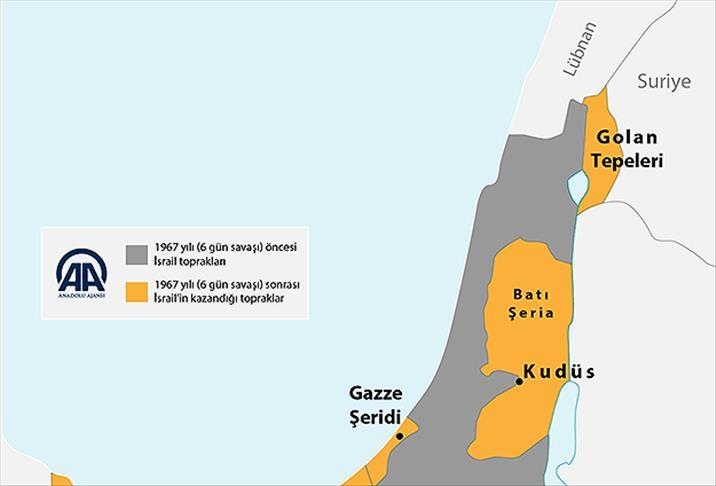
Territorial Changes | Israel expanded its borders by 3.5 times; occupied the Sinai Peninsula and Gaza Strip from Egypt, the West Bank and East Jerusalem from Jordan, and the Golan Heights from Syria | ||||||||
Date | 5 June 1967 – 10 June 1967 | ||||||||
Result | Israel's decisive military victory. Severe military and political defeat for the Arab states (Naksa) | ||||||||
The Six-Day War, or the 1967 Arab-Israeli War, was a military conflict fought between Israel and its Arab neighbors Egypt, Syria, and Jordan from June 5 to June 10, 1967. Iraq provided military support to the Arab states during the war. The conflict ended with Israel’s military and geographical superiority, fundamentally altering the political demographic and military map of the Middle East. This defeat and territorial loss are referred to by Palestinians and the Arab world as the “Naksa” (Setback or Day of Land Loss).
Tensions in the region remained unresolved after the First Arab-Israeli War of 1948 and the 1956 Suez Crisis. From the mid-1960s onward, border clashes between Israel and its Arab neighbors intensified. On November 13, 1966, Israel launched a large-scale military operation against the Jordanian-controlled village of Samuha, which was condemned by the United Nations Security Council and further heightened regional tensions. On April 7, 1967, during an aerial clash over the Golan Heights between Syrian and Israeli aircraft, six Syrian fighter jets were shot down, marking one of the critical turning points toward war.
One of the major sparks leading to war was a false intelligence report sent by the Soviet Union to Egypt in May 1967, claiming that Israel was massing troops along its border with Syria. Based on this report, Egyptian President Gamal Abdel Nasser deployed forces to the Sinai Peninsula to prevent a potential attack on Syria and demanded the withdrawal of the United Nations Emergency Force (UNEF), which had been stationed in the region since 1956. As tensions escalated, Egypt announced on May 22–23, 1967, that it was closing the Strait of Tiran, Israel’s only maritime access to the Red Sea and a vital route for ships carrying strategic materials to Israel.
Israel declared the closure of international waterways a direct “casus belli.” In response, on May 30, Egypt and Jordan signed a mutual defense pact, and on June 4, Iraq joined them to form a broader Arab defense alliance. On the Israeli side, amid growing perceptions of threat, a national unity government was formed on June 1, 1967, and Moshe Dayan, a commander from the 1956 war, was appointed Minister of Defense.
A map regarding the war - Anadolu Ajansı
Before the war, the military balance was numerically in favor of the Arab states. The Arab alliance (Egypt, Syria, Jordan, and Iraq) possessed approximately 537,000 troops, 2,904 tanks, and 900 to 978 combat aircraft. In contrast, Israel’s total manpower including reserves numbered between 250,000 and 264,000, with 800 to 1,000 tanks and 300 to 365 aircraft.
However, Israel was exceptionally well-prepared in terms of military training and tactical intelligence. The Israeli Air Force had spent years conducting firing drills on mockups of Egyptian air bases and had developed a military operation known as “Operation Focus.” Additionally, in 1966, Israeli intelligence (Mossad) acquired a Soviet-made MiG-21 fighter jet from an Iraqi pilot for one million dollars, enabling Israeli analysts to identify critical weaknesses in the Arab armies’ primary air power before the war began.
The war began on the morning of June 5, 1967, at 07:45 local time (08:45 Egypt time), with a surprise and simultaneous attack by the Israeli Air Force on Egyptian military airfields—Operation Focus. Israeli jets flew at extremely low altitudes (50 meters) over the Mediterranean Sea to avoid radar detection and maintained radio silence. They caught the Egyptian Air Force completely unprepared while its aircraft were still on the ground. Israel timed its attack to coincide with the end of Egypt’s morning patrol flights and the change of shifts, destroying over 300 Egyptian aircraft within hours. On the same day, attacks were launched against Syrian, Jordanian, and Iraqi air bases. By the end of the first day of the war, the Arab countries had lost 80 percent of their air power—more than 400 aircraft—and Israel gained complete air superiority.
Ground operations (on the Jerusalem, West Bank, Sinai, and Golan fronts) saw the Egyptian army, deprived of air cover, suffer heavy losses against rapidly advancing Israeli armored units. Israeli forces captured the Gaza Strip and the entire Sinai Peninsula, reaching the eastern bank of the Suez Canal.
The Jordanian army, which had launched an attack on Israel in the war’s first hours, also quickly collapsed. Israeli forces counterattacked and entered the Old City walls on June 7, capturing East Jerusalem. Israeli troops, led by Defense Minister Moshe Dayan and Chief of Staff Yitzhak Rabin, reached the Al-Aqsa Mosque and the Western Wall. With East Jerusalem, the entire West Bank came under Israeli control,脱离了约旦的管辖。
On the Syrian front, after losing its air power in the first days of the war, the Syrian army engaged Israeli forces in artillery duels in the Golan Heights region. On June 9 and 10, Israel advanced northward, capturing the Golan Heights from Syria and began moving toward the Syrian capital, Damascus.
On June 8, 1967, while the war was still ongoing, the USS Liberty, a U.S. intelligence vessel sailing in international waters of the Mediterranean, was attacked by Israeli fighter jets and torpedo boats. Thirty-four American sailors were killed and 171 wounded. The Israeli government later claimed the attack was a case of mistaken identity—believing the ship to be Egyptian—and apologized to the United States, paying compensation.
An infographic on the Israeli occupation - Anadolu Ajansı
Following interventions by the Soviet Union and the United States and a United Nations Security Council call for a ceasefire, the war officially ended on June 10, 1967, when Jordan accepted the ceasefire on June 7, Egypt on June 8, and Syria on June 10.
The consequences of the six-day war were severe in military and territorial terms:
Documentary on the Six-Day War - Al Jazeera Türk
The military outcome of the war profoundly shook the balance of power in the Middle East. Egyptian President Gamal Abdel Nasser announced on radio that he accepted responsibility for the devastating defeat and would resign. However, after mass protests erupted in the streets, he reversed his decision.
Following the war, the United Nations Security Council adopted its historic Resolution 242 on November 22, 1967. The resolution emphasized the principle that “territory cannot be acquired by war,” calling for Israel’s withdrawal from occupied territories, while also affirming the right of every state in the region to live in peace within secure and recognized boundaries. Although Israel withdrew from the Sinai Peninsula in 1982 following its 1979 peace treaty with Egypt, its occupation of East Jerusalem, the West Bank, and the Golan Heights continues to this day. Israel declared East Jerusalem its eternal capital in 1980 and annexed the Golan Heights in 1981.
From the perspective of Israeli domestic politics and Jewish religious belief, the war created a major turning point. The secular Israeli state, founded on nationalist ideals, came to be viewed by many Jews as the fulfillment of a theological validation and a “divine miracle” following its capture of religiously and historically significant territories such as East Jerusalem (particularly the Western Wall and Al-Aqsa Mosque) and the West Bank (known in the Torah as Judea and Samaria). This perception laid the groundwork for the rise of religious-nationalist settlement movements in Israel after the war, such as Gush Emunim, and for the settlement of Jewish civilians in the occupied territories. Much like the Nakba following the First Arab-Israeli War, the Six-Day War has been cemented as the foundational act of a prolonged occupation that continues to this day.
The 1967 Six-Day War is regarded by Palestinian history as the second most destructive turning point after the 1948 Nakba (Catastrophe), and is referred to by Palestinians as the “Naksa” (Setback or Day of Land Loss).
The military, territorial, demographic, and political consequences of the war have left lasting impacts on the Palestinian people that persist to this day.
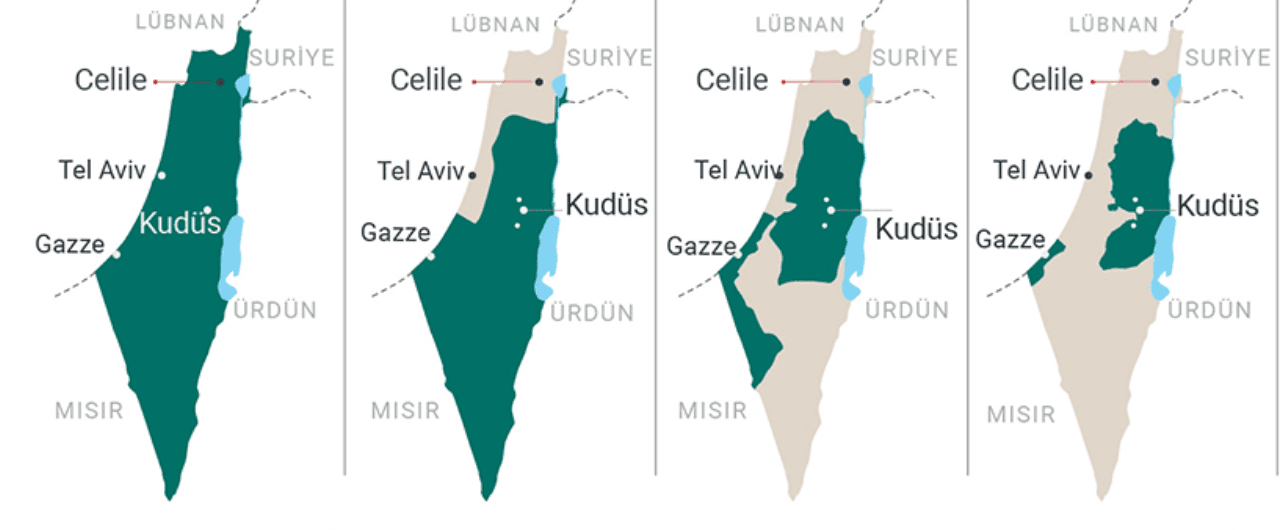
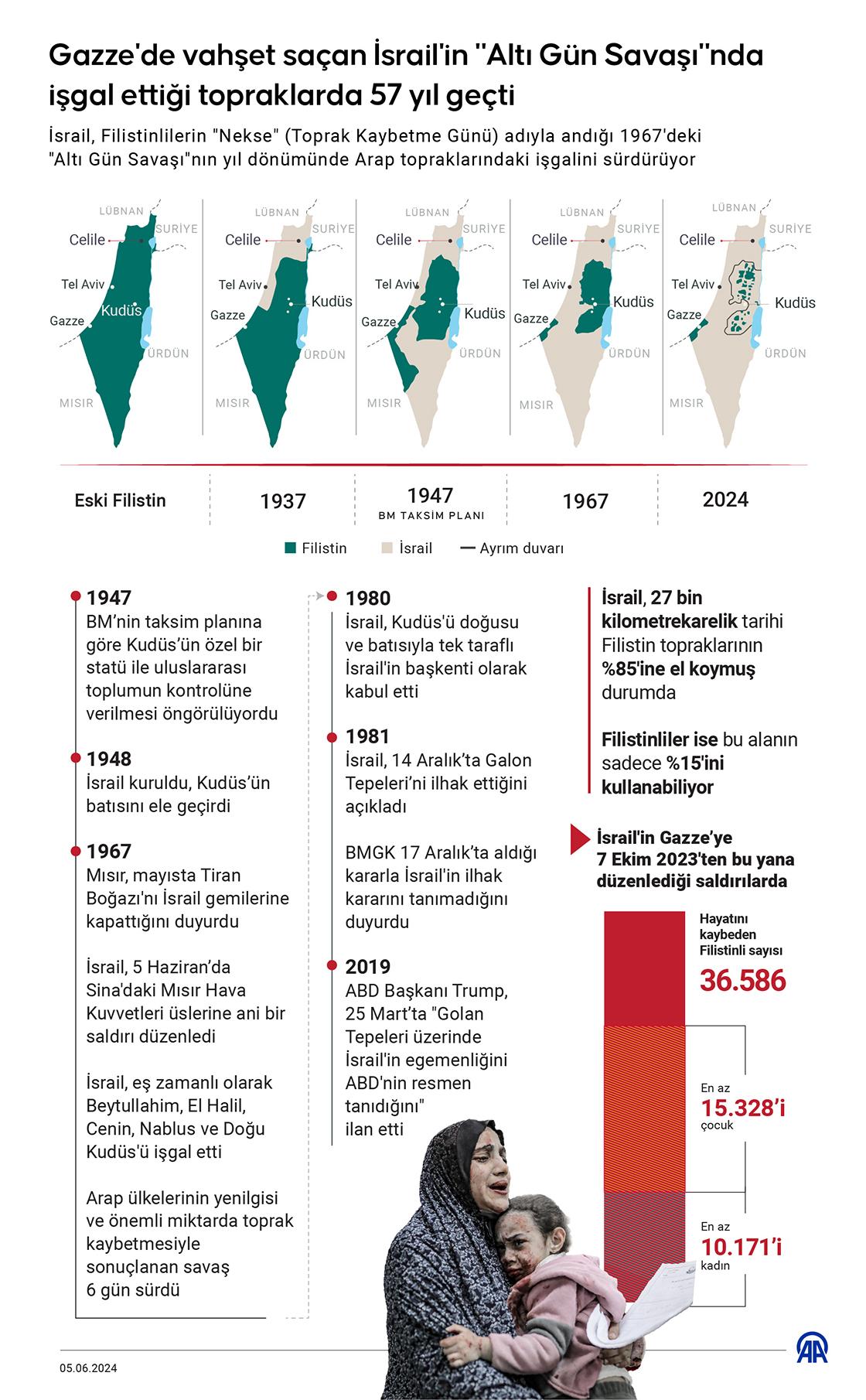
The most direct territorial outcome of the war was the complete military control of all historic Palestinian lands by Israel. After the 1948 war, Israel had controlled 78 percent of Palestine; with the 1967 war, the remaining territories—the West Bank, East Jerusalem, and the Gaza Strip—were militarily occupied, bringing the total under Israeli control to 100 percent.
Although United Nations Security Council Resolution 242 called for Israel’s withdrawal from these occupied territories, the resolution was never implemented, and Israeli military dominance over Palestinian land was made permanent.
The violence and destruction caused by the war triggered a new wave of forced displacement among Palestinians. According to statistics, between 300,000 and 350,000 Palestinians living in the West Bank and Gaza Strip were displaced as a result of the war and subsequent occupation policies, with the majority seeking refuge in neighboring Arab countries, especially Jordan.
The 1967 occupation opened the door for Israeli Jews to settle in the West Bank, East Jerusalem, and Gaza, and initiated new demographic engineering projects.
Despite the Fourth Geneva Convention classifying such actions as war crimes, Israeli civilian settlers were relocated to occupied territories, and every new settlement unit was accompanied by the state or military confiscation of land owned by Palestinians.
As a result of these policies over the decades, today 85 percent of the historic 27,000 square kilometers of Palestinian land has been seized by Israel, leaving Palestinians with access to only 15 percent of their homeland.
One of the most dramatic outcomes of the war occurred in East Jerusalem. Immediately after capturing East Jerusalem, Israeli forces demolished the entire historic Maghrebi Quarter in front of the Western Wall to create a large prayer and gathering area.
To disrupt the demographic balance in favor of Jews and sever East Jerusalem’s ties with other Palestinian cities, twelve new settlement units housing a combined population of 200,000 were established within the city.
In 1980, Israel passed a law declaring Jerusalem its eternal and undivided capital in an attempt to formalize its occupation. However, this annexation decision was rejected by the international community and the United Nations.
Al Jazeera Turk. Altı Gün Savaşı – Al Jazeera Türk Belgesel, YouTube video. Accessed June 7, 2026.
Anadolu Ajansı. "Gazze’de Vahşet Saçan İsrail’in Altı Gün Savaşı’nda İşgal Ettiği Topraklarda 57 Yıl Geçti." Anadolu Ajansı, 2024. Accessed June 7, 2026.
Anadolu Ajansı. "Nekse’nin 59. Yılında İsrail’in Filistin Topraklarını İşgali Sürüyor." Anadolu Ajansı, 2026. Accessed June 7, 2026.
Anadolu Ajansı. “Nekse’yi Yaşayanlar Gazze’deki Durumu 1967 İşgalinden Daha Barbarca Şeklinde Nitelendirdi.” Anadolu Ajansı, 2024. Accessed June 7, 2026.
Ay, Rahim. 2021. “İsrail’in Kuruluşunun Teolojik Meşruiyet Sorunu: 1967 Altı Gün Savaşları Bağlamında Bir Soruşturma.” Eskiyeni, no. 43: 351–370. Accessed June 7, 2026.
Digitallibrary.un.org. Security Council Official Records, 22nd Year, 1347th Meeting, 5 June 1967, New York. Accessed June 7, 2026.
Foreign Relations of the United States (FRUS). "153. Telegram From the Department of State to the Embassy in Jordan." Accessed June 7, 2026.
Foreign Relations of the United States (FRUS). "157. Message From the White House to Premier Kosygin." Accessed June 7, 2026.
Foreign Relations of the United States (FRUS). "159. Message From President Johnson to Premier Kosygin." Accessed June 7, 2026.
Foreign Relations of the United States (FRUS). Foreign Relations of the United States, 1964–1968, Volume XIX, Arab-Israeli Crisis and War, 1967. Washington: United States Government Printing Office, 2004. Accessed June 7, 2026.
GZT. "1967 Altı Gün Savaşı: Nedenleri ve Sonuçları." Accessed June 7, 2026.
GZT. "Yenilginin Tescili: 6 Gün Savaşı." Accessed June 7, 2026.
Jewish Virtual Library. “UN Security Council Resolution 228.” Accessed June 7, 2026.https://jewishvirtuallibrary.org/jsource/UN/unres228.html
Marxists Internet Archive. Brezhnev, Leonid. On Soviet Policy Following the Israeli Aggression in the Middle East. June 20, 1967. Accessed June 7, 2026.
Olgun, Kenan. "Türk Basınında 1967 Arap İsrail Savaşı." 38. ICANAS Uluslararası Asya ve Kuzey Afrika Çalışmaları Kongresi, 10–15 Eylül 2007, cilt 5, 2231–2255. Accessed June 7, 2026.
Palinfo (Türkçe). "Altı Gün Savaşı." 2020. Accessed June 7, 2026.
Sağdıç, Kadir. "Altı Gün Savaşları." Anka Enstitüsü. Accessed June 7, 2026.
Sezer, Selim. "Bir Gaspın Tarihi: Filistin Toprakları." Anadolu Ajansı – Analiz, 2024. Accessed June 7, 2026.
Tomar, Cengiz. "İskân, Nekbe, Nekse ve Kudüs: Bir İşgalin Serencâmı." Anadolu Ajansı – Analiz Haber, 2018. Accessed June 7, 2026.
Yalçın, Osman. 2021. “1967 Arap-İsrail Savaşı ve Savaşta Hava Harekâtı.” Akademik Tarih ve Araştırmalar Dergisi 4, no. 5: 53–104. Accessed June 7, 2026.
Çiçek, Turan. "Altı Gün Savaşı." May 2014. Accessed June 7, 2026.
Ünal, Hasan. “Altı Gün Savaşı’ndan On İki Gün Savaşı’na.” Harici. Accessed June 7, 2026.
İlbaş, Serdal. 2025. “Koalisyon Karar Birimi Çerçevesinde İsrail’in Dış Politikasının Analizi: Altı Gün Savaşı Örneği”. Külliye 6 (3): 499-516.https://doi.org/10.48139/aybukulliye.1753076

Leaders and Commanders | Yitzhak Rabin (Chief of Staff) Uzi Narkis (Commander of the Jerusalem Front) David Elazar (Commander of the Northern/Syrian Front) Arab Alliance: Gamal Abdel Nasser (President of Egypt) Abdel Hakim Amer (Chief of Staff of Egypt) King Hussein (King of Jordan) Hafez al-Assad (Syrian Minister of Defense) Israel: Levi Eshkol (Prime Minister) Moshe Dayan (Minister of Defense) | ||||||||
|---|---|---|---|---|---|---|---|---|---|
Region | East Jerusalem Middle East (Sinai Peninsula Golan Heights) West Bank Gaza Strip | ||||||||
Side | Syria Arab Alliance: Egypt Jordan Iraq Israel | ||||||||
Military Forces | Israel: 246,000–264,000 troops, 800–1,000 tanks, 300–365 fighter aircraft. Arab Alliance: Approximately 537,000 troops (Egypt: ~300,000, Syria: ~100,000, Jordan: ~50,000), 2,904 tanks, 957–978 fighter aircraft | ||||||||
Losses and Casualties | Israel: Approximately 700–800 killed, 40–48 fighter aircraft, fewer than 100 tanks. (Additionally, during the war, the U.S. Navy intelligence ship USS Liberty was attacked, resulting in American naval casualties and wounded.) Arab Alliance: Approximately 20,000–25,000 killed, more than 400–450 fighter aircraft (most destroyed on the ground before taking off) | ||||||||
Territorial Changes | Israel expanded its borders by 3.5 times; occupied the Sinai Peninsula and Gaza Strip from Egypt, the West Bank and East Jerusalem from Jordan, and the Golan Heights from Syria | ||||||||
Date | 5 June 1967 – 10 June 1967 | ||||||||
Result | Israel's decisive military victory. Severe military and political defeat for the Arab states (Naksa) | ||||||||
No Discussion Added Yet
Start discussion for "Six-Day War (1967 Arab-Israeli War)" article
Background and Causes of the War
Military Balance and Preparations
Course of the War
Ceasefire and Outcomes of the War
Political and Theological Implications
Impact on Palestinians and Palestine
Territorial Loss and Full Occupation
Demographic Devastation and a New Wave of Refugees
Settlement Policies and Land Confiscation
Status of Jerusalem and Judaization