Sivasi Hatun Camii is located in the Yukarı Develi Câmi-i Kebîr Mahallesi of Kayseri, on Selçuk Sokak. According to inscriptions, the mosque was constructed in the year 680 AH / 1281/82 CE. It was built during the reign of the Seljuk Sultan III. Gıyaseddin Keyhüsrev (III. Keykavus).
The founders of the mosque are identified in Arabic inscriptions on the portal.
- The Arabic inscription in sulus script on the lintel of the portal indicates that the mosque was commissioned during the time of Sultan III. Gıyaseddin Keyhüsrev. The inscription reads: “By the command of the exalted sultan, Kılıçarslan’s son Keyhusrev, who holds the reins of the nations yearning for the two qiblas, the blessing of religion and the world, this blessed mosque was ordered to be built, may Allah perpetuate His dominion.”
- An Arabic four-line inscription in sulus script above the flat-arched entrance of the portal states that the mosque was commissioned in 1281/82 by Nasrullah bin Göcersalân (Nasrullah, son of Göçer Aslan) and his concubine Sevasti binti Sâ’d (Siva Sitti, daughter of Sâ’d). The concubine Sevasti may also be read as Sivasti or Seva Sitti.
Plan and Building Materials
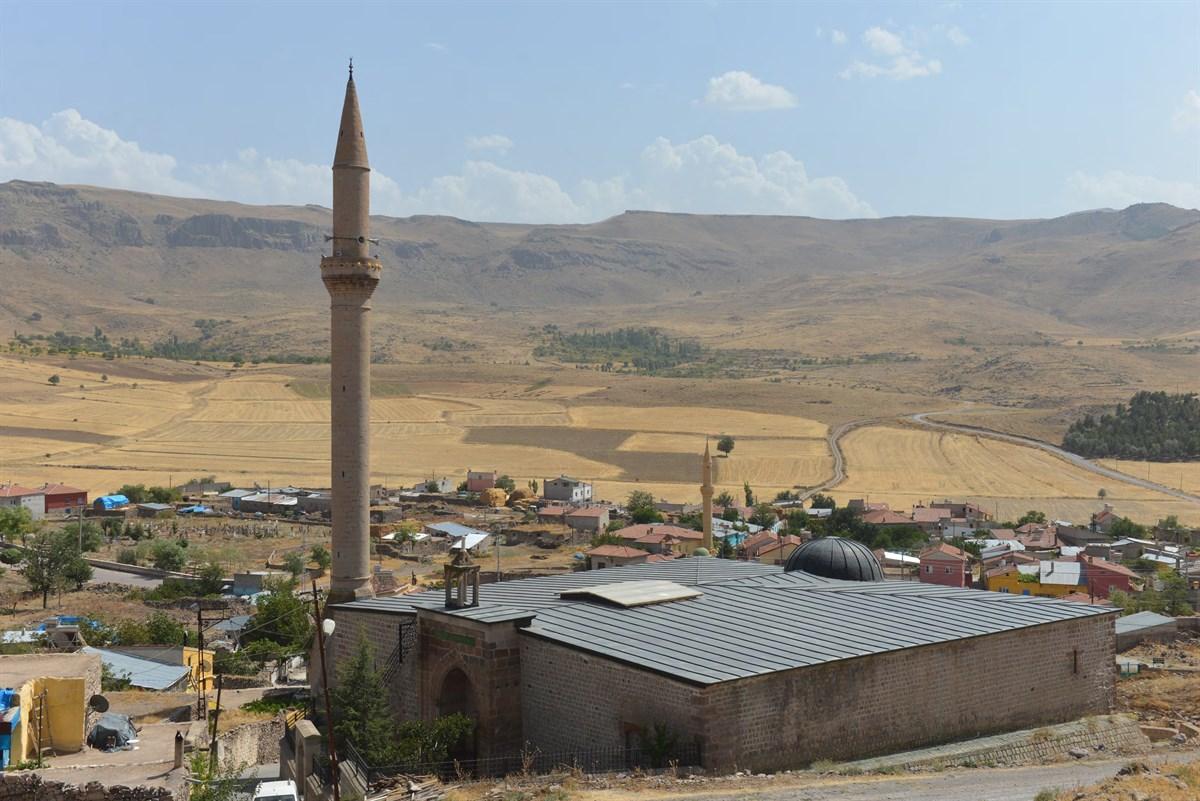
The mosque was constructed on a rectangular plot oriented northeast-southwest, set upon a sloping terrain. The main walls are built primarily of roughly dressed stone. The portal, corner elements, buttresses, windows, and minaret are constructed using finely cut stone.
- The northwest facade is bounded by a stepped retaining wall extending from ground level to a certain height.
- The central section of the southwest facade contains a rectangular prismatic mass forming the mihrap projection.
- The massive wall of the southeast facade features four rectangular windows. At the eastern corner of this facade rises the single-balconied minaret, known to have been added later to the structure.
The portal, located at the center of the northeast facade, is designed as a rectangular mass projecting outward and rising above the roofline.
- The portal is framed on its sides and top by moldings and borders of varying widths and profiles.
- The portal opening is shaped as a pointed arch recessed into the facade; its sole decorative element is a geometric composition of half-stars placed on the inner concave molding.
- The portal niche, designed like a narrow iwan, is surrounded by a pointed arch resting on two cylindrical columns with muqarnas capitals; it is further enclosed by a second, arched molding with keel-shaped arches.
- On either side of the portal niche are opposing mihrabiye niches, each with a five-sided, pointed-arch form.
- On the northern wing of the northeast facade, there is also a round-arched doorway (Bey Kapısı), currently sealed.
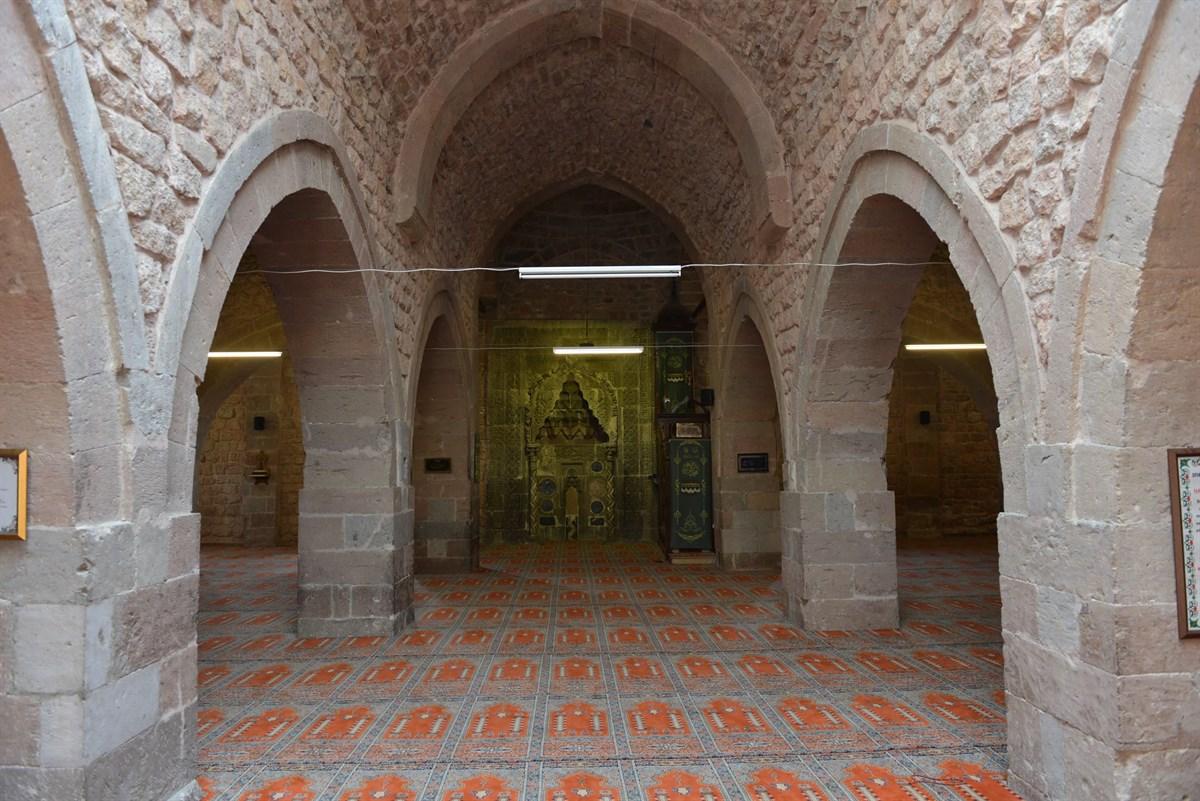
The square prayer hall, entered through the portal’s flat-arched opening, is divided into five bays by four rows of square piers aligned northeast-southwest. The bays are covered with pointed barrel vaults.
- The square area in front of the mihrap is covered by a domed maksûre supported by pendentives.
- The square area along the mihrap axis and the northeast wing of the central bay is designed as an open-air courtyard-like space, left uncovered.
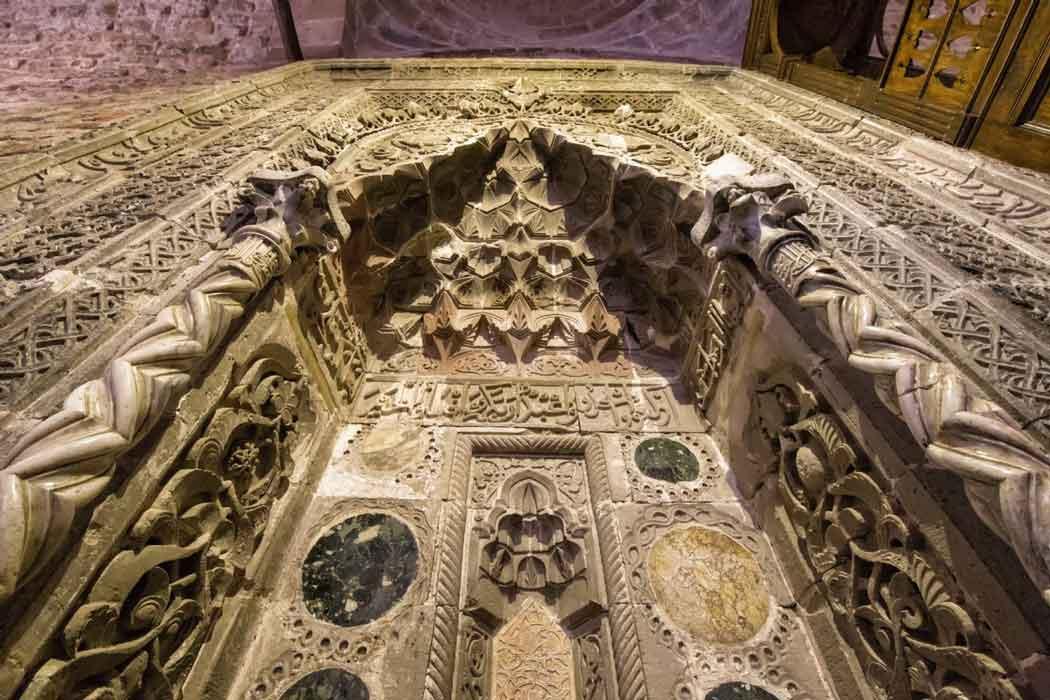
At the center of the qibla wall stands a mihrap made of gray andesite stone, aligned flush with the wall and shaped as a rectangular niche recessed into the wall.
- The mihrap niche is crowned by eight rows of muqarnas, resting on two cylindrical columns with twisted shafts and acanthus capitals, all enclosed by a pointed arch. The upper part of the mihrap is decorated with seven rows of muqarnas and framed by a pointed arch.
- The profile of the arch surrounding the muqarnas is adorned with a stone lattice pattern featuring palmette and lotus motifs that create a high-relief effect.
- Beneath the main mihrap niche, a smaller niche with three sides and three rows of muqarnas is carved into the wall.
- On the side walls of this smaller niche, variously colored marbles of differing sizes and shapes, embedded within woven medallions, are particularly striking.
The moldings and borders surrounding the mihrap are adorned with geometric compositions, vegetal motifs, and inscriptions in naskh script.
- On the borders: The complete 18th verse of Surah Al-Imran and part of the 19th verse (Meaning: “Allah, the angels, and those endowed with knowledge bear witness that there is no deity except Him. There is no god but Allah, the Almighty, the All-Wise. The true religion in the sight of Allah is Islam.”1).
- On the lower row of muqarnas: Verse 77 of Surah Al-Hajj (Meaning: “O you who believe, bow down, prostrate yourselves, worship your Lord, and do good, so that you may succeed.”).
- Below the column capitals: Verse 107 of Surah Al-Anbiya (Meaning: “O Muhammad, We have sent you only as a mercy to all the worlds.”) and Verse 4 of Surah Al-Qalam (Meaning: “Indeed, you are of a great moral character.”).
A kiosk minaret is situated adjacent to the portal’s roof on the northern facade.
- Access to the kiosk minaret is via a single-flight staircase with thirty-two steps, attached to the eastern wing of the portal.
- The minaret consists of a pyramidal cap supported by a single stone structure with eight-sided foundations connected by round arches.
- The kiosk minaret was likely added to the structure in a later period.
- Also rising at the eastern corner of the southeast facade is another single-balconied minaret, known to have been added later.
- Original fragments of the mosque’s 13th-century walnut wood minbar, crafted in the chakma kündekârî technique, are currently housed in the Ankara Ethnography Museum and the Kayseri Museum; the wooden minbar beside the mosque is a modern replacement.
- On the mirror stone above the fountain in the entrance and central bay of the prayer hall is inscribed: “Hayrat sahibi Osman, year 1117.” This date corresponds to 1705/06 CE in the Gregorian calendar.
- A white marble inscription block, repurposed as a keystone in one of the arches of the southeast bay, bears the beginning of verse 18 of Surah Al-Imran.