


This article was automatically translated from the original Turkish version.
+2 More
Shadow play is regarded as a symbolic representation of human existence and is grounded in the philosophical duality between light and darkness. This art form relies on the technique of projecting objects onto a screen through light, while simultaneously creating a cosmic unity through text, performance, and materials used. Shadow play is performed on a screen known as the Ayna or Ayîne-i Devran, imbued with Sufi depth. 【1】 In this context, the play constitutes a symbolic plane reflecting social reality and cultural values.
Scholarly debates regarding the origins of this art center on two main theories: one posits that it spread from Asia to the West, while the other argues the reverse. However, the general consensus holds that its origin lies in Asia, due to its rich cultural structure and technical characteristics. The foundations of Turkish shadow play are assessed to have been laid in the 16th century following the influences brought to Istanbul after Yavuz Sultan Selim’s campaign to Egypt, and it acquired its present form from the 17th century onward. The art completed its development within the multi-ethnic structure of the Ottoman Empire and was inscribed on UNESCO’s Intangible Cultural Heritage List in 2009. 【2】
The figures used in shadow play performances, known as tasvir, are typically crafted from camel or ox hide. After being shaped with knives called nevrekan, the leather is rendered translucent through special techniques and colored with root dyes, enabling light transmission and projection onto the screen. The figures are manipulated horizontally using rods made from approximately 50 cm long gürgen wood. Due to the use of horizontal rods, movement is restricted to one direction; to overcome this limitation, the fırdöndü technique is employed. Beneath the screen lies the Peş Tahtası, where instruments and figures are positioned.
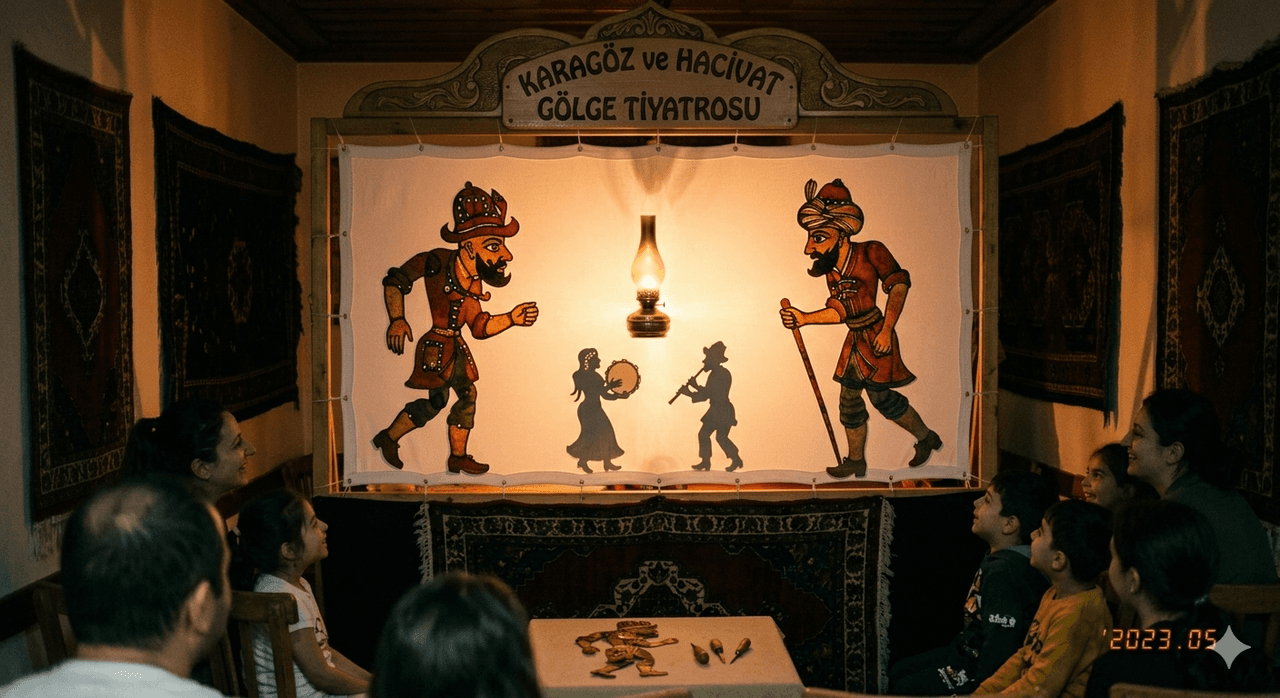
Visual representing shadow play. (Generated by artificial intelligence.)
Before the performance begins, static figures placed on the screen and raised with the sound of a nareke are called göstermelik. These figures provide the audience with symbolic codes regarding the content of the play.
Additionally, fixed preliminary figures such as Kanlı Kavak, Eczane, or Salıncak are used decoratively throughout the performance.
Karagöz plays constitute a microcosm reflecting the social strata and ethnic diversity of Ottoman society. Characters are classified as follows:
The refined and educated Çelebi, the drug-addicted Tiryaki, and the dwarf-like, perpetually repetitive Beberuhî.
Play texts encompass not only elements from the real world but also host a vast mythological universe. On screen appear mythic beings such as Şahmeran, Simurg, Burak, and sea maidens, alongside demonic entities such as sorcerers, cazus, jinn, zebanis, and dragons. These beings sometimes initiate action within the plot, and at other times serve merely as visual enrichments.
The Karagöz screen serves as a historical record offering a detailed depiction of life in Ottoman Istanbul. The city’s various neighborhoods, leisure spots, traditional professions, sporting activities, and daily events were documented through this art form. The dialogues between Karagöz and Hacivat are not merely sources of humor but also mechanisms of social critique and cultural transmission.
From the late 19th century onward, figures such as Ahmet Mithat Efendi attempted to modernize shadow play by synthesizing it with Western theatrical techniques. 【3】 During the Republican era, the art was employed as an educational tool to introduce new cultural values to the public. Today, in response to the shrinking traditional performance spaces due to digitalization and popular culture, academic proposals have been developed to ensure the sustainability of the art, including its inclusion in educational curricula, adaptation to digital platforms, and integration with animation and game technologies.
Düzgün, Dilaver. "Türk Gölge Oyunu Karagözde İstanbul Hayatı." Atatürk Üniversitesi Türkiyat Araştırmaları Enstitüsü Dergisi. Accessed April 8, 2026. https://dergipark.org.tr/tr/pub/ataunitaed/article/39765.
Gümüş, İbrahim. "Gölgedeki Mit: Karagöz’de Olağanüstü Varlıklar." Çeşm-i Cihan: Tarih Kültür ve Sanat Araştırmaları Dergisi E-Dergisi. Accessed April 8, 2026. https://dergipark.org.tr/tr/pub/cesmicihan/article/1032977.
Topaloğlu, Kenan. "Türk Gölge Oyunu Karagöz’de ‘Beberuhî’ Tipi." Atatürk Üniversitesi Sosyal Bilimler Dergisi. Accessed April 8, 2026. https://dergipark.org.tr/tr/pub/ataunisosbd/article/37754.
Öznülüer, Hüseyin and Mikail Karabulut. "Osmanlı Dönemi Gölge Oyununun Günümüz Karagöz Hacivat Tasvirlerine Yansımaları." Erzincan Üniversitesi Sosyal Bilimler Enstitüsü Dergisi. Accessed April 8, 2026. https://dergipark.org.tr/en/download/article-file/4649089.
[1]
Öznülüer, Hüseyin ve Mikail Karabulut. "Osmanlı Dönemi Gölge Oyununun Günümüz Karagöz Hacivat Tasvirlerine Yansımaları." Erzincan Üniversitesi Sosyal Bilimler Enstitüsü Dergisi. Erişim 8 Nisan 2026.https://dergipark.org.tr/en/download/article-file/4649089.
[2]
Öznülüer, Hüseyin ve Mikail Karabulut. "Osmanlı Dönemi Gölge Oyununun Günümüz Karagöz Hacivat Tasvirlerine Yansımaları." Erzincan Üniversitesi Sosyal Bilimler Enstitüsü Dergisi. Erişim 8 Nisan 2026.https://dergipark.org.tr/en/download/article-file/4649089.
[3]
Öznülüer, Hüseyin ve Mikail Karabulut. "Osmanlı Dönemi Gölge Oyununun Günümüz Karagöz Hacivat Tasvirlerine Yansımaları." Erzincan Üniversitesi Sosyal Bilimler Enstitüsü Dergisi. Erişim 8 Nisan 2026.https://dergipark.org.tr/en/download/article-file/4649089.


Historical Development and Geographical Origins
Stage Technique and Material Structure
Preliminary Figures and Symbolic Meanings
Character Typology and Social Representation
Central Characters
Istanbul Types
Ethnic and Regional Types
Bravados and Entertainers
Supernatural Beings and Mythological Elements
Istanbul Life and Cultural Memory
Modernization and Academic Perspectives