This article was automatically translated from the original Turkish version.
To set fire to one’s ships means to burn and destroy the means necessary for return, thereby committing oneself to a path from which there can be no turning back. Once such a point of no return has been crossed, the very thought of returning becomes futile and pointless, since the possibility of return is no longer observable. Consequently, the individual will begin to refuse even to consider returning. For one who no longer contemplates return, thinking ahead becomes easier. Because it is easier, such a person may begin to see, observe, reflect upon, and evaluate the future more clearly. Having ceased to expend energy on dwelling in the past or contemplating retreat, they will now direct all their strength solely toward moving forward. Since the direction is now exclusively forward, they will be able to steer more effectively and adopt a more resolute attitude in their progress.
Setting fire to the ships is the easy part. It must be remembered that destruction is far easier than construction. Before burning and destroying, one must ask: Have the things left behind been properly assessed? Is their loss truly necessary or worthwhile? Has a cost-benefit analysis been conducted? Have the necessary consultations been held? Or is a years-long accumulation of effort being hastily sacrificed due to a momentary surge of excitement sparked by a new glimmer of hope following a problem or hardship? These circumstances must be carefully observed, and if needed, prolonged reflection must be undertaken. For it must not be forgotten that setting fire to one’s ships means not only burning the vessels but also consuming and erasing the path already traveled—and with it, the people and connections left behind. This is to embark on a journey from which there is no return. Such an absolute decision inevitably carries with it substantial risks!

Visual Representing the State Before the Journey (Generated by Artificial Intelligence)
If the potential challenges of a long-term journey have been thoroughly anticipated and even exceeded in foresight, and if the anticipated outcome would provide sufficient satisfaction—or even if the goal remains unattainable—yet the act of progressing along the path itself is deemed valuable and necessary, then such a course may be viewed with far greater warmth and acceptance.
Sometimes, what is left behind may be so precious that it cannot be abandoned, and once lost, cannot be regained—such as family and close relatives. If leaving them behind is temporary and mutually accepted, then the situation is, of course, different. So far, we have spoken of burning and destruction. One must be cautious, for once what is burned and destroyed has turned to ash, its rebirth from the ashes will be slow and arduous.
Finally, the person who sets fire to their ships must lay down permanent foundations, so that even in the face of adverse scenarios, they may continue forward, drawing strength from these foundations and maintaining their direction without losing their way.
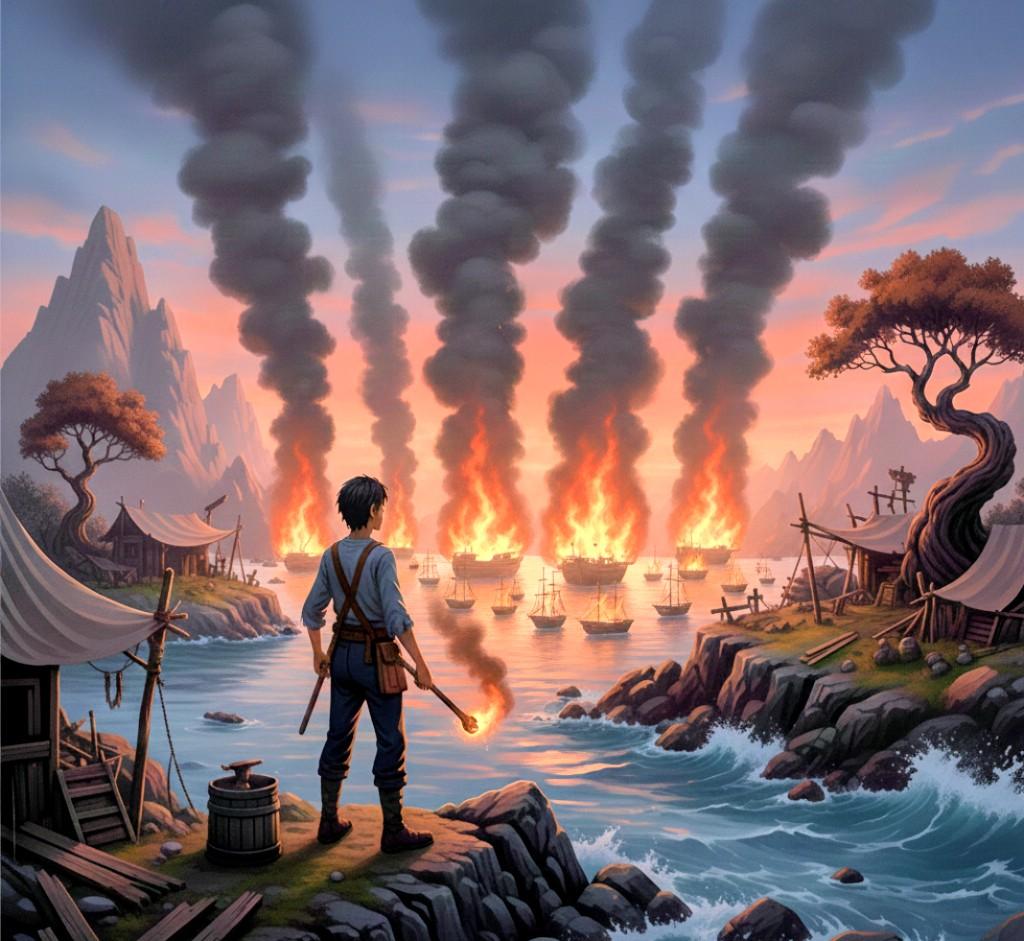
Visual Representing the Ships Set on Fire (Generated by Artificial Intelligence)