


This article was automatically translated from the original Turkish version.
Setar (Traditional Iranian Instrument)
Meaning and Origin: It means "Three Strings" in Persian. It is a delicate-sounding string instrument with origins in Iran and the Middle East. | Physical Structure: The body (resonance box) is typically made from mulberry wood, while the long neck is made from walnut or apple wood. Strings and Frets: Although named for three strings, modern setars have four strings. There are 25 to 28 movable frets on the long neck. Playing Technique: It is played not with an external plectrum (pick), but directly using the fingernail of the right index finger. | ||||||||
|---|---|---|---|---|---|---|---|---|---|
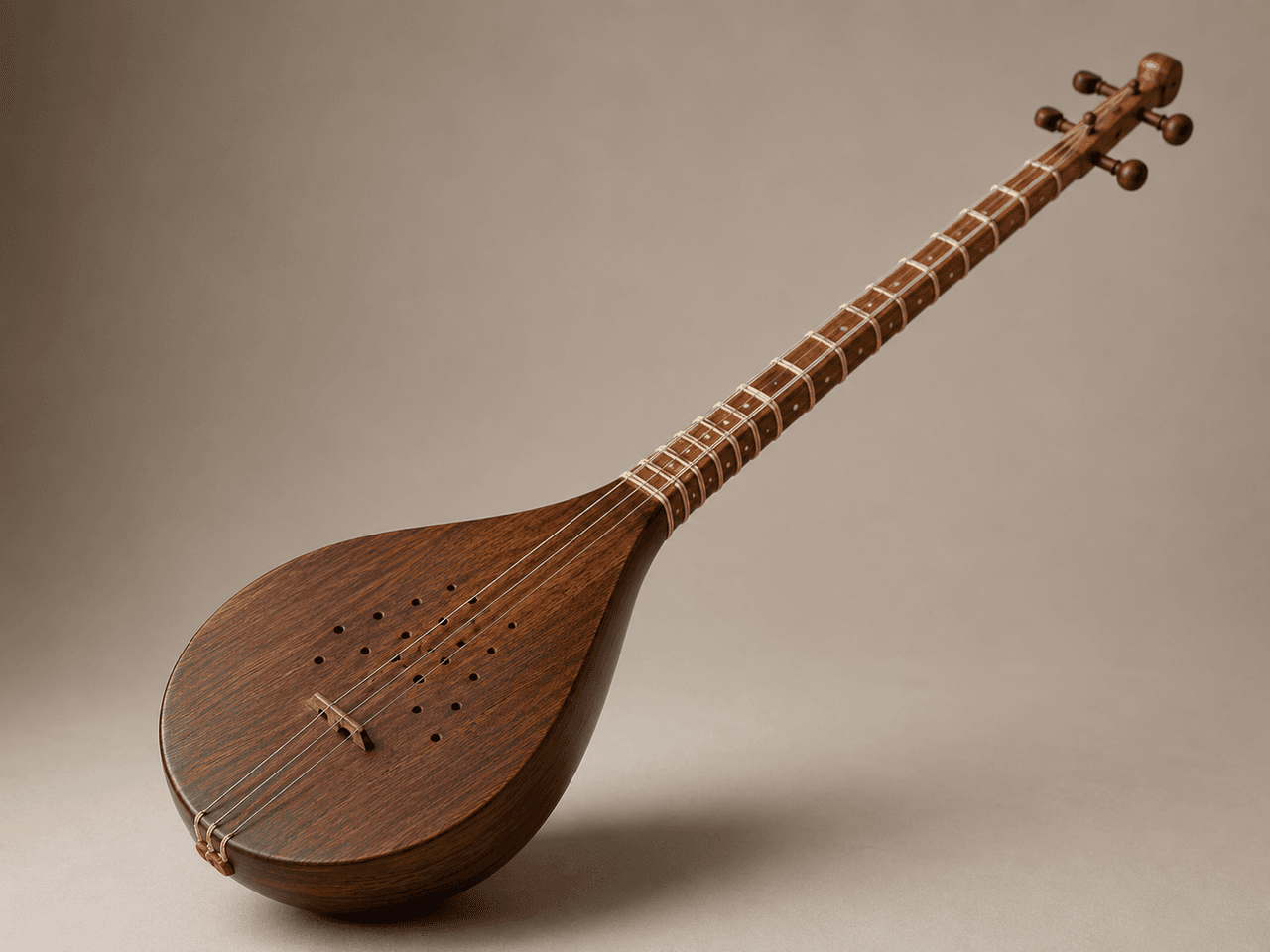
(Generated by Artificial Intelligence.)
Setar
Origin | Iran/Persian musical culture | ||||||||
|---|---|---|---|---|---|---|---|---|---|
Instrument Type | Long-necked, fretted, stringed lute | ||||||||
Classification | Stringed instrument / chordophone | ||||||||
Number of Strings | 3 | ||||||||
Material | Wood, bone, string | ||||||||
Number of Strings | 3 | ||||||||
Performance Style | Played by striking the strings with the fingernail of the right index finger | ||||||||
Setar (Traditional Iranian Instrument)
Historical Note | The setar was originally three-stringed, as its name suggests. In the 19th century, the Sufi musician Müştak Ali Şah added a fourth string to increase its musical capacity. This string is still referred to today as the "Müştak string". | ||||||||
|---|---|---|---|---|---|---|---|---|---|
Setar is a long-necked lute-type instrument and one of the most fundamental string instruments in the Iranian classical music tradition. Although its name derives from the Persian words se, meaning "three", and tar, meaning "string", modern setars typically have four strings. This instrument embodies the aesthetic, philosophical, and technical essence of Iranian musical culture and plays a central role in the performance of the Iranian classical repertoire (Radif).
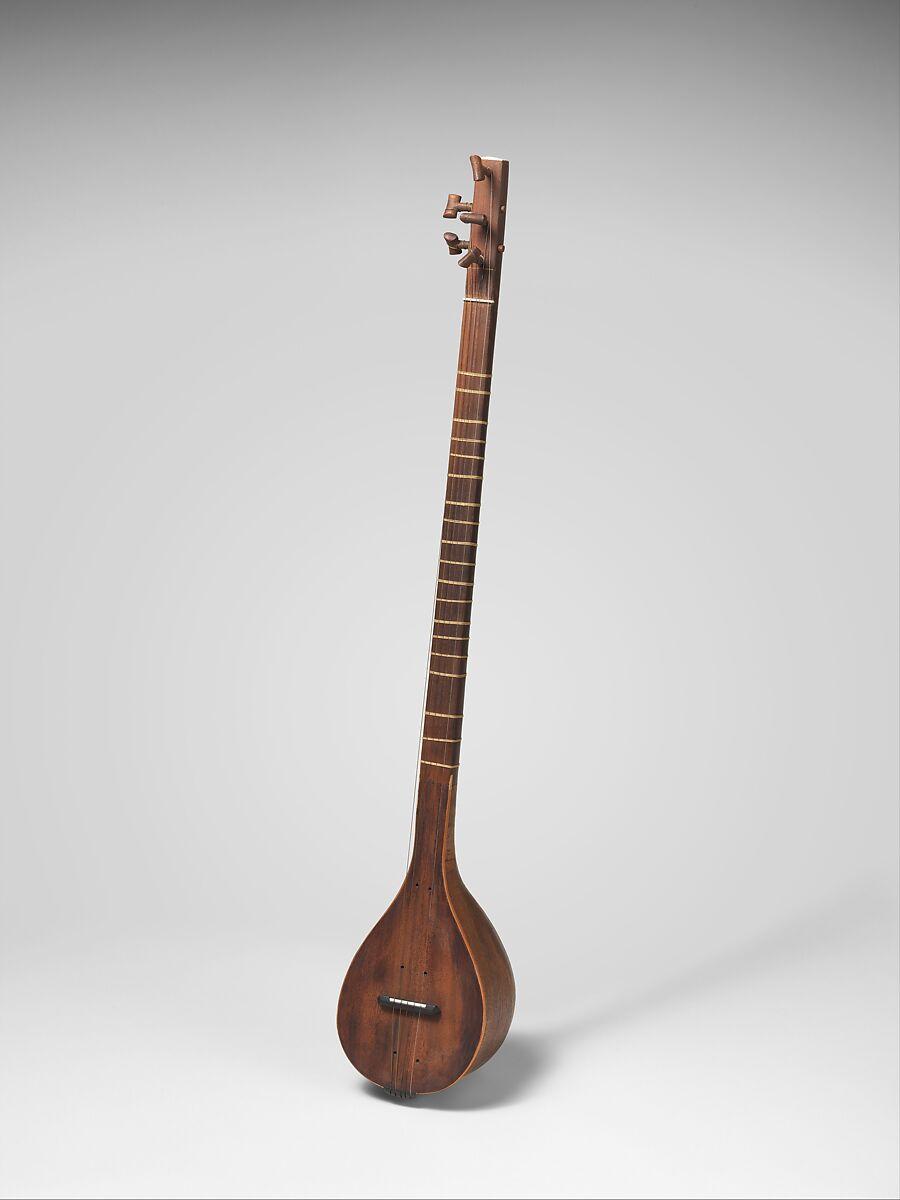
Iranian Setar with a Bowl-Shaped Body Made from Mulberry Wood (The Met)
The historical roots of the setar extend to long-necked lute forms and ancient reliefs in Western Asia dating back to the second millennium BCE. The tradition of long-necked lutes related to the tanbur/setar family was discussed by early Islamic-era theorists such as Al-Farabi, and later by music theorists like Safi al-Din al-Urmawi.
The setar appeared as a literary motif in 12th-century Persian poetry and began to be visually depicted in Iranian miniature art from the 16th century onward. Throughout its historical development, due to social perceptions and instrumental restrictions within Persian-Iranian culture, the setar became a symbol of a delicate, low-decibel, "secret" and "internal" style of musical expression.
The setar consists organologically of a body (soundbox), a neck, and strings. The instrument’s reflective soundbox is bowl-shaped, carved from mulberry wood, and lacks internal bracing, ribs, or framing. The neck is typically made from walnut wood and is fitted with 22 to 28 movable frets made of silk, gut, or rarely synthetic materials.
Modern setars have four strings: white, yellow, drone, and bass. The bridge structure is critical to the instrument’s acoustic performance; unlike instruments of the violin family, the setar’s bridge is not glued to the soundboard. Instead, it is held in place by the friction generated from the static tension of the strings and functions as a mechanical isolator that transmits vibrations directly to the soundboard. Approximately ten small sound holes cut into the soundboard optimize the instrument’s vibrational characteristics and resonance balance.
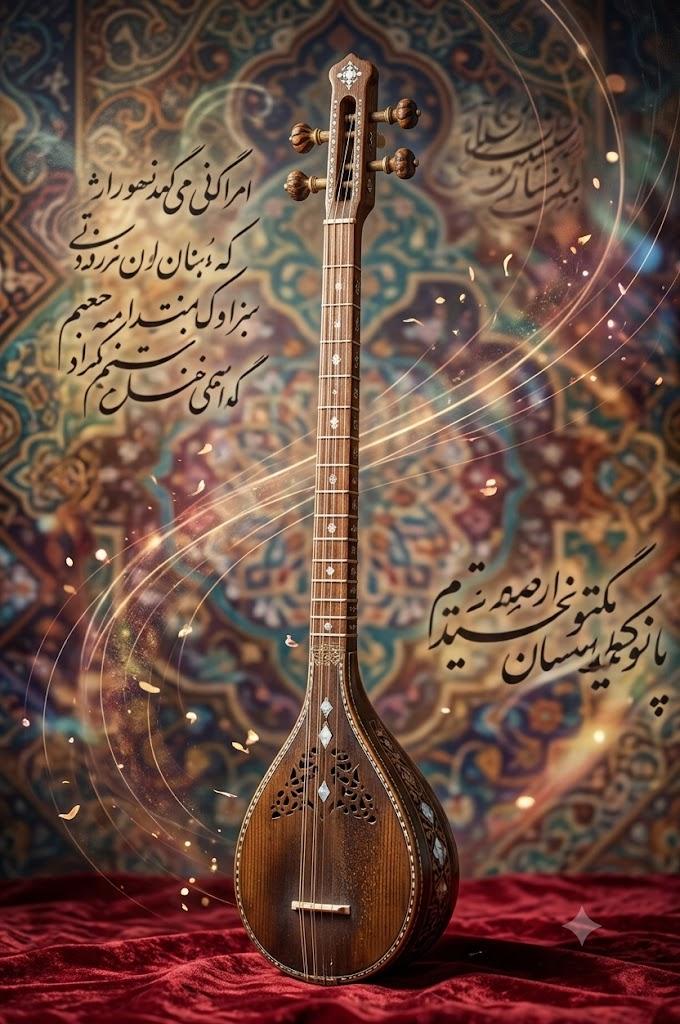
Setar (Generated by Artificial Intelligence.)
The vibrational behavior of the setar is closely linked to the orthotropic mechanical properties of the mulberry and walnut woods used in its construction. In addition to traditional luthier craftsmanship, modern engineering methods such as 3D laser scanning and finite element analysis (FEM) have demonstrated that the vibrational modes of the soundboard determine the instrument’s tonal character. Modal analyses have identified approximately 20 natural frequencies between 0 and 3000 Hz, confirming that these vibration patterns — known as Chladni figures — are directly correlated with the amplitude distribution across the plate surface.
The setar is one of the principal instruments used in the performance of the Radif. The Radif is a rich musical corpus comprising over 250 melodic units (gushe) organized within twelve principal modal systems (dastgah). Mastering the Radif requires students to memorize it entirely — a discipline demanding at least ten years of rigorous training, regarded not merely as technical instruction but as a spiritual journey aimed at opening the doors of inner consciousness.
Improvisation is central to performance. The performer selects and interprets pieces within a dastgah entirely according to their immediate emotional state and the energy of the listener. In musical theory, the performer reinterprets each piece anew and differently each time; thus, the performance is unpredictable even for the performer himself, constituting a state of total immersion (immersion).
Pedrammehr, Siamak, Nima Jafarzadeh Aghdam, Sajjad Pakzad, Mir Mohammad Ettefagh, and Morteza Homayoun Sadeghi. “A study on vibration of Setar: stringed Persian musical instrument,” *Journal of Vibroengineering*, Vol. 20, no. 7 (2018): 2680–2689. Accessed July 1, 2026. https://www.extrica.com/article/19505
The Metropolitan Museum of Art. "Setar." metmuseum.org. Accessed July 1, 2026. https://www.metmuseum.org/art/collection/search/500954
UNESCO. "Radif of Iranian Music." Representative List of the Intangible Cultural Heritage of Humanity. Accessed July 1, 2026. https://ich.unesco.org/en/RL/radif-of-iranian-music-00279
Wilpers, Michael. "Persian Classical Music: Bahman Panahi, Tar and Setar; Ali Mojallal, Tombak." Smithsonian. Accessed July 1, 2026. https://asia-archive.si.edu/podcast/persian-classical-music-bahman-panahi-tar-and-setar-ali-mojallal-tombak/

Setar (Traditional Iranian Instrument)
Meaning and Origin: It means "Three Strings" in Persian. It is a delicate-sounding string instrument with origins in Iran and the Middle East. | Physical Structure: The body (resonance box) is typically made from mulberry wood, while the long neck is made from walnut or apple wood. Strings and Frets: Although named for three strings, modern setars have four strings. There are 25 to 28 movable frets on the long neck. Playing Technique: It is played not with an external plectrum (pick), but directly using the fingernail of the right index finger. | ||||||||
|---|---|---|---|---|---|---|---|---|---|
(Generated by Artificial Intelligence.)
Setar
Origin | Iran/Persian musical culture | ||||||||
|---|---|---|---|---|---|---|---|---|---|
Instrument Type | Long-necked, fretted, stringed lute | ||||||||
Classification | Stringed instrument / chordophone | ||||||||
Number of Strings | 3 | ||||||||
Material | Wood, bone, string | ||||||||
Number of Strings | 3 | ||||||||
Performance Style | Played by striking the strings with the fingernail of the right index finger | ||||||||
Setar (Traditional Iranian Instrument)
Historical Note | The setar was originally three-stringed, as its name suggests. In the 19th century, the Sufi musician Müştak Ali Şah added a fourth string to increase its musical capacity. This string is still referred to today as the "Müştak string". | ||||||||
|---|---|---|---|---|---|---|---|---|---|
Historical Development and Origins
Organological Structure and Materials
Acoustic and Modal Analysis
The Radif Tradition and Performance Philosophy