


This article was automatically translated from the original Turkish version.
Savatlama is one of the traditional jewelry arts, a decorative technique involving the application of a black metallic alloy onto metal surfaces, particularly silver, by melting the alloy with heat and embedding it into the surface. Those who practice this art are called “savat master” or “savat artist.” Savatlama enhances valuable items with an aesthetic texture by adding fine black textural lines or reliefs onto metal surfaces.
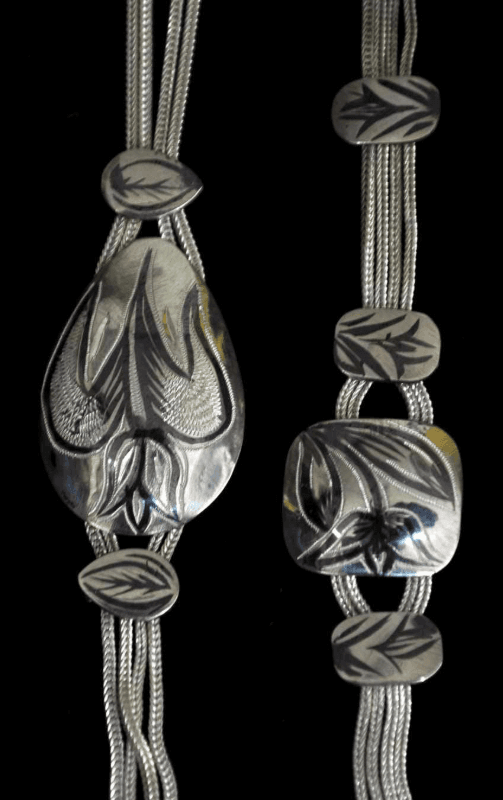
Jewelry Decorated with Savatlama Art (Source: Culture Portal)
The savatlama technique can be traced back to ancient Egypt, Rome and the Byzantine Empire, and became more widespread during the Middle Ages. This technique, used in Roman jewelry, gradually spread to Europe and reached its peak under Italian artisans of the Renaissance period. In the Ottoman Empire, savatlama was widely applied to weapons, jewelry and everyday objects, and was also commonly practiced in regions such as Turkistan, Iran and Caucasus. Today, this traditional craft is being preserved by a limited number of masters in regions such as Van and Eskişehir.
The savat alloy typically consists of a mixture of silver, copper, lead and sulfur. The preparation process involves melting these metals and then adding sulfur to form a black metallic sulfide alloy. The resulting alloy is cooled and ground into a powder, which is then used to fill grooves carved into the metal surface. This material is heated to 450 °C to fuse it onto the metal surface. The depth of the savat and the intensity of the black tone are proportional to the amount of sulfur used.
The savatlama process consists of three main stages:
The savatlama technique is frequently used on silver jewelry and objects. Items such as bracelets, rings, necklaces, earrings and belt buckles, as well as tobacco trays, cigarette holders, scabbards and trays, are among the objects decorated with savatlama. Designs typically feature botanical, geometric and animal motifs. In regions such as Van and Eskişehir, local symbols and figures are incorporated into the patterns applied to savat-decorated jewelry.
Savatlama art was widely practiced in Ottoman times in cities such as Van, Erzincan, Bitlis and Eskişehir. In the 19th century, Van alone had 120 jewelry workshops, and the savat-decorated items produced there were highly admired. Today, this traditional craft is being preserved by a limited number of masters, primarily in Van. In Türkiye, savat art is recognized as an important cultural heritage, especially in settlements such as Van, Eskişehir and Alpu.
"Savaşlı Gümüş." Kültür Portalı. Accessed January 14, 2025.https://www.kulturportali.gov.tr/turkiye/van/nealinir/savatli-gumus.
Geleneksel Meslekler Ansiklopedisi. Ministry of Trade of the Republic of Turkey. Accessed January 14, 2025.
Savat Tekniği Sunum. Open Lecture -Ankara Üniversitesi. Accessed January 14, 2025.
Şekerci, Haldun. "Kuyumculukta Savat Tekniği ve Savatlı Takı Uygulamaları." E-Journal of New World Sciences Academy. Dumlupınar University. Accessed January 14, 2025.http://dx.doi.org/10.12739/NWSA.2014.9.4.2C0055.

History
Savat Alloy and Preparation
Steps in Savatlama Production
Savat-Decorated Items and Ornamentation
Savat Art in Türkiye