This article was automatically translated from the original Turkish version.
Product Name | Samsun Kaz Tiridi | ||||||||
|---|---|---|---|---|---|---|---|---|---|
Product Type | Meals and Soups | ||||||||
Registration Date | 09.07.2013 | ||||||||
Application Date | 27.12.2011 | ||||||||
Registration Number | 174 | ||||||||
Geographical Indication Type | Signpost | ||||||||
Registering Authority | Samsun Inner City Municipalities Union | ||||||||
Registration Date | 27 December 2011 | ||||||||
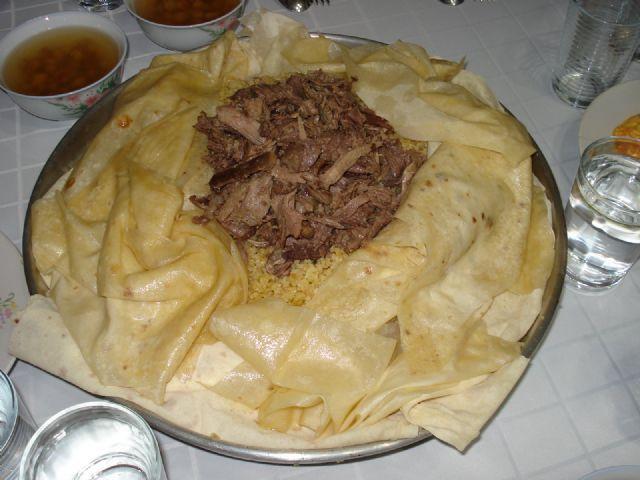
Samsun kaz tiridi (kaz asma) is a traditional tirit dish unique to Samsun, a province in Türkiye’s Black Sea Region. It is prepared by boiling or suspending the goose to cook, shredding the meat, serving it with bulgur pilaf made from the goose broth, and arranging thin sheets of dough (tilit) brushed with rendered goose fat. This dish is especially consumed during winter months and is one of the distinguishing elements of Samsun’s culinary culture.
The origins of Samsun kaz tiridi are generally traced back at least 100 to 200 years.【1】 Associated with gatherings and communal meals held during long winter nights in the region, the dish has been preserved through oral transmission across generations. Preparation knowledge was primarily passed down within families, especially by women, reinforcing the dish’s local identity and continuity.
The geese used for kaz tiridi are fattened during autumn and winter. During this period, their movement is restricted and they are fed corn, wheat, and similar grains to enhance the fat content and flavor of the meat. After slaughter, the feathers are removed, the skin is cleaned, and the fat is rendered separately.
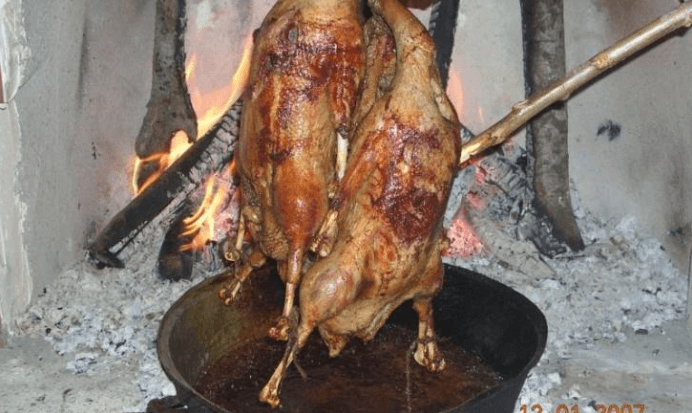
Image of a Suspended Goose for Kaz Tiridi ( Ministry of Culture and Tourism of the Republic of Türkiye)
The most common method of cooking kaz tiridi is boiling. The cleaned goose is cooked in a pot or pressure cooker with water and salt. In traditional practices, the “kaz asma” method is also used, in which the goose is suspended by its neck and slowly rotated over a wood fire. The fat that drips from the goose during cooking is collected and used in other stages of preparation.
One of the defining elements of the dish is tilit, a thin dough made from flour, water, and salt, cooked on a griddle and then dipped in melted goose fat to coat it thoroughly. The dough sheets are typically cut into triangular pieces and mixed to ensure complete coverage with fat. The broth obtained from cooking the goose is used to prepare the bulgur pilaf.
Samsun kaz tiridi is typically served on a large tray. The bulgur pilaf, cooked in goose broth, is placed in the center, followed by the shredded goose meat arranged on top. The greased tilit pieces are arranged around the pilaf. The dish is usually eaten by hand and accompanied by beverages such as grape or cranberry compote.
“Samsun Kaz Tiridi” was granted geographical indication status on 27 December 2011, placing it under protected designation. This registration aims to preserve the dish’s unique production method, ingredient composition, and presentation style specific to Samsun. Today, kaz tiridi continues to be prepared in home kitchens and a limited number of businesses in the districts of Kavak, Vezirköprü, Havza, Asarcık, and Ladik in Samsun, remaining an important cultural value representing the region’s gastronomic identity.
Alıcı, Kemal, and Abdullah Badem. “Samsun İline Ait Bir Yemek: Kaz Tiridi.” *II. Uluslararası Turizmde Yeni Jenerasyonlar ve Yeni Trendler Kongresi Bildirileri.* (2021): 325–334. Accessed December 18, 2025. https://www.researchgate.net/publication/354338705_Samsun_Iline_Ait_Bir_Yemek_Kaz_Tiridi
Erdoğan, Deniz, and Oya Özkanlı. “Coğrafi İşaretli Ürünlerin Bölgesel Etkisinin Halk Tarafından Algılanması: Kaz Tiridi Örneği.” *Journal of Humanities and Tourism Research* 12, no. 3 (2022): 440–454. Accessed December 18, 2025. https://dergipark.org.tr/tr/download/article-file/2706946
Samsun İl Directorate of Culture and Tourism. “Kaz Tiridi.” T.C. Kültür veTurizm Bakanlığı. Accessed December 18, 2025. https://samsun.ktb.gov.tr/TR-216888/kaz-tiridi.html
T.C. Kavak Kaymakamlığı. "Kaz Tiriti." Accessed December 18, 2025. http://www.samsunkavak.gov.tr/kaz-tiriti
Tekbalkan, Murat. “Yöresel Yemeklerin Bölge Turizmine Katkısı: Samsun Kaz Tiridi Örneği.” *Journal of Tourism and Gastronomy Studies* 5, no. 4 (2017): 155–169. Accessed December 18, 2025. https://jotags.net/index.php/jotags/article/view/313/524
Türkiye Kültür Portalı. “Kaz Tiridi (Kaz Asma) - Samsun.” T.C. Kültür ve Turizm Bakanlığı. Accessed December 18, 2025. https://www.kulturportali.gov.tr/turkiye/samsun/neyenir/kaz-tiridi-kaz-asma
Çirişoğlu, Emel. “Kaz Etinin Türk Gastronomi’sindeki Yeri.” *Turkish Journal of Agriculture - Food Science and Technology* 10, no. 11 (2022): 2102-2107. Accessed December 18, 2025. https://agrifoodscience.com/index.php/TURJAF/article/view/5083/2664
[1]
Kemal Alıcı and Abdullah Badem, “Samsun İline Ait Bir Yemek: Kaz Tiridi,” II. Uluslararası Turizmde Yeni Jenerasyonlar ve Yeni Trendler Kongresi Bildirileri, (2021): p. 325, Access date: 18 December 2025, https://www.researchgate.net/publication/354338705_Samsun_Iline_Ait_Bir_Yemek_Kaz_Tiridi

Product Name | Samsun Kaz Tiridi | ||||||||
|---|---|---|---|---|---|---|---|---|---|
Product Type | Meals and Soups | ||||||||
Registration Date | 09.07.2013 | ||||||||
Application Date | 27.12.2011 | ||||||||
Registration Number | 174 | ||||||||
Geographical Indication Type | Signpost | ||||||||
Registering Authority | Samsun Inner City Municipalities Union | ||||||||
Registration Date | 27 December 2011 | ||||||||
Historical Background and Cultural Context
Feeding and Preparation of the Goose
Cooking Methods
Tilit and Auxiliary Components
Serving and Consumption Style
Geographical Indication and Contemporary Status