


This article was automatically translated from the original Turkish version.
+1 More
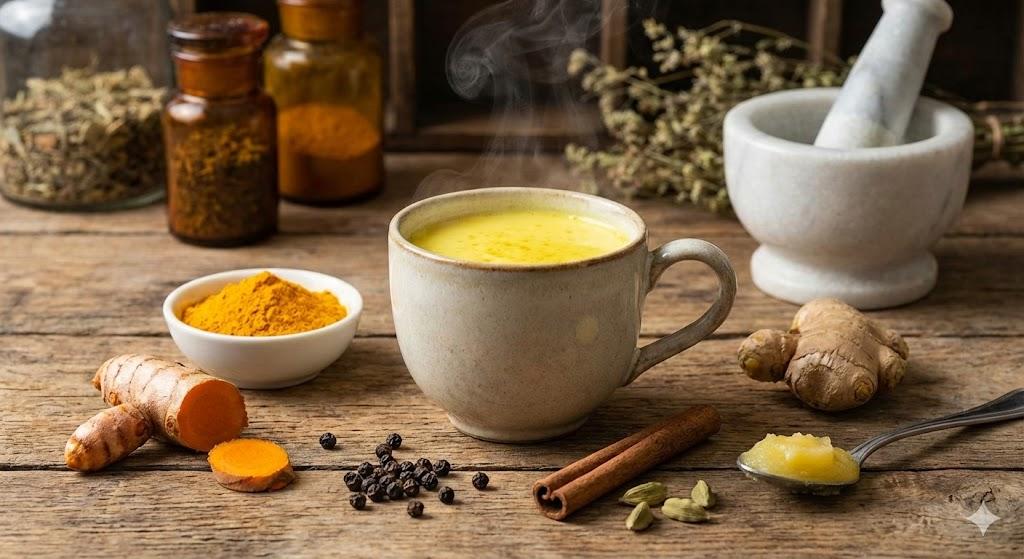
Saffron Milk (Generated by Artificial Intelligence.)
Common Name | Saffron Milk / Golden Milk | ||||||||
|---|---|---|---|---|---|---|---|---|---|
Original Name | Haldi Doodh | ||||||||
Origin | India | ||||||||
Primary Effects | Anti-inflammatory, Antioxidant, Analgesic | ||||||||
Turmeric Milk (known in Western literature as Golden Milk, originally called Haldi Doodh), is a traditional beverage made by mixing milk with turmeric powder (Curcuma longa), rooted in the ancient Indian medical system of Ayurveda. Today, this beverage is recognized as a functional food due to its anti-inflammatory, antioxidant, and immune-boosting properties.【1】
The origins of turmeric milk trace back to Ayurveda, one of the world’s oldest holistic healing systems, dating to around 3000 BCE. In Indian culture and medical literature, this mixture is known as Haldi Doodh and is regarded not merely as a drink but as a cultural ritual passed down through generations. In Ayurvedic practice, turmeric is considered a spice that enhances “Ojas,” the vital energy associated with vitality and immunity.
In traditional use, turmeric milk is regarded as “the family doctor” due to its healing properties. In India, mothers and grandmothers prepare it especially during winter months to alleviate feverish illnesses, accelerate recovery after physical trauma, or help those suffering from insomnia before bedtime. Traditional recipes include not only cow’s milk but also variations based on the condition being treated, using water or clarified butter (ghee) as the base.
Its popularity in the Western world under the names Golden Milk or Turmeric Latte began in the early 21st century. During this period, the traditional recipe was adapted to modern palates and dietary preferences—such as plant-based milks and espresso additions—transforming it into a global health trend with commercial recognition.
The core ingredients of the beverage are milk—either animal-based or plant-based such as almond or coconut milk—and turmeric. However, the biological efficacy of the mixture depends on additional components. Modern recipes and scientific formulations commonly combine the following ingredients:
When examined pharmacologically, the therapeutic efficacy of turmeric milk relies on a complex chemical interaction. The primary bioactive compound in turmeric, curcumin, possesses potent medicinal properties but has very low bioavailability. When taken orally, its poor water solubility, weak intestinal absorption, and rapid metabolism in the liver (via glucuronidation) prevent it from reaching effective concentrations in the bloodstream when consumed alone.
The turmeric milk formulation offers a synergistic solution to overcome these pharmacokinetic barriers:
Scientific literature and clinical studies suggest that regular consumption of turmeric milk may have beneficial effects on various physiological systems:
Disclaimer: The content presented here is for general encyclopedic informational purposes only. This information must not be used for diagnosis, treatment, or medical advice. Always consult a qualified healthcare professional before making any health-related decisions. Neither the author nor KÜRE Encyclopedia assumes any responsibility for consequences arising from the use of this information for diagnostic or therapeutic purposes.
Andrew Weil Center for Integrative Medicine. "Integrative Health Recipe: Golden Milk." The University of Arizona. Accessed December 31, 2025.https://awcim.arizona.edu/health_hub/awcimagazine/integrative_health_recipe_golden_milk.html
Daraksha Iram, Manish Singh Sansi, Kamal, Gandhi, Rajan Sharma, and Shilpa Vij. "Turmeric Milk: An Elixir." *Indian Dairyman.* Accessed December 31, 2025.https://www.researchgate.net/profile/Kamal-Gandhi-4/publication/360164046_Turmeric_Milk_An_Elixir/links/62660b25bca601538b664384/Turmeric-Milk-An-Elixir.pdf
Medanta. "5 Health Benefits of Turmeric Milk (Golden Milk)." Patient Education Blog. Accessed December 31, 2025.https://www.medanta.org/patient-education-blog/health-benefits-of-turmeric-milk-golden-milk.
Paleker, Gairoonisa. "Rhizome networks: Turmeric’s global journey from haldi doodh to turmeric latte." *Agenda* 37, no. 1 (2023): 19–26. Accessed December 31, 2025.https://www.tandfonline.com/doi/full/10.1080/10130950.2023.2177554
Shoba, Guido, David Joy, Thangam Joseph, Muhammed Majeed, Rajendran Rajendran, and P. S. Srinivas. "Influence of piperine on the pharmacokinetics of curcumin in animals and human volunteers." *Planta Medica* 64, no. 4 (1998): 353-356. Accessed January 14, 2026.https://pubmed.ncbi.nlm.nih.gov/9619120/
[1]
Medanta, "5 Health Benefits of Turmeric Milk (Golden Milk)," Patient Education Blog, Erişim: 31 Aralık 2025, https://www.medanta.org/patient-education-blog/health-benefits-of-turmeric-milk-golden-milk
[2]
Daraksha Iram, Manish Singh Sansi, Kamal Gandhi, Rajan Sharma ve Shilpa Vij, "Turmeric Milk: An Elixir." Indian Dairyman (2022): syf 55, https://www.researchgate.net/profile/Kamal-Gandhi-4/publication/360164046_Turmeric_Milk_An_Elixir/links/62660b25bca601538b664384/Turmeric-Milk-An-Elixir.pdf
[3]
Guido Shoba, David Joy, Thangam Joseph, Muhammed Majeed, Rajendran Rajendran ve P. S. Srinivas, "Influence of piperine on the pharmacokinetics of curcumin in animals and human volunteers," Planta Medica 64, 4 (1998): syf 353, https://pubmed.ncbi.nlm.nih.gov/9619120/
[4]
Daraksha Iram, Manish Singh Sansi, Kamal Gandhi, Rajan Sharma ve Shilpa Vij. "Turmeric Milk: An Elixir." Indian Dairyman (2022): syf 56, https://www.researchgate.net/profile/Kamal-Gandhi-4/publication/360164046_Turmeric_Milk_An_Elixir/links/62660b25bca601538b664384/Turmeric-Milk-An-Elixir.pdf
Medanta, "Health Benefits of Turmeric Milk (Golden Milk)," Patient Education Blog, Erişim: 31 Aralık 2025, https://www.medanta.org/patient-education-blog/health-benefits-of-turmeric-milk-golden-milk
[5]
Medanta, "Health Benefits of Turmeric Milk (Golden Milk)," Patient Education Blog, Erişim: 31 Aralık 2025, https://www.medanta.org/patient-education-blog/health-benefits-of-turmeric-milk-golden-milk
[6]
Guido Shoba, David Joy, Thangam Joseph, Muhammed Majeed, Rajendran Rajendran ve P. S. Srinivas, "Influence of piperine on the pharmacokinetics of curcumin in animals and human volunteers," Planta Medica 64, 4 (1998): syf 353, https://pubmed.ncbi.nlm.nih.gov/9619120/
[7]
Medanta. "5 Health Benefits of Turmeric Milk (Golden Milk)," Patient Education Blog, Erişim: 31 Aralık 2025, https://www.medanta.org/patient-education-blog/health-benefits-of-turmeric-milk-golden-milk
Daraksha Iram, Manish Singh Sansi, Kamal Gandhi, Rajan Sharma ve Shilpa Vij, "Turmeric Milk: An Elixir," Indian Dairyman (2022): syf 58, https://www.researchgate.net/profile/Kamal-Gandhi-4/publication/360164046_Turmeric_Milk_An_Elixir/links/62660b25bca601538b664384/Turmeric-Milk-An-Elixir.pdf

Saffron Milk (Generated by Artificial Intelligence.)
Common Name | Saffron Milk / Golden Milk | ||||||||
|---|---|---|---|---|---|---|---|---|---|
Original Name | Haldi Doodh | ||||||||
Origin | India | ||||||||
Primary Effects | Anti-inflammatory, Antioxidant, Analgesic | ||||||||
History and Origins
Ingredients and Preparation Principles
Bioavailability and Chemical Interactions
Health Effects【7】