


This article was automatically translated from the original Turkish version.
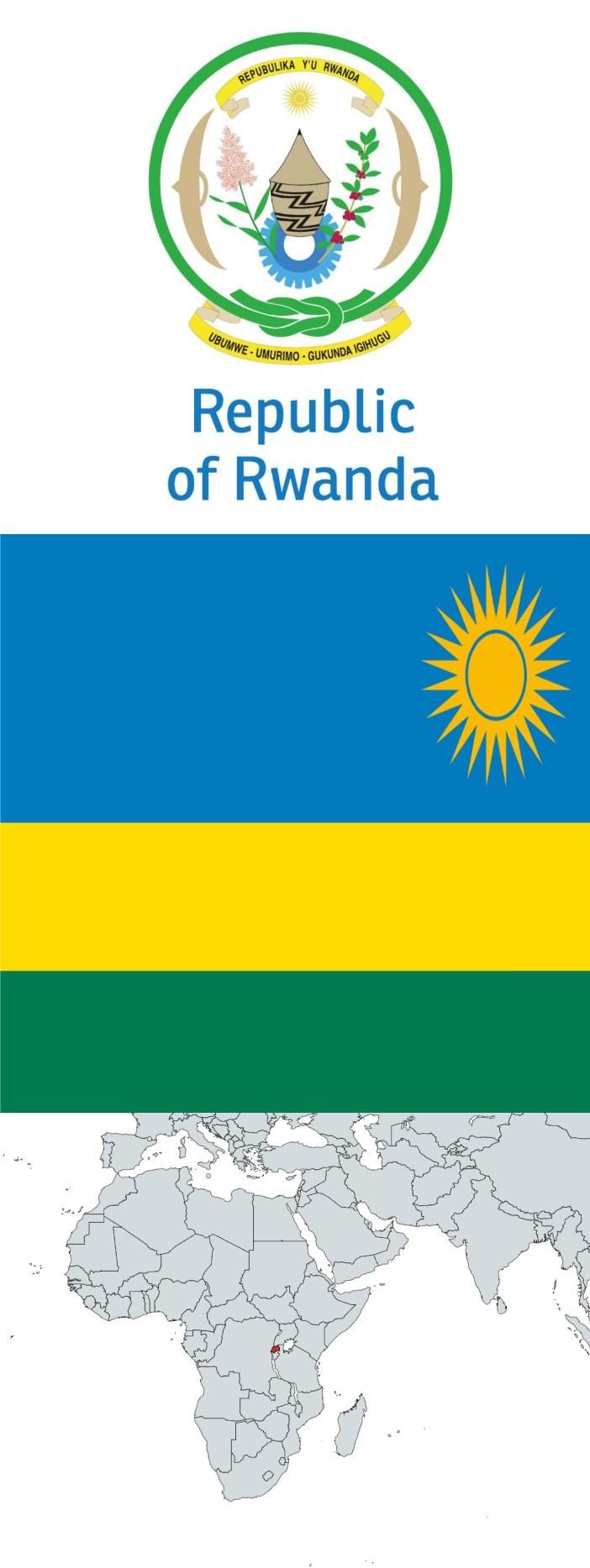
Republic of Rwanda
Official Name | Republic of Rwanda | ||||||||
|---|---|---|---|---|---|---|---|---|---|
Form of Government | Republic | ||||||||
Date of Independence | 1 Temmuz 1962 | ||||||||
Capital | Kigali | ||||||||
President | Paul Kagame | ||||||||
Official Language | French Swahili Kinyarwanda English | ||||||||
Common Languages | Kinyarwanda | ||||||||
National Day | 1 July | ||||||||
Area | 26,338 km² | ||||||||
Total Population | 14.1 million | ||||||||
Climate | Temperate tropical climate | ||||||||
GDP | 14.771 million USD | ||||||||
GDP per Capita | 1,043 USD | ||||||||
Ethnic Groups | Twa (%1) Hutu (%95.9) Tutsi (%2.1) | ||||||||
Religious Composition | Other/Nonreligious (%2.0) Christianity (%95.9) Islam (%2.1) | ||||||||
Telephone Code | +250 | ||||||||
Internet Domain Code | .rw | ||||||||
Rwanda is a landlocked country located in the center of the African continent, within the Great Lakes region. Situated just south of the equator, Rwanda is bordered by Uganda to the north, Tanzania to the east, Burundi to the south, and the Democratic Republic of the Congo to the west and northwest. With a total area of 26,338 km², its estimated population density is 503 people per km². The 2025 population is approximately 14.1 million.【1】
The country’s capital, administrative, economic, and cultural center is Kigali; other important cities include Gitarama, Butare, Ruhengeri, and Gisenyi. The official languages are Kinyarwanda, English, French, and Swahili, with Kinyarwanda being the native language spoken by nearly the entire population. The currency is the Rwandan franc (RWF/FRW). The country’s official name is the Republic of Rwanda, which gained its independence on 1 July 1962 (from United Nations trusteeship under Belgian administration).
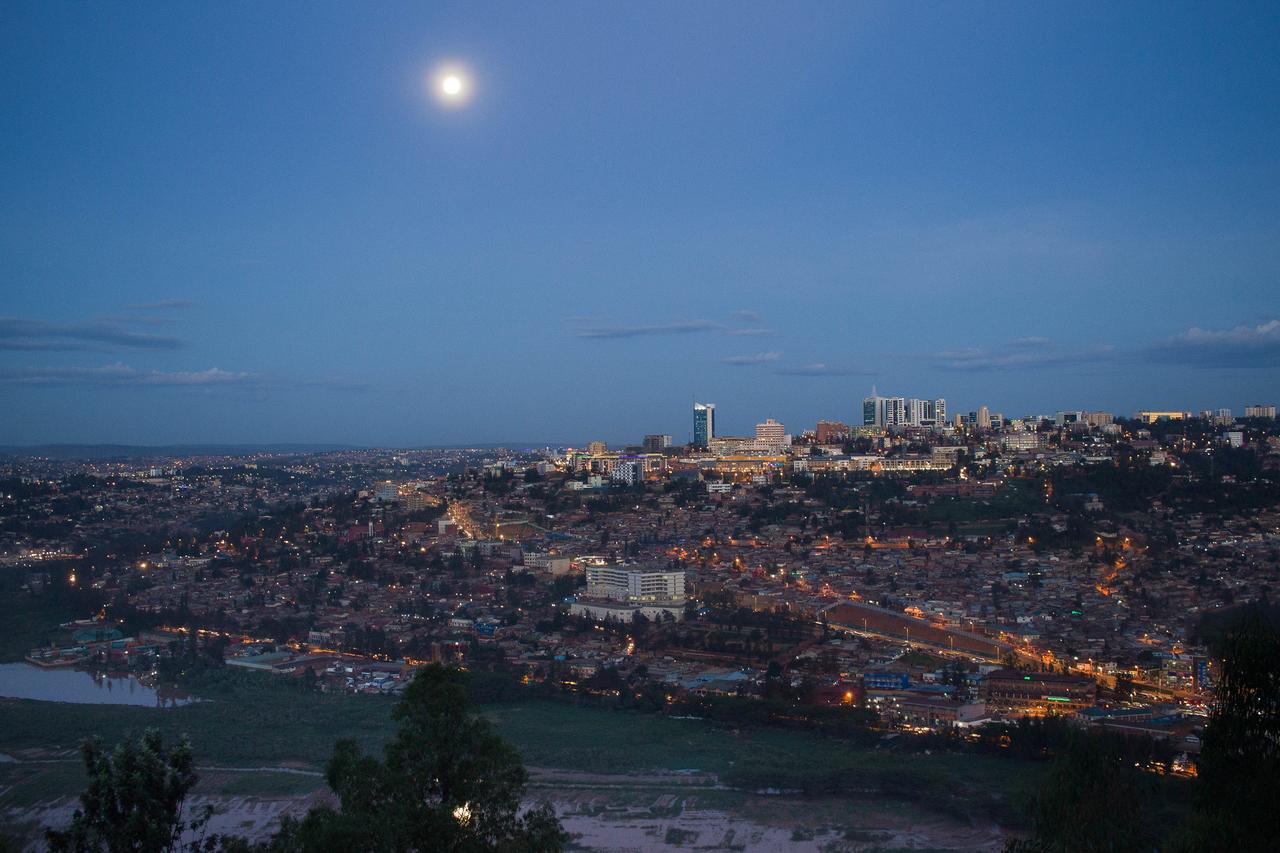
City View of Kigali, Rwanda (Flickr)
The earliest settlements in Rwanda date back to around 8000 BCE. Bantu communities began arriving in the region from around 700 BCE, during which time the Hutu and Tutsi groups settled in Rwandan territory. Over time, a centralized monarchy emerged, governed by kings believed to share a common lineage. Within this political structure, local administrators managed cattle, land, and military affairs; the Hutu, Tutsi, and Twa communities coexisted within this framework. The Tutsi formed the ruling class, while the Hutu were primarily engaged in agriculture and livestock rearing. From the 15th century onward, various small kingdoms developed in the region, and by the 19th century, the Tutsi-origin Kingdom of Rwanda had consolidated regional dominance. The reign of Kigeri Rwabugiri (1853–1895) is regarded as one of the most powerful periods in the kingdom’s administrative and military history.
At the 1884 Berlin Conference, Rwanda was designated as part of German East Africa, but Germany only established effective authority in the region by the mid-1890s. The monarchy continued formally during this period, and German occupation was completed in 1897. In the early 20th century, missionary activity increased and Christianity spread widely.
After World War I, the 1919 Treaty of Versailles placed Rwanda under Belgian mandate administration. The Belgian administration implemented programs in health, education, and agriculture; coffee production began during this period. Under the influence of Catholic missionaries, the majority of the population adopted Christianity, and the monarchy also embraced the religion. The Belgian administration reinforced ethnic divisions by officially recognizing the Tutsi as a superior ruling class.
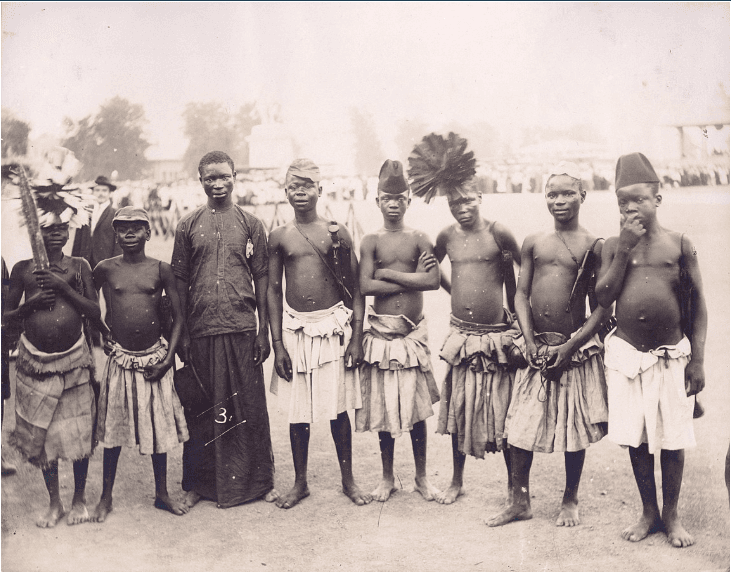
The Twa People, 1904 (Store Norske Leksikon)
Political parties established in the 1950s reflected the division between Hutu and Tutsi communities. In 1959, a Hutu uprising against the Tutsi-dominated monarchy occurred, intensifying conflicts. A 1961 referendum abolished the monarchy, and on 1 July 1962, Rwanda declared independence. After independence, Grégoire Kayibanda was elected president; however, ethnic tensions persisted. In 1973, a coup led by General Juvénal Habyarimana changed the government, and Habyarimana retained power through subsequent elections.
Tutsi refugees, in response to exile conditions and discriminatory policies, founded the Rwandese Alliance for National Unity (RANU) in 1979. The organization adopted the name Rwandan Patriotic Front (RPF) in 1987. On 1 October 1990, the RPF launched an armed campaign, advancing from the north and triggering a civil war. The 1993 ceasefire ended with the downing of President Habyarimana’s plane in 1994.
During the Rwandan genocide from April to July 1994, approximately one million people, predominantly Tutsi and moderate Hutu, were killed. The genocide was carried out by the Interahamwe militias and extremist Hutu groups with state support. International actors failed to intervene effectively. In the same year, over two million Hutu fled to neighboring countries. The United Nations established the International Criminal Tribunal for Rwanda in November 1994 to prosecute those responsible for the genocide.
The armed wing of the RPF captured Kigali on 4 July 1994, halting the genocide. Subsequently, a Government of National Unity was formed, including parties that had not participated in the genocide, and Pasteur Bizimungu was appointed president. Upon Bizimungu’s resignation in 2000, Paul Kagame was appointed president. Kagame was re-elected in the 2003, 2010, and 2017 elections.
Rwanda’s national anthem, known as “Rwanda Nziza,” means “Beautiful Rwanda” in Turkish. This four-stanza anthem highlights the beauty of the country and the shared heritage of its people.
Its central themes emphasize the unity and common identity of the Rwandan people, as well as the values they embrace as their national heritage and the foundation of national development.
Rwandan National Anthem (Urumaxi Anthems)
Rwanda’s national flag, adopted in 2001, is a powerful symbol of the country’s journey toward unity, hope, and peace following the 1994 Tutsi genocide. The new design consists of three unequal horizontal stripes: a double-width light blue at the top, yellow in the center, and green at the bottom. At the right end of the light blue stripe is a bright yellow sun with 24 rays, encircled by a blue ring.
The light blue, covering half the flag, represents happiness and peace, reflecting the country’s commitment to harmony within its borders and with its neighbors. The yellow stripe symbolizes economic development, growth, and the country’s mineral wealth, while the green stripe signifies Rwanda’s natural beauty, prosperity, and environmental conservation efforts. The bright yellow sun represents national unity, transparency, and the new era of hope and enlightenment experienced by the Rwandan people after the genocide.
The adoption of the current flag is closely linked to the country’s history. During the monarchy, Rwanda had no national flag; after independence in 1961, a vertical tricolor of red, yellow, and green—Pan-African colors—was adopted. However, this first flag became associated with extremist ideologies and the 1994 genocide, prompting its replacement. The government adopted the new flag to symbolize the elimination of ethnic divisions, national reconciliation, and a unified “Pan-Rwandan” identity for all citizens. The flag’s features, usage, and protocols of respect are defined by law.
Rwanda is located in the center of the African continent, approximately 75 miles south of the equator. Due to its geographical position and topography, Rwanda is known as the “Land of a Thousand Hills” and lies within the interior of the African continent. It is situated 880 miles west of the Indian Ocean and 1,250 miles east of the Atlantic Ocean. The country’s total area is 26,338 km². Rwanda is bordered by Uganda to the north, Tanzania to the east, Burundi to the south, and the Democratic Republic of the Congo to the west.
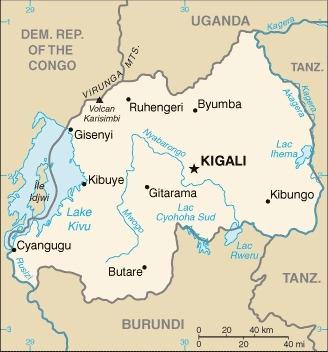
Map of Rwanda (The World Factbook)
Rwanda has a high geographical elevation. Its altitude ranges from 900 meters to a maximum of 4,507 meters. These elevations divide the country into steep, mountainous areas in the west and lower, undulating plains in the east. The western mountainous terrain was formed by the East African Rift System and forms the foundation of Rwanda’s topography.
Rwanda’s most important mountain range is the Virunga Volcanic Chain, located in the northwest corner of the country. This chain consists of five volcanic peaks, among which Mount Karisimbi (4,507 m) is the highest point in Rwanda. These volcanic areas include the Volcanoes National Park, home to the famous mountain gorillas. Additionally, a high ridge known as the Congo-Nile Divide runs from north to south across the country, separating the watersheds of the Nile and Congo rivers.
Rwanda is dominated by high hills and narrow valleys between them rather than extensive plains. However, in the eastern region, around the Akagera River, there are lower-altitude savanna plains and extensive wetlands. This area is vital for the Akagera National Park, which supports large mammal populations and wildlife conservation. In the northwest, the volcanic mountain foothills have extremely fertile soils, creating ideal valley and slope areas for intensive agriculture.
Rwanda occupies a strategic position as a source of water for two of Africa’s major river systems: the Nile and the Congo. It has 23 lakes of varying sizes. The largest body of water is Lake Kivu, located on the western border and shared with the neighboring Democratic Republic of the Congo (DRC). Other significant lakes include Muhazi, Ihema, Bulera, Ruhondo, and Mugesera. Among rivers, the Nyabarongo River is the longest in Rwanda, and together with its tributaries, it forms the main source of the Nile River, along with the Akagera River.
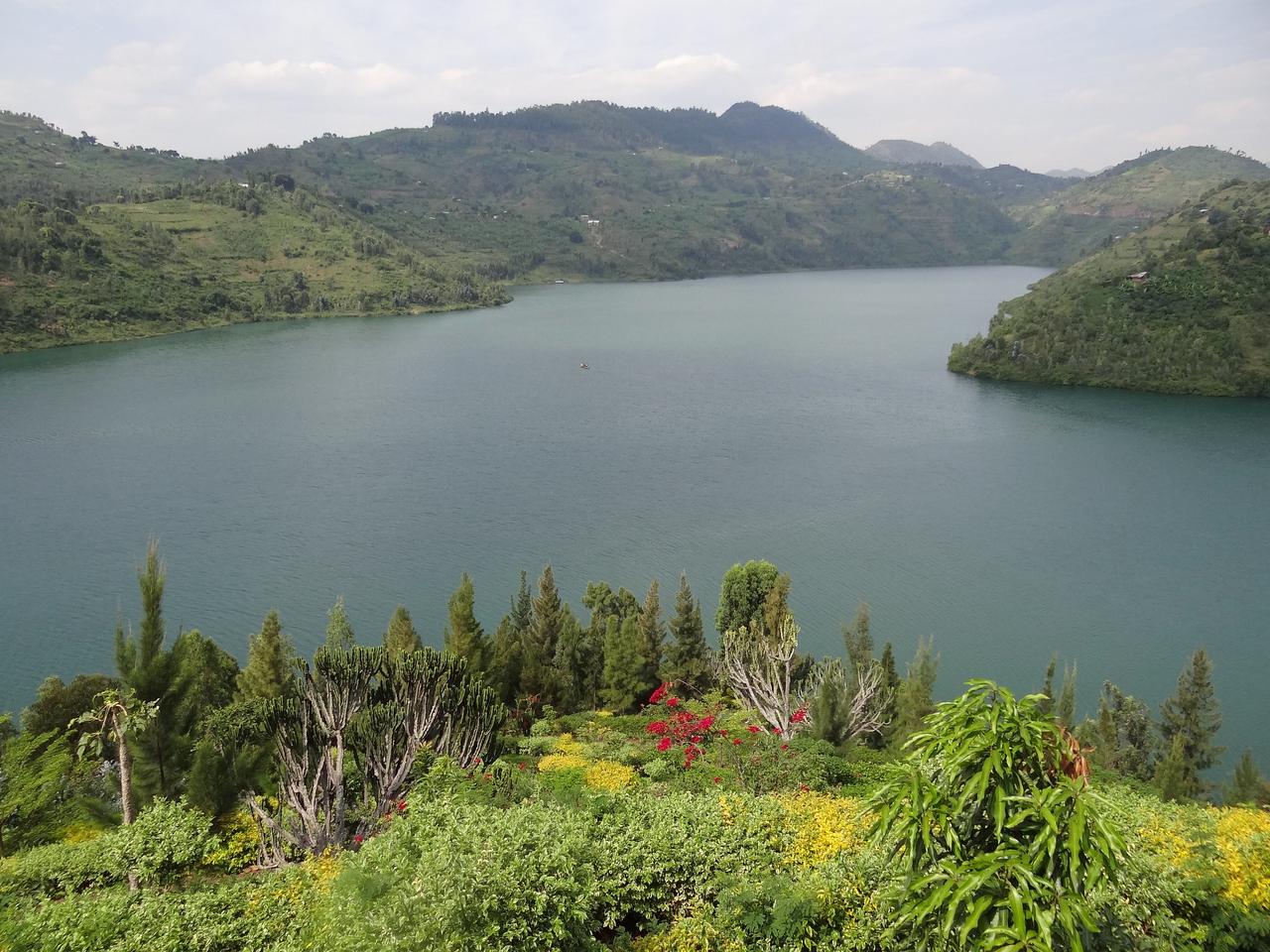
North Kivu Lake / Kibuye, Rwanda (flickr)
Rwanda has a temperate tropical climate characterized by two rainy and two dry seasons. The high altitude ensures generally mild temperatures, though frost and snow can occur above 4,500 meters.
Average temperatures range between 24.6°C and 27.6°C. Two rainy seasons occur: March to May and October to November (or February to April and November to January), with monthly average rainfall between 110 and 200 mm. The warmest months are typically August and September. The long dry summer season lasts from May to September.
Rwanda Climate Map (Rwanda Meteorology Agency)
Rwanda’s vegetation is diverse. Dense equatorial forests dominate the northwest, while tropical savannas prevail in the eastern regions. Akagera, Volcanoes, and Gishwati-Mukura National Parks constitute the country’s key wildlife and natural conservation areas.
Compared to other African countries, Rwanda lacks oil resources but is rich in mineral and water resources.
Major underground resources include gold, cassiterite (tin ore), wolframite (tungsten ore), and methane gas. Cassiterite is among the country’s primary exports.
The country also possesses significant hydropower potential and fertile agricultural land. Coffee and tea, due to favorable climate and terrain conditions, are the main commercial agricultural products.
Rwanda has made significant progress in improving access to infrastructure services and basic public services.
Access to clean drinking water sources has increased from 87% in 2016/17 to 90% in 2023/24. This rate is higher in urban areas (97%) than in rural areas (87%). Access to improved sanitation facilities has also risen from 86% to 94% during the same period. Access to improved toilets not shared with other households has increased from 66% to 72%.
In 2024, the highest water consumption occurred in households (28,011,469 m3), followed by non-residential uses (12,806,060.49 m3) and industry (2,278,315.00 m3).
Rwanda’s electricity consumption continues to rise. Residential and settlement electricity consumption increased from 178.9 million kWh in 2022 to approximately 211.1 million kWh in 2023.
According to 2023 data, large industries accounted for the largest share of total industrial consumption at 268,377,244.88 kWh. Overall, energy consumption shows an upward trend:
Access to all-weather roads in Rwanda is nearly universal at the national level. 95% of rural households can reach such roads within 20 minutes, and 67% of households live within 200 meters of such roads. Satisfaction with road quality stands at 62%, while 20% perceive improvement in quality.
Public Transport: Access to public transport is better in urban areas; 54% of urban households and 17% of rural households can reach a transport stop within 20 minutes.
Private Vehicle Ownership: Bicycle ownership is more common in rural areas (16%) than in urban areas (12%), while private car ownership in urban areas is 6%.
Rwanda’s economy is a landlocked African economy based on agricultural and mining exports. According to International Monetary Fund (IMF) data, Rwanda is the 143rd largest economy in the world among 190 countries as of 2025 estimates. 【2】
The economy has experienced remarkable recovery and growth over the past two decades due to intensive development strategies implemented after the 1994 genocide. The country aims to transition from a predominantly rural, agriculture-based structure to one focused on services and information and communication technologies (ICT).
The key macroeconomic data for 2023 are as follows:
• Gross Domestic Product (GDP): Recorded at $14.33 billion at current prices.
• Per Capita National Income: At $1,062 at current prices.
• GDP Growth Rate: GDP growth at constant prices was 8.3%.
• Consumer Price Inflation: Average Consumer Price Index (CPI) inflation was 14%.
• Current Account Balance: The current account balance as a percentage of GDP showed a deficit of -11.5% in 2023.
• Debt: The government’s total debt as a percentage of GDP stands at 63.4%. 【3】
Agriculture and related products constitute important export items for the country.【4】 Major agricultural exports according to 2024 data are:
Other important agricultural exports include vegetables, certain roots and tubers, and live trees and plants.【6】
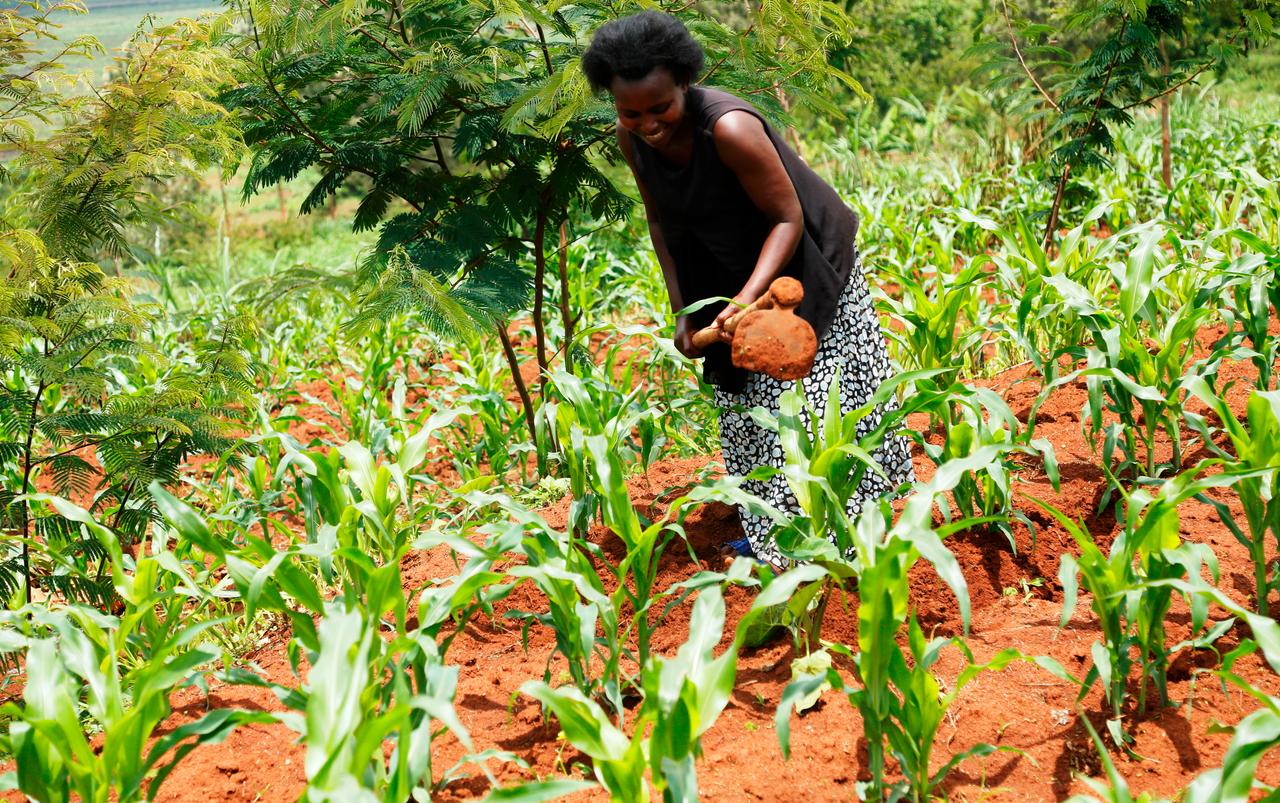
Agriculture in Rwanda (SPIU World Bank / KOICA Funded Projects)
The industrial sector accounts for 21% of GDP. This sector is largely focused on food processing, especially coffee and tea industries. Limited textile, cement, and furniture manufacturing, along with small-scale mining activities, also exist. Although the country’s natural resources are less abundant than those of other African countries, its main underground resources include tin, tungsten, tantalite, beryl, and gold.
Mining: Metal ores, slag, and ashes constituted Rwanda’s largest export group in 2024 with an export value of $241 million.【7】 This group includes niobium, tantalum, vanadium, zirconium ores ($119.275 million) and tin ores and concentrates ($78.661 million).【8】
Rwanda’s foreign trade indicators (2023–2024) show a persistent trade deficit.【9】 According to 2024 data, Rwanda’s total exports amounted to $587.484 million (approximately $0.59 billion). 【10】 In the same period, total imports reached $1.616.708 million (approximately $1.62 billion).【11】
Major Export Products (2024, million $): Analyzing Rwanda’s 2024 foreign trade, the main export items and their approximate revenues stand out. The largest share of exports came from metal ores, slag, and ash, generating $241 million. The second-largest export group is agriculture: coffee, tea, and spices exports were valued at $158 million. In addition to these main sectors, aircraft also represented a significant export item with $48 million in exports.【12】
Major Import Products (2024, million $): According to Rwanda’s 2024 foreign trade data, the country’s largest import categories are technological equipment and transportation vehicles. Leading the import list is the group of electrical machinery and apparatus, valued at $253 million.【13】 Within this group, telephones and other information exchange devices ($122.163 million) hold the largest share.【14】 The second-largest import item is machinery, mechanical appliances, and tools valued at $150 million, while motor vehicles are also a major import item at $144 million.【15】
Rwanda generally ranks lower in international financial flows and competitiveness indices:
Rwanda’s demographic structure is shaped by the 2024 Population and Housing Census (2024 RPHC). According to these results, the country’s population is recorded at 14,256,567. With a population density of approximately 503 people per square kilometer, Rwanda is one of the most densely populated countries in the world. The annual average population growth rate is 2.3%. Rwanda has a very young population with a median age of 20.
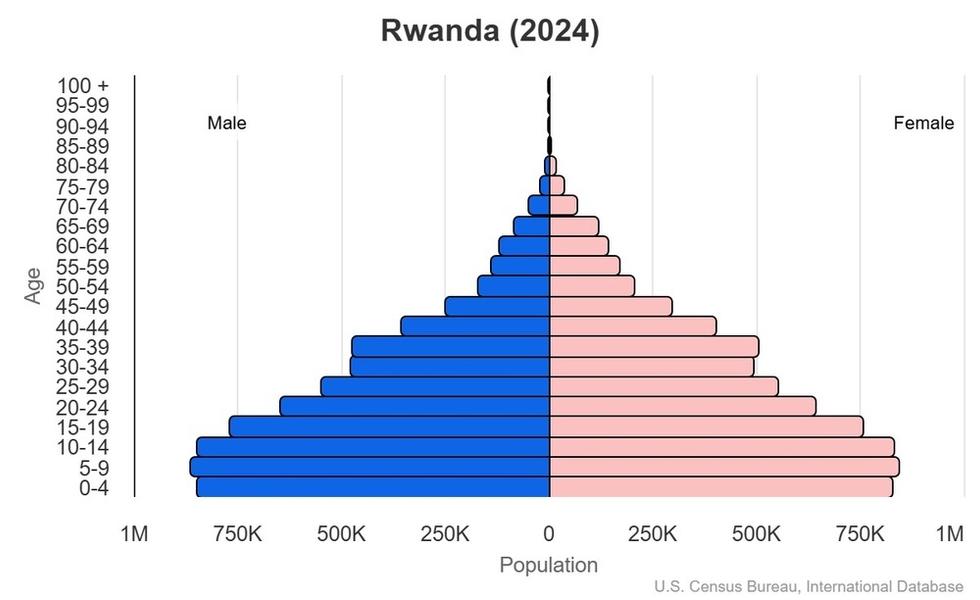
Rwanda Demographics Graph (The World Factbook)
More than half of the population is concentrated in the most densely populated regions: the Eastern and Southern provinces. The Gasabo district in the capital Kigali is identified as Rwanda’s most populous administrative unit. Although urbanization has increased recently, the majority of the population still resides in rural areas. 2022 data show that 72.1% of the population lives in rural areas and 27.9% in urban areas. A continuous upward trend in urban population share is observed.
Rwanda’s population is traditionally divided into three main ethnic groups: Hutu, Tutsi, and Twa. Historically, the Hutu constituted the majority of the population (approximately 84%), the Tutsi a smaller portion (approximately 15%), and the Twa (Pygmies) the smallest ethnic group (approximately 1%). However, after the 1994 genocide, the Rwandan government, in line with policies to strengthen national unity, largely restricted the public emphasis and use of ethnic identities. Today, the official narrative focuses on a common “Rwandan” identity rather than ethnic distinctions.
Rwanda’s religious structure shows that the vast majority of the population is Christian, while Islam persists as a minority religion. According to 2019–2020 estimates, approximately 95.9% of the population is Christian, with Roman Catholics (38.0%) and Protestants (57.7%) being the largest groups. Muslims constitute approximately 2.1% of the population, while the remaining 2.0% belong to other faiths or are non-religious.
Islam entered Rwandan territory from the 1890s onward via Muslim traders from East African coastal regions along trade routes. The first mosque was built in the capital Kigali in 1914. During the German colonial administration, Christian missionary activity was encouraged and Islamic expansion was restricted, causing Islam to concentrate primarily in urban centers like Kigali and specific trading areas rather than rural regions. After Rwanda gained independence in 1962, Muslims gained religious freedom. Today, mosques and Islamic societies exist in the country, and Ramadan is recognized as an official holiday. It has been reported that conversions to Islam have increased since the 1994 genocide as a result of societal efforts toward peace and equality.
The devastating consequences of the 1994 Tutsi genocide left a significant mark on Rwanda’s demographic profile. Particularly between 1991 and 2002, high mortality rates and large-scale population movements (flight and return) significantly slowed the country’s annual population growth rate. During this period, the average annual population growth rate was as low as 1.2%.
Rwanda has made significant progress in education and literacy in recent years. According to the 2022 Population and Housing Census (RPHC2022), 78.8% of the population aged 15 and above is literate; this means that 21.2% of the population cannot read or write.
There are notable differences in literacy rates by gender and geographic distribution.
Literacy is higher among men (81.0%) than among women (76.7%). Correspondingly, the rate of illiteracy is higher among women (23.3%) than among men (19.0%).
Literacy rates are considerably higher in urban areas (89.8%) than in rural areas (74.2%).
Youth Population: Among the youth population aged 16–30, the literacy rate is above the national average at 88%. This age group has the highest literacy rate in Kigali City (94%). Compared to rural areas (85%), literacy rates in urban areas (92%) are significantly higher in this age group as well.
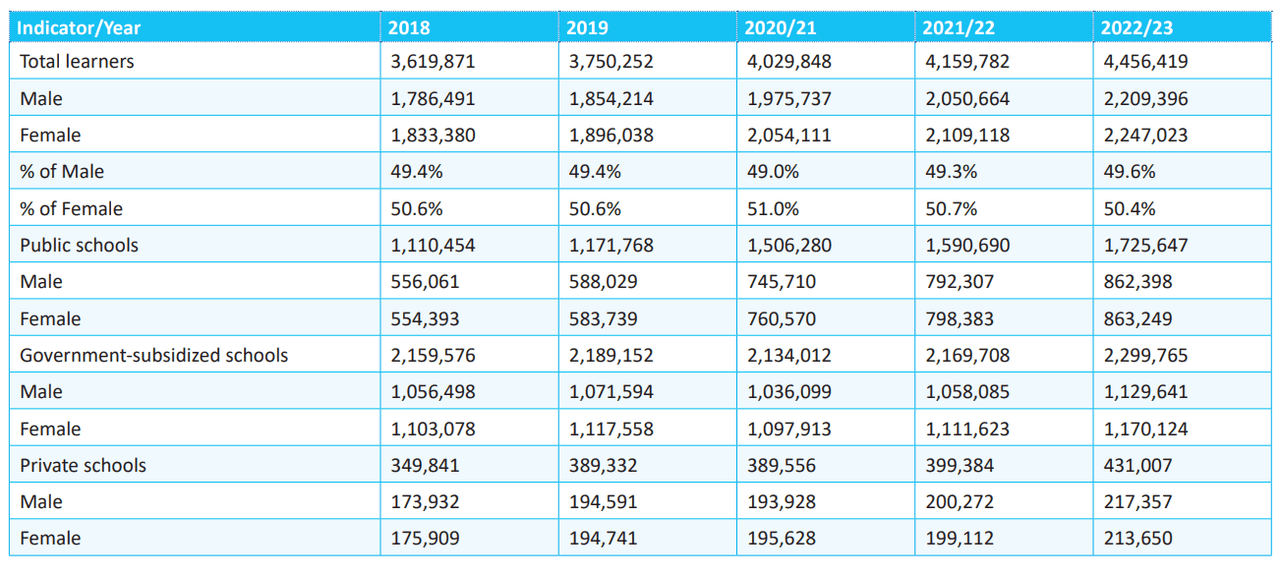
Total Number of Students in Rwanda’s Education System (NISR)
Approximately 54.0% of literate people aged 15 and above are literate only in Kinyarwanda. The proportions of those literate in multiple languages are as follows:
Rwandan culture reflects a structure that strongly preserves powerful social values, particularly the determination for peace and reconciliation, along with rich traditional elements. At the center of social structure is the tradition of Umuganda (coming together for a common purpose); this practice, which requires the entire nation to gather for public service work on the last Saturday of each month, is a symbol of national unity.
Cattle hold high social importance in the culture; particularly the long-horned Inyambo cattle, which are tended with special songs and originate from the royal herd, have ceremonial significance.
Amasunzu is a traditional Rwandan hairstyle symbolizing prestige and courage.
Rwandan literature has been largely transmitted through oral tradition. Exhibits at the Ethnography Museum preserve traditional customs, beliefs, poetry, and oral history.
These groups showcase Rwanda’s most dynamic traditional music and dance style. Originally established centuries ago for the Royal Court, their dances are notable for jumping techniques derived from military training. Performances can be seen in cultural villages, museums, and accommodation facilities.
The National Ballet of Rwanda, URUKEREREZA performance (Embassy Festival)
The Hobe Rwanda Festival introduces Rwandan culture by highlighting local musicians, artists, and dancers.
Rwanda Museum of Art, explores the fusion of traditional and modern creativity by hosting local and international contemporary artworks and temporary exhibitions.
Rwandan cuisine is based on simple, flavorful dishes using local ingredients and influenced by African culinary traditions. The diet follows a “from farm to table” approach, utilizing fresh vegetables and readily available protein sources.
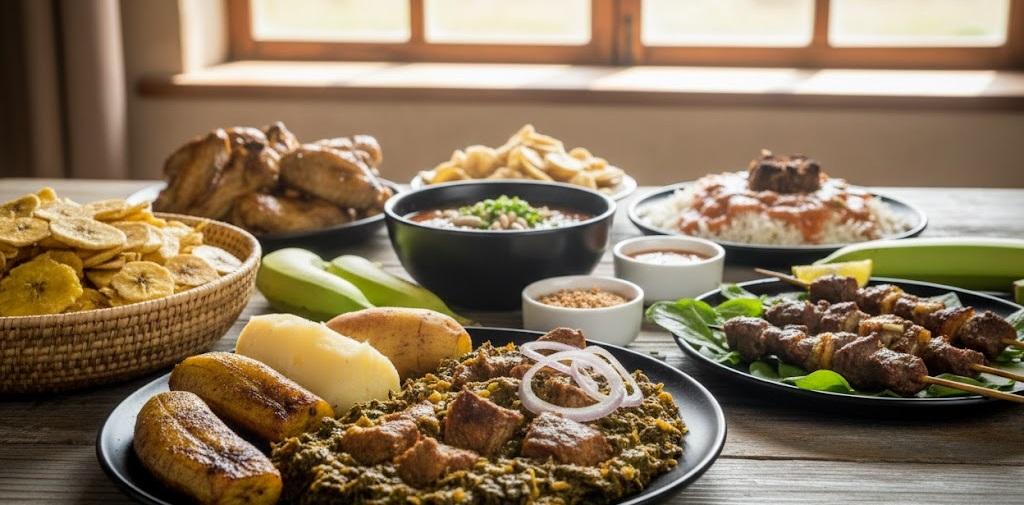
Rwandan Cuisine (Generated by Artificial Intelligence)
Akabanga is an extremely spicy red pepper oil and an essential part of Rwandan cuisine. Popular street foods include Mizuzu (glazed fried plantain chips), potato fries with mayonnaise, and boiled eggs.
Coffee: Although long exported as a cash crop, its consumption has become widespread thanks to cafes established by the youth. African Coffee (a mixture of ginger and milky espresso-chocolate) is popular among the youth.
Traditional Beverages
Rwandan tourism embraces a high-value, nature- and conservation-oriented approach consistent with the country’s geographic identity as the “Land of a Thousand Hills.” The sector plays a central role in the national economy by significantly contributing to foreign exchange earnings and job creation. Rwanda is internationally recognized for ease of doing business and tourism leadership.
Rwanda holds two distinct UNESCO World Heritage properties.
Genocide Memorial Sites (Nyamata, Murambi, Gisozi, and Bisesero): Comprising four memorial sites that bear witness to key events of the 1994 Tutsi genocide. These sites carry Outstanding Universal Value by illustrating the scale and magnitude of mass killings and play a role in peace culture education.
Nyungwe National Park: One of Africa’s oldest rainforests, it boasts high biological diversity. It provides habitat for chimpanzees and 12 other primate species. A vital natural area for Central African rainforest conservation efforts, it was inscribed on the list in 2023.
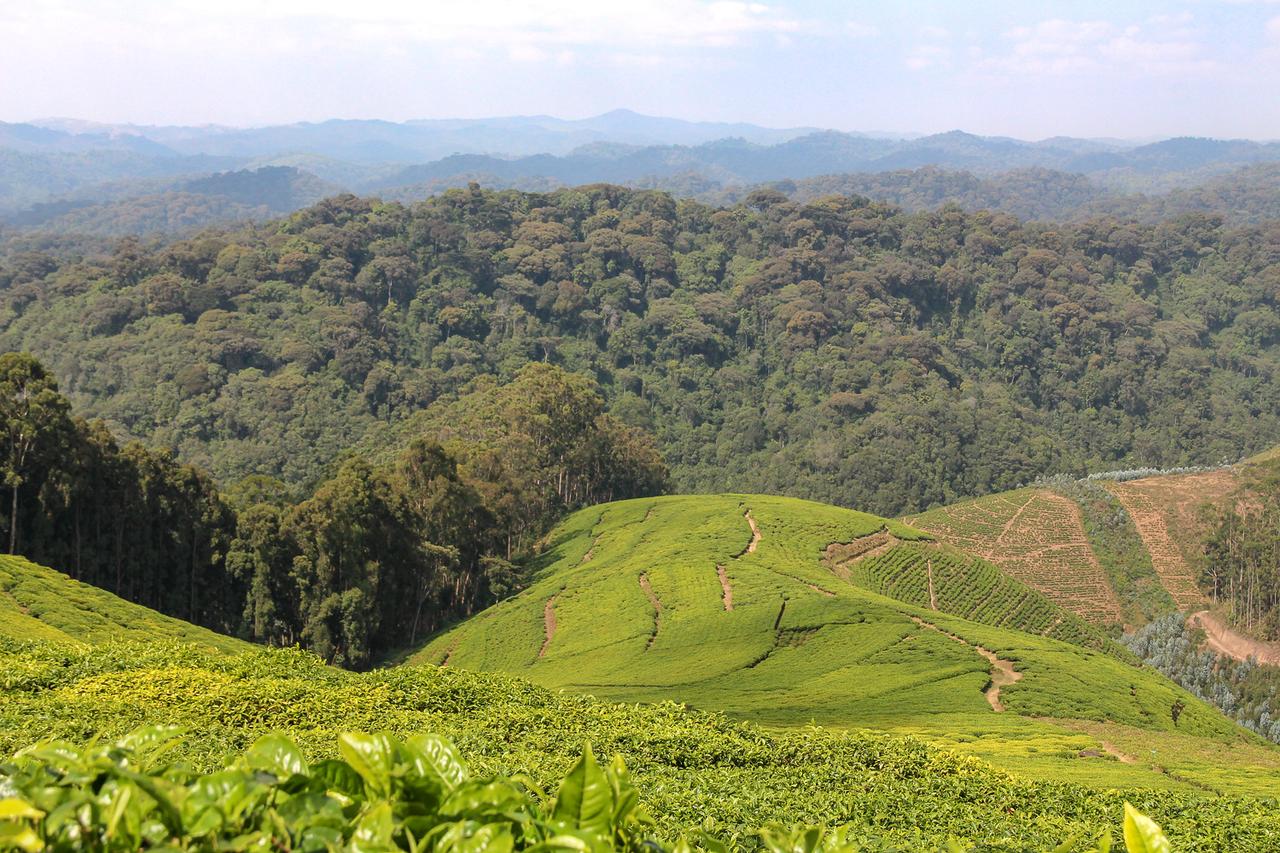
Nyungwe National Park (flickr)
Major Tourist Cities
Historic Structures and Sites
Museums and Cultural Institutions
Rwanda National Museums Institute (INMR) manages museums across the country.
Rwanda adopts an approach that promotes tourism with a focus on conservation and responsible tourism.
Primate and wildlife tracking (gorillas, chimpanzees, monkeys) and birdwatching appeal to a nature-based, high-value tourism segment. Events like KigaliUP attract both local and international audiences. The majority of Environment Museum visitors are locals.
Economic Performance: In 2023, tourism revenues reached $620 million, and the country welcomed over 1.4 million visitors. Although specific figures for tourism’s direct contribution to GDP are not provided, tourism plays a central role in national strategies as an investment and employment generator.
Rwanda’s foreign policy presents a comprehensive framework aimed at advancing the country’s position in a changing international environment and aligning with contemporary trends. Rwanda’s diplomacy and international engagement are based on a multilateral, cooperative, and cautious approach.
U.S. Congressional Delegation Visit to Rwanda (MINAFFET)
The strategic orientation of foreign policy rests on five main pillars:
Rwanda, adopting the vision of “African solutions to African problems,” aims to position itself as a guarantor of stability on the continent. This is grounded in its military diplomacy. Rwanda is one of the top three contributors to UN peacekeeping missions and leads bilateral deployments to countries such as Mozambique and the Central African Republic (CAR).
Relations with the DRC are tense due to allegations that Rwanda supports the M23 rebel group, while the DRC accuses Rwanda of harboring the FDLR militia operating in eastern DRC.
Rwanda has become a key player in CAR in terms of security and economic interests:
The United States played a key role as an observer and mediator in the DRC-Rwanda peace negotiations. Washington supports peace by offering economic incentives to gain access to critical mineral supply chains in the region and to limit China’s influence.
Relations came to prominence due to the controversial “Rwanda Policy” signed with the UK, which aimed to send asylum seekers to Rwanda. This policy triggered international legal scrutiny regarding whether Rwanda is a safe country for returning asylum seekers.
Relations between Türkiye and Rwanda have rapidly developed within an institutional framework following the opening of mutual embassies (Rwanda: 2013, Türkiye: 2014) and President Paul Kagame’s first official state visit to Türkiye on 22 January 2025. The two countries have cooperation agreements across a wide range of areas, from aviation to defense, education to economy, agriculture to technology.

Rwandan President Kagame and Turkish President Erdoğan, 2024 (Anadolu Ajansı)
Political and Security Cooperation: Türkiye shares Rwanda’s sensitivity regarding the genocide against the Tutsi and appreciates Rwanda’s efforts to become a “beacon of stability” in Africa. Türkiye has also expressed satisfaction with Rwanda’s immediate closure of schools linked to FETÖ.
Economic Relations and Investments: Bilateral economic relations are rapidly growing, with Türkiye serving as a key partner in Rwanda’s development goals. Turkish companies’ total investments in Rwanda have exceeded $400 million (as of 2019, accounting for approximately 14–15% of total investment in Rwanda).
The Turkey-Rwanda Business Council under DEİK was established in 2012. Thanks to Rwanda’s membership in the East African Community (a market of 130 million), Turkish investors are encouraged to access the region.
Turkish firms have undertaken large-scale infrastructure and symbolic projects such as the Kigali Convention Center and Hotel, Kigali BK Arena, and a $358 million 100-megawatt power plant. Other key sectors targeted for cooperation include infrastructure (railways, aviation), agriculture, energy, tourism, and healthcare.
Culture and Education: The Yunus Emre Institute has been operational since 2021, and through YTB and YÖK scholarships, 285 Rwandan students have been awarded higher education scholarships to date.
The Rwanda Defence Force (RDF) has a professional military structure. Beyond its national defense mission, it demonstrates significant logistical and manpower capacity through active peacekeeping roles.
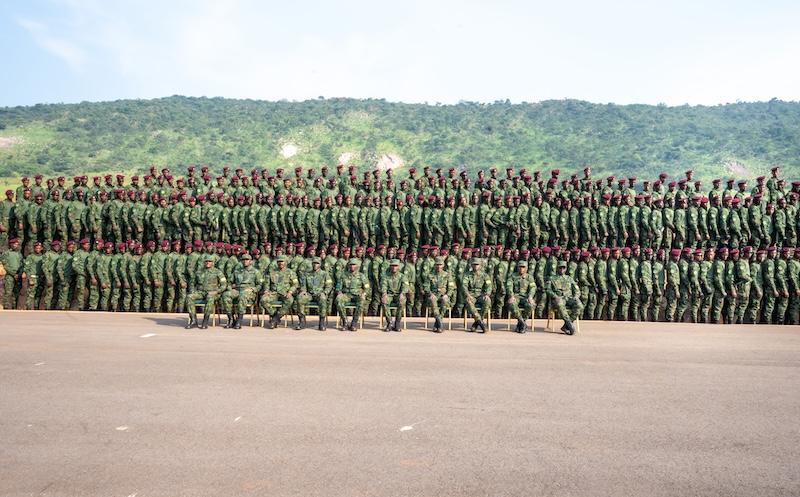
Rwandan Army (MOD)
Rwanda’s military strength is organized under the Rwanda Defence Force. The RDF comprises the following units:
As of 2025, the active personnel strength is estimated between 30,000 and 35,000. Military service is voluntary; both men and women may join from age 18. Conscription is not practiced. Service is carried out either through renewable five-year contracts or as a career. As of 2022, women constituted approximately 6% of the RDF.【19】
Rwanda’s military expenditures as a percentage of Gross Domestic Product (GDP) are as follows:
(*2024 value is an estimate. SIPRI)
These figures indicate that defense spending has steadily remained within approximately 1.3–1.5% of GDP. Additionally, under defense cooperation agreements with Türkiye, defense and aerospace industry products worth $16.5 million were imported from Türkiye in 2021.
Within the Ministry of Defense, procurement processes were institutionalized in 2005 through the Military Tender Board (MTB). Following legislative changes in 2007 and 2008, defense acquisitions are now managed by the Procurement Unit and the Tender Committee.
The Tender Committee consists of seven members, and decisions require at least a 3/5 majority. The Procurement Unit performs the following duties:
This structure is based on principles of transparency, competition, efficiency, and accountability.
The primary responsibilities of the Rwanda Defence Force include safeguarding the country’s territorial integrity and sovereignty, particularly by preventing infiltration by illegal armed groups from the border with the Democratic Republic of the Congo (DRC). The RDF participates in the following external operations (estimated personnel numbers as of 2025):
The Rwanda Defence Force traces its origins to the Rwandan Patriotic Army (RPA), established after the 1990–1994 civil war. It was renamed RDF in 2003 to reflect its national structure. The RPA previously participated in the First and Second Congo Wars. Since 2021, RDF units have conducted operations against insurgent groups along the DRC border.
The proportion of Rwanda’s military spending relative to total government expenditures reflects the evolution of the country’s fiscal and defense policies over time.
As of 2024, Rwanda’s military spending accounted for 4.24% of total government expenditures. This represents a decline from 4.63% in 2023 and marks the first decrease after a period of growth. Rwanda ranks 88th globally (among 145 countries) in this category, positioned between Fiji and Madagascar.
Anadolu Ajansı. "Cumhurbaşkanı Erdoğan, Ruanda Cumhurbaşkanı Kagame ile görüştü." Accessed November 11, 2025.https://www.aa.com.tr/tr/gundem/cumhurbaskani-erdogan-ruanda-cumhurbaskani-kagame-ile-gorustu/3136259
BTI Transformation Index. "Rwanda Country Report 2024." BTI. Accessed November 16, 2025.https://bti-project.org/en/reports/country-report/RWA
Chandra, Anika. "Rwanda is Where the Wild Things Roam." GQ Middle East. Accessed November 13, 2025.https://www.gqmiddleeast.com/article/where-the-wild-things-roam
Chatham House. "Rwanda Peace Deal Rests on Risk Appetite of Corporate America." Chatham House, The Royal Institute of International Affairs. Accessed November 18, 2025.https://www.chathamhouse.org/2025/05/credibility-us-backing-drc-rwanda-peace-deal-rests-risk-appetite-corporate-america
Chatham House. "Rwanda’s Regional and Foreign Policy Priorities." Chatham House, The Royal Institute of International Affairs. Accessed November 12, 2025.https://www.chathamhouse.org/events/all/research-event/rwandas-regional-and-foreign-policy-priorities
Chatham House. "Supreme Court Ruling on UK’s Rwanda Policy Need Not Lead to Conflict with ECHR." Chatham House, The Royal Institute of International Affairs. Accessed November 11, 2025.https://www.chathamhouse.org/2023/10/supreme-court-ruling-uks-rwanda-policy-need-not-lead-conflict-echr
Country Reports. "Rwanda." Countryreports.org. Accessed November 12, 2025.https://www.countryreports.org/country/Rwanda.htm
Embassy Festival. "The National Ballet of Rwanda, URUKEREREZA performs 'Umushagiliro' | Embassy Festival 2020." YouTube, 2:52. Accessed December 4, 2025.https://www.youtube.com/watch?v=3XN_Kah47ZU
External Economic Relations Board. "Turkey-Rwanda Business Council." DEİK. Accessed November 10, 2025.https://www.deik.org.tr/turkiye-afrika-is-konseyleri-turkiye-ruanda-is-konseyi
External Economic Relations Board. "Turkey-Rwanda Business Forum." DEİK. Accessed November 10, 2025.https://www.deik.org.tr/etkinlikler-turkiye-ruanda-is-forumu
External Economic Relations Council. *Rwanda Information Note.* Istanbul: DEİK, November 2022. Accessed November 10, 2025.https://www.deik.org.tr/uploads/ruanda-bilgi-notu-kasim-2022.pdf
International Crisis Group. "Rwanda’s Growing Role in Central African Republic." crisisgroup.org. Accessed November 13, 2025.https://www.crisisgroup.org/africa/central-africa/central-african-republic-rwanda/b191-rwandas-growing-role-central-african-republic
Jones, Adam. "View over Lake Kivu from Home St. Jean - Kibuye (Karongi) - Rwanda - 01." Flickr. Accessed December 4, 2025.https://flic.kr/p/eEDHCv
K, Adrien. "Kigali." Flickr. Accessed December 4, 2025.https://flic.kr/p/Ku1ZmQ
MINECOFIN. “Budget Factsheet for Fiscal Year 2024/2025.” *minecofin.gov.rw.* Accessed December 4, 2025.https://www.minecofin.gov.rw/index.php?eID=dumpFile&f=101843&t=f&token=95400326fe171b890e5fc53afad64fbd39a9dbd7&utm
MOD. "Procurement Unit." *Mod.gov.rw.* Accessed December 4, 2025.https://www.mod.gov.rw/procurement
Ministry of Foreign Affairs of the Republic of Turkey. "Turkey-Rwanda Political Relations." mfa.gov.tr. Accessed November 9, 2025.https://www.mfa.gov.tr/turkiye-ruanda-siyasi-iliskileri.tr.mfa
Ministry of Foreign Affairs of the Republic of Turkey. "Visit of Our Minister to the Republic of Rwanda, January 11–12, 2023, Kigali." *mfa.gov.tr*. Accessed November 18, 2025.https://www.mfa.gov.tr/sayin-bakanimizin-ruanda-cumhuriyeti-ziyareti--11-12-ocak-2023--kigali.tr.mfa
Ministry of Foreign Affairs of the Republic of Türkiye. "Country Profile." mfa.gov.tr. Accessed November 7, 2025.https://www.mfa.gov.tr/ulke-kunyesi_.tr.mfa
Ministry of Foreign Affairs of the Republic of Türkiye. "Joint Press Conference by Minister of Foreign Affairs Mr. Mevlüt Çavuşoğlu and Minister of Foreign Affairs and International Cooperation of Rwanda Dr. Richard Sezibera." *mfa.gov.tr.* Accessed November 17, 2025.https://www.mfa.gov.tr/disisleri-bakani-sayin-mevlut-cavusoglu-nun-ruanda-disisleri-bk-ile-oratk-basin-toplantisi.tr.mfa
Ministry of Foreign Affairs of the Republic of Türkiye. "Ruanda’nın Siyasi Görünümü." mfa.gov.tr. Accessed November 18, 2025.
Ministry of Foreign Affairs of the Republic of Türkiye. "The Economy of Rwanda." mfa.gov.tr. Accessed November 16, 2025.https://www.mfa.gov.tr/ruanda_nin-ekonomisi.tr.mfa
Modern Diplomacy. "Rwanda is Becoming Africa’s Most Active Security Provider." moderndiplomacy.eu. Accessed November 17, 2025.https://moderndiplomacy.eu/2023/10/29/rwanda-is-becoming-africas-most-active-security-provider/
National Institute of Statistics of Rwanda. "Rwanda Statistical Yearbook 2024." NISR. Accessed December 3, 2025.https://statistics.gov.rw/statistical-publications/statistical-yearbook/rwanda-statistical-yearbook-2024
National Institute of Statistics of Rwanda. "Statistical Publications." statistics.gov.rw. Accessed November 18, 2025.https://www.statistics.gov.rw/statistical-publications
Republic of Rwanda. “Welcome to Rwanda.” gov.rw. Accessed November 13, 2025.https://www.gov.rw/
Rwanda Development Board. "Invest in Tourism." RDB. Accessed November 19, 2025.https://rdb.rw/investment-opportunities/invest-in-tourism/
Rwanda Information Society Authority. "Peacekeeping." RISA. Accessed November 16, 2025.https://ogs.prod.risa.rw/rw/government/facts-and-figures-4-2-1
Rwanda Meteorology Agency. "Climatology of Rwanda." Accessed November 17, 2025.https://www.meteorwanda.gov.rw/services/climatology-of-rwanda
Rwanda Ministry of Agriculture. "LWH-RSSP Projesi." SPIU World Bank. Accessed November 16, 2025.https://lwh-rssp.minagri.gov.rw/index.php?id=14
Rwanda Mission to the United Nations. "The Security Council." rwandainun.gov.rw. Accessed November 19, 2025.
SIPRI. "SIPRI Military Expenditure Database." Milex.sipri.org. Accessed December 4, 2025.https://milex.sipri.org/sipri
StatBase. "RWA: Military expenditure share government spending." StatBase.org. Accessed November 18, 2025.https://statbase.org/data/rwa-military-expenditure-share-government-spending/
Store Norske Leksikon. "Rwandas historie." SNL. Accessed November 16, 2025.https://snl.no/Rwandas_historie
T.C. Ministry of Trade. "Ruanda Genel Bilgiler." ticaret.gov.tr. Accessed November 25, 2025.https://ticaret.gov.tr/yurtdisi-teskilati/afrika/ruandaGenel%20Bilgiler
T.C. Ministry of Trade. "Rwanda Republic Country Profile." ticaret.gov.tr. Accessed November 25, 2025.https://ticaret.gov.tr/data/67d3ea7b13b8760450673277/Ruanda%20%C3%9Clke%20Profili%202025.pdf
The World Factbook. "Rwanda." CIA.gov. Accessed November 10, 2025.https://www.cia.gov/the-world-factbook/countries/rwanda/#military-and-security
Together Women Rise. "Customs and Cuisine of Rwanda." togetherwomenrise.org. Accessed November 29, 2025.
Tomar, Cengiz. "Ruanda." *TDV İslam Ansiklopedisi*. Accessed November 17, 2025.https://islamansiklopedisi.org.tr/ruanda
U.S. Department of State, Office of the Spokesperson. "Joint Statement on the Second Joint Oversight Committee Meeting for the Peace Agreement Between the Democratic Republic of the Congo and the Republic of Rwanda." state.gov. September 2025. Accessed November 18, 2025.https://www.state.gov/releases/office-of-the-spokesperson/2025/09/joint-statement-on-the-second-joint-oversight-committee-meeting-for-the-peace-agreement-between-the-democratic-republic-of-the-congo-and-the-republic-of-rwanda
U.S. Department of State. "Peace Agreement Between the Democratic Republic of the Congo and the Republic of Rwanda." state.gov. Accessed November 17, 2025.
UNESCO. "Memorial sites of the Genocide: Nyamata, Murambi, Gisozi and Bisesero." UNESCO World Heritage Centre. Accessed November 29, 2025. https://whc.unesco.org/en/list/1586
UNESCO. "Nyungwe National Park." UNESCO World Heritage Centre. Accessed November 29, 2025.
Urumaxi Anthems. "National Anthem of Rwanda - 'Rwanda Nziza'." YouTube, 2:57. Accessed December 4, 2025.https://www.youtube.com/watch?v=KQvWKfIqE2s
Visit Rwanda. "Festivals and Events." vistrwanda.com. Accessed November 29, 2025.
Visit Rwanda. "Museum of the Environment." vistrwanda.com. Accessed November 29, 2025.
Visit Rwanda. "Museums and Art Galleries." vistrwanda.com. Accessed November 29, 2025.
Visit Rwanda. "Responsible Tourism." vistrwanda.com. Accessed November 29, 2025.
Visit Rwanda. "Rwandan Culture and Traditions." vistrwanda.com. Accessed November 29, 2025. https://visitrwanda.com/interests/rwandan-culture-and-traditions/
travelmag.com. "Where tea meets primary rainforest in Nyungwe." Flickr. Accessed December 4, 2025.https://flic.kr/p/26W5b9n
[1]
T.C. Dışişleri Bakanlığı, "Ülke Künyesi," mfa.gov.tr, Erişim tarihi 7 Kasım 2025, https://www.mfa.gov.tr/ulke-kunyesi_.tr.mfa
[2]
T.C. Dışişleri Bakanlığı, "Ruanda Ülke Profili," mfa.gov.tr, syf 4, https://ticaret.gov.tr/data/67d3ea7b13b8760450673277/Ruanda%20%C3%9Clke%20Profili%202025.pdf
[3]
T.C. Dışişleri Bakanlığı, "Ruanda Ülke Profili," mfa.gov.tr, syf 4
[4]
T.C. Dışişleri Bakanlığı, "Ruanda Ülke Profili," mfa.gov.tr, syf 6
[5]
T.C. Dışişleri Bakanlığı, "Ruanda Ülke Profili," mfa.gov.tr, syf 6
[6]
T.C. Dışişleri Bakanlığı, "Ruanda Ülke Profili," mfa.gov.tr, syf 11
[7]
T.C. Dışişleri Bakanlığı, "Ruanda Ülke Profili," mfa.gov.tr, syf 6
[8]
T.C. Dışişleri Bakanlığı, "Ruanda Ülke Profili," mfa.gov.tr, syf 11
[9]
T.C. Dışişleri Bakanlığı, "Ruanda Ülke Profili," mfa.gov.tr, syf 6
[10]
T.C. Dışişleri Bakanlığı, "Ruanda Ülke Profili," mfa.gov.tr, syf 12
[11]
T.C. Dışişleri Bakanlığı, "Ruanda Ülke Profili," mfa.gov.tr, syf 6
[12]
T.C. Dışişleri Bakanlığı, "Ruanda Ülke Profili," mfa.gov.tr, syf 6
[13]
T.C. Dışişleri Bakanlığı, "Ruanda Ülke Profili," mfa.gov.tr, syf 13
[14]
T.C. Dışişleri Bakanlığı, "Ruanda Ülke Profili," mfa.gov.tr, syf 14
[15]
T.C. Dışişleri Bakanlığı, "Ruanda Ülke Profili," mfa.gov.tr, syf 7
[16]
T.C. Dışişleri Bakanlığı, "Ruanda Ülke Profili," mfa.gov.tr, syf 13
[17]
T.C. Dışişleri Bakanlığı, "Ruanda Ülke Profili," mfa.gov.tr, syf 14
[18]
T.C. Dışişleri Bakanlığı, "Ruanda Ülke Profili," mfa.gov.tr, syf 7
[19]
The World Factbook, ''Rwanda,” CIA.gov, Erişim tarihi 4 Aralık 2025, https://www.cia.gov/the-world-factbook/countries/rwanda/
Republic of Rwanda
Official Name | Republic of Rwanda | ||||||||
|---|---|---|---|---|---|---|---|---|---|
Form of Government | Republic | ||||||||
Date of Independence | 1 Temmuz 1962 | ||||||||
Capital | Kigali | ||||||||
President | Paul Kagame | ||||||||
Official Language | French Swahili Kinyarwanda English | ||||||||
Common Languages | Kinyarwanda | ||||||||
National Day | 1 July | ||||||||
Area | 26,338 km² | ||||||||
Total Population | 14.1 million | ||||||||
Climate | Temperate tropical climate | ||||||||
GDP | 14.771 million USD | ||||||||
GDP per Capita | 1,043 USD | ||||||||
Ethnic Groups | Twa (%1) Hutu (%95.9) Tutsi (%2.1) | ||||||||
Religious Composition | Other/Nonreligious (%2.0) Christianity (%95.9) Islam (%2.1) | ||||||||
Telephone Code | +250 | ||||||||
Internet Domain Code | .rw | ||||||||
No Discussion Added Yet
Start discussion for "Rwanda (Republic of Rwanda)" article
History
Early Period and Kingdom Structure
Colonial Administration: Germany and Belgium
Politicization, Ethnic Tensions, and Independence
Emergence of RANU and RPF
1994 Tutsi Genocide
Post-1994 Political Reorganization
National Anthem
Flag
Geography
Location
Landforms
Mountains
Plains and Valleys
Rivers and Lakes
Climate and Vegetation
Climate
Vegetation
Natural Resources
Minerals
Other Resources
Energy and Transportation Infrastructure
Water and Sanitation
Energy Statistics
Transportation Infrastructure
Economy
Key Economic Indicators (2023)
Sectoral Distribution
Agriculture and Livestock
Industry
Foreign Trade
Major Foreign Trade Partners (2024)
Foreign Investment and Business Environment
Demography and Education
Key Demographic Indicators (2024)
Population Distribution and Urbanization
Ethnic Structure
Religious Distribution
Migration and Population Decline
Education
Literacy Rate
Language Literacy
Culture
Literature
Performing Arts
Intore Dance Groups
Festivals
Traditional Crafts
Contemporary Art
Culinary Culture
Staple Foods
Popular Dishes
Spices and Snacks
Beverages
Tourism
Tourist Regions and Attractions
UNESCO World Heritage Sites
Historic Cities, Structures, and Archaeological Sites
Tourism Policy
Conservation-Oriented Tourism
Tourist Profile
Tourism’s Share in the Economy
Foreign Policy and Security
Regional Conflicts and Military Diplomacy
Bilateral Relations
Relations with the Democratic Republic of the Congo (DRC)
2025 Peace Agreement (Washington, 27 June 2025):
Relations with the Central African Republic (CAR)
Relations with the United States
Relations with the United Kingdom
Relations with Türkiye
International Organizations
Military and Defense Capacity
Land, Air, and Naval Components
Defense Industry
Personnel Status
Defense Budget
Logistics Infrastructure
Operational History
Rwanda’s Military Expenditure Statistics