This article was automatically translated from the original Turkish version.
+1 More
Catalog Names | NGC 2246 NGC 2239 NGC 2238 NGC 2237 | ||||||||
|---|---|---|---|---|---|---|---|---|---|
Constellation | Monoceros (Unicorn) | ||||||||
Distance(s) | Approximately 5 600 parsecs) 200 light years (1 | ||||||||
Apparent Magnitude | +9.0 magnitude (average, varies depending on filter) | ||||||||
Physical Diameter | Approximately 130 light years | ||||||||
Nebula Type | H II region (ionized hydrogen gas region) | ||||||||
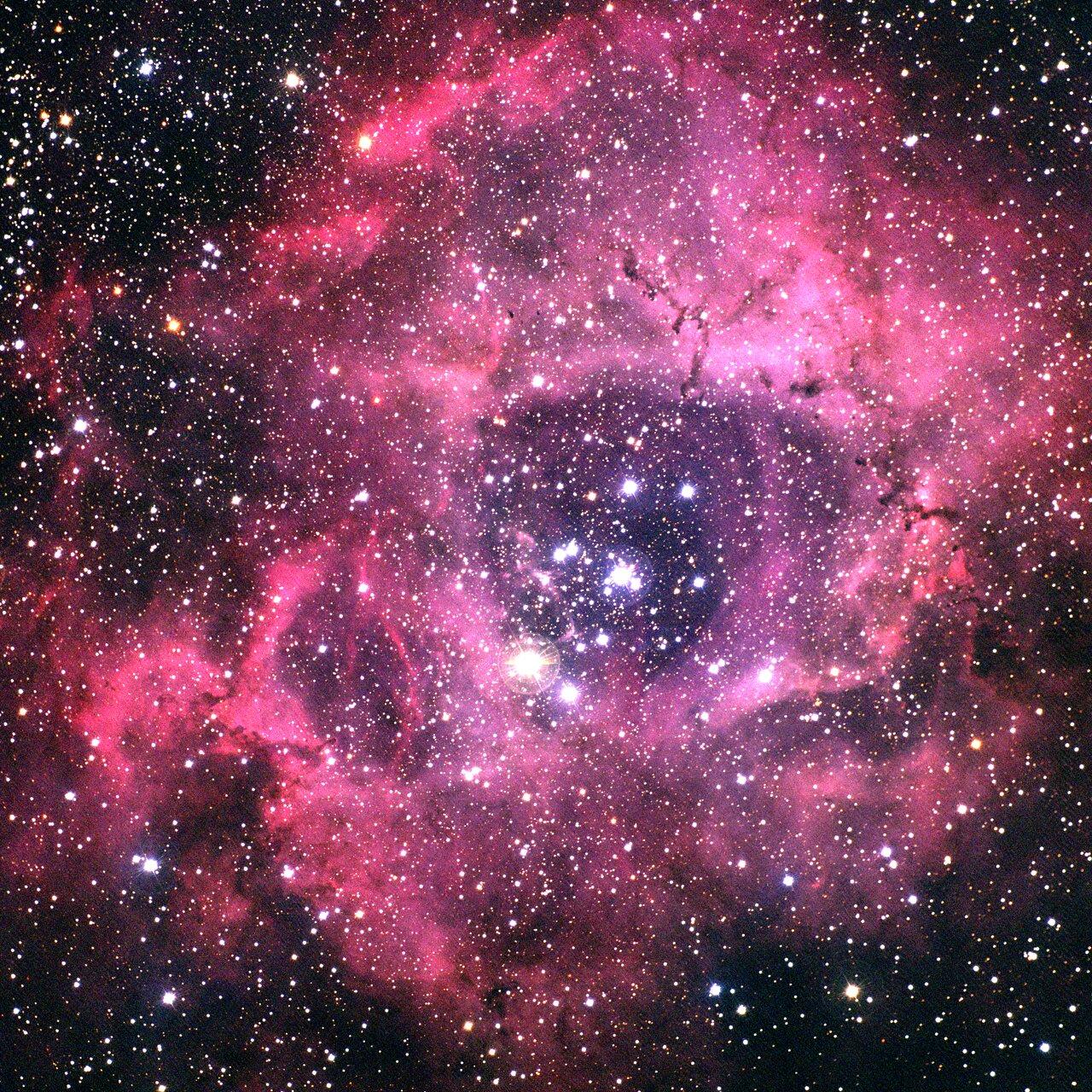
The Rosette Nebula is a large and widespread emission nebula located in the constellation Monoceros (Unicorn). Although commonly referred to as NGC 2237, different regions of the nebula complex are cataloged separately as NGC 2237, NGC 2238, NGC 2239, NGC 2244 and NGC 2246. Structurally an H II region, the Rosette Nebula glows brightly due to ionized hydrogen gas energized by ultraviolet radiation from young stars within it.
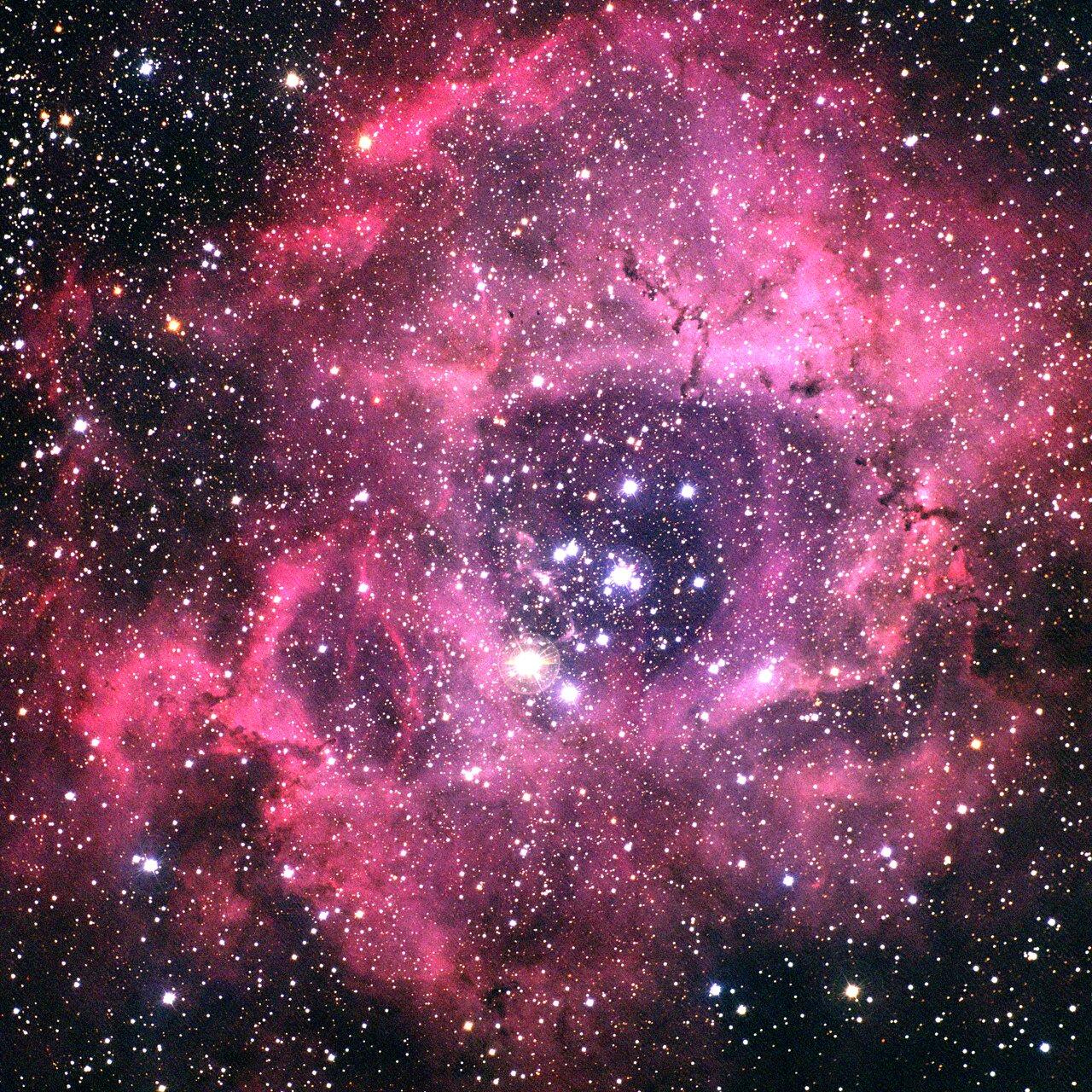
The Rosette Nebula (NOIRLab)
The different components of the Rosette Nebula have been cataloged separately by astronomers:
All these components reside in different regions of a vast molecular cloud and together form the Rosette Nebula as a unified structure.
The Rosette Nebula is particularly notable for its central open star cluster, NGC 2244. This cluster contains numerous young, hot and massive stars formed approximately two million years ago. These stars ionize the surrounding hydrogen gas, causing the nebula to emit light.
This process is described as a “feedback mechanism”: high-energy stars ionize, heat and expel surrounding gas, thereby triggering or suppressing further star formation.
The Rosette Nebula has moderate brightness in visible light and can be imaged by amateur astronomers using wide-field telescopes and especially H-alpha filters. However, optical telescopes provide limited data; infrared and radio wavelength observations enable a clearer understanding of star formation processes.
The Rosette Nebula formed from local gravitational collapses within a giant molecular cloud. The energetic influence of the central star cluster has shaped the surrounding gas and accelerated the structure’s evolution by influencing ongoing star formation.
Over time, as the central stars reach the end of their life cycles, they will explode as supernovae, dispersing the nebula’s gas. The H II region will gradually dissipate, indicating that the nebula has a relatively short lifespan of only a few million years.
The Rosette Nebula serves as a key observational target for studying star formation and the evolution of H II regions. The interaction between its central star cluster and surrounding ionized gas is frequently modeled to understand star formation processes. Additionally, its wide angular structure and relatively close distance make it ideal for multi-wavelength observations across various spectral bands.
The following spectral bands are commonly used to observe the Rosette Nebula:
ESA/Hubble. "Rosette Nebula." ESA/Hubble. Accessed July 10, 2025. https://esahubble.org/images/heic2505f/.
NASA. "The Rosette Nebula." NASA. Accessed July 10, 2025. https://www.nasa.gov/image-article/rosette-nebula/.
NASA. “A Cosmic Rose: NGC 2237 in Monoceros.” *APOD (Astronomy Picture of the Day)*, February 14, 2025. Accessed July 10, 2025. https://apod.nasa.gov/apod/ap250214.html.
NASA. “Rosette Nebula Context Image.” *NASA Science*. Accessed July 10, 2025. https://science.nasa.gov/asset/hubble/rosette-nebula-context-image/.
NOIRLab. “Rosette Nebula, NGC 2237.” *NSF’s NOIRLab*. Accessed July 10, 2025. https://noirlab.edu/public/images/noao-rosette/.

Catalog Names | NGC 2246 NGC 2239 NGC 2238 NGC 2237 | ||||||||
|---|---|---|---|---|---|---|---|---|---|
Constellation | Monoceros (Unicorn) | ||||||||
Distance(s) | Approximately 5 600 parsecs) 200 light years (1 | ||||||||
Apparent Magnitude | +9.0 magnitude (average, varies depending on filter) | ||||||||
Physical Diameter | Approximately 130 light years | ||||||||
Nebula Type | H II region (ionized hydrogen gas region) | ||||||||
Location and General Properties
Structural Components and Cataloging
Star Formation and the Central Cluster: NGC 2244
Physical and Chemical Properties
Observation and Visual Appearance
Formation and Evolution
Significance of the Rosette Nebula
Primary Filters Used in Observational Studies